Chardham Yatra Route Map from Delhi
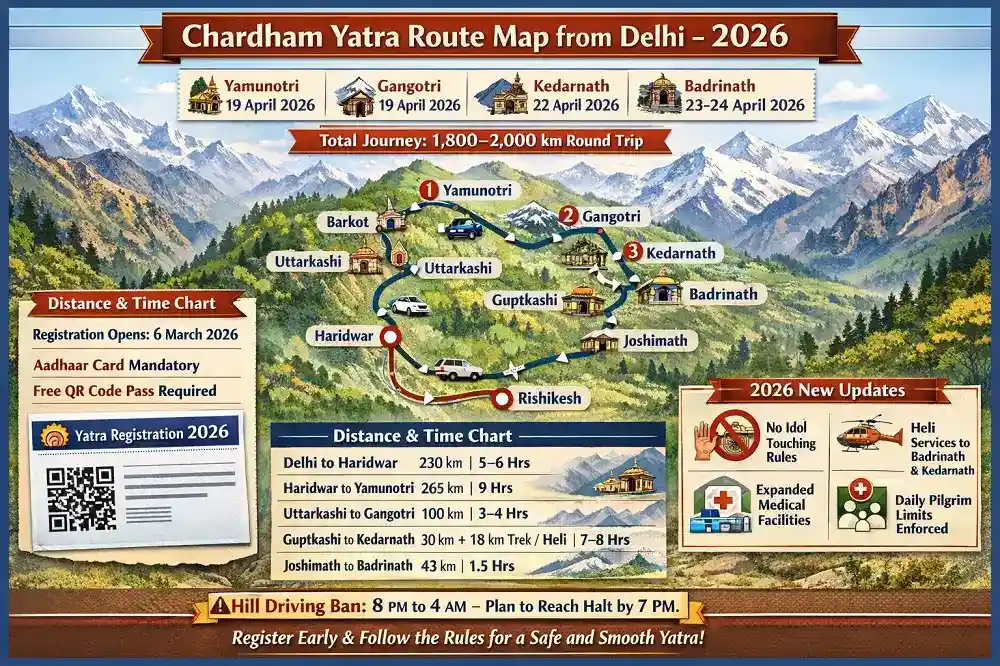
The Chardham Yatra route map from Delhi in 2026 covers roughly 1,800–2,000 km round trip — passing through four sacred shrines: Yamunotri, Gangotri, Kedarnath, and Badrinath, all deep in Uttarakhand’s Garhwal Himalayas. Temples open from 19 April 2026. Registration started 6 March 2026 — completely free. Over 1.26 lakh pilgrims registered on Day 1 alone. If you’re planning to go, start now.
Planning without a clear route map is like starting a trek without checking the weather. Roads close. Token systems kick in. Hotels in Barkot and Guptkashi fill up weeks before May. This guide has everything — 2026 verified kapat dates, updated registration rules, real distances, honest cost estimates, and tips from how this yatra actually plays out on the ground.
2026 Kapat Opening Dates — Officially Confirmed
| Dham | Opening Date | Occasion | Closing Date |
|---|---|---|---|
| Yamunotri | 19 April 2026 | Akshaya Tritiya | ~11 Nov 2026 |
| Gangotri | 19 April 2026 | Akshaya Tritiya | ~10 Nov 2026 |
| Kedarnath | 22 April 2026 | Announced on Mahashivratri | ~11 Nov 2026 |
| Badrinath | 23–24 April 2026 | Announced on Basant Panchami | ~13 Nov 2026 |
⚠️ New Rule 2026: Touching idols, bells, and religious books inside temple courtyards is strictly prohibited. Applying tika and distributing prasad inside Kedarnath’s courtyard is also banned this year.
Chardham Yatra Route Map from Delhi — The Full Picture
The traditional parikrama sequence starts at Yamunotri in the west and moves east — Gangotri, then Kedarnath, then Badrinath. This clockwise direction is considered spiritually correct and is followed by every organized package tour.
Complete Route: Delhi → Haridwar → Barkot → Yamunotri → Uttarkashi → Gangotri → Guptkashi → Sonprayag → Kedarnath → Rudraprayag → Joshimath → Badrinath → Rishikesh → Delhi
Most pilgrims take an overnight train from Delhi to Haridwar — arrive fresh in the morning and start the mountain drive on Day 2. This saves a full travel day and keeps fatigue in check, especially important for families with elderly members.
- Suggested Tour: Chardham Yatra Package from Delhi
Distance Chart — Segment by Segment
| Segment | Distance | Travel Time | Mode |
|---|---|---|---|
| Delhi → Haridwar | ~210–240 km | 5–6 hrs | Road / Train |
| Haridwar → Barkot | ~220 km | 7–8 hrs | Road |
| Barkot → Janki Chatti | ~45 km | 1.5 hrs | Road |
| Janki Chatti → Yamunotri | 6 km trek | 2–3 hrs one way | Trek / Pony |
| Barkot → Uttarkashi | ~80–100 km | 3–4 hrs | Road |
| Uttarkashi → Gangotri | ~100 km | 3–4 hrs | Road |
| Uttarkashi → Guptkashi | ~200 km | 7–8 hrs | Road |
| Guptkashi → Sonprayag | ~30 km | 1 hr | Road |
| Sonprayag → Kedarnath | ~18–20 km trek | 6–8 hrs one way | Trek / Helicopter |
| Kedarnath → Joshimath | ~175 km | 6–7 hrs | Road |
| Joshimath → Badrinath | ~43 km | 1.5 hrs | Road |
| Badrinath → Rishikesh | ~297 km | 9–10 hrs | Road |
| Rishikesh → Delhi | ~230 km | 5–6 hrs | Road |
⚠️ Critical Rule: Night driving is strictly banned in the hills between 8 PM and 4 AM. Plan every day so you reach your overnight halt well before 7:30 PM.
12-Day Chardham Yatra Itinerary from Delhi — 2026
This itinerary uses the “base + day trip” model — Barkot as your base for Yamunotri, Uttarkashi as your base for Gangotri. You’re not shifting heavy bags every single day — which makes a real difference over 12 days on mountain roads.
| Day | Route | Night Halt | Key Activity |
|---|---|---|---|
| Day 1 | Delhi → Haridwar | Haridwar | Ganga Aarti at Har Ki Pauri |
| Day 2 | Haridwar → Barkot | Barkot | En-route Mussoorie / Kempty Falls |
| Day 3 | Barkot → Yamunotri → Barkot | Barkot | 6 km trek, Surya Kund, darshan |
| Day 4 | Barkot → Uttarkashi | Uttarkashi | Vishwanath Temple, Shakti Temple |
| Day 5 | Uttarkashi → Gangotri → Uttarkashi | Uttarkashi | Gangotri darshan, Bhagirathi views |
| Day 6 | Uttarkashi → Guptkashi | Guptkashi | Tehri Lake stop optional en-route |
| Day 7 | Guptkashi → Kedarnath | Kedarnath | 16–18 km trek or helicopter |
| Day 8 | Kedarnath → Rudraprayag | Rudraprayag | Early morning darshan, then descend |
| Day 9 | Rudraprayag → Joshimath | Joshimath | Drive via Chamoli, Auli viewpoint |
| Day 10 | Joshimath → Badrinath → Joshimath | Joshimath | Tapt Kund dip, Badrinath darshan |
| Day 11 | Joshimath → Rishikesh | Rishikesh | Long drive via Devprayag, rest |
| Day 12 | Rishikesh → Delhi | Delhi | Return home — Yatra complete |
The Four Dhams — What to Know Before You Arrive
Yamunotri — First Dham on the Chardham Route
Yamunotri sits at 3,293 metres in Uttarkashi district, dedicated to Goddess Yamuna. The road ends at Janki Chatti — from there it’s a 6 km uphill trek to the temple. Ponies and palanquins (palkis) are available for those who can’t walk. Leave Barkot by 6 AM to have enough daylight for the trek and return.
The Surya Kund hot spring right beside the temple is something you won’t see anywhere else — pilgrims tie raw rice and potatoes in cloth and cook them in the boiling water as an offering. It’s a living ritual. Don’t miss it.
Gangotri — The Most Road-Friendly Dham
At 3,048 metres, the road goes right up to the temple — no trekking needed. The Bhagirathi River runs alongside you for the entire drive, and the scenery is genuinely stunning. The temple closes daily between 2 PM and 3 PM — time your arrival accordingly.
If you have an extra day at Uttarkashi, the Gaumukh glacier trek (18 km from Gangotri, separate permit required) leads to the actual source of the Ganga — a deeply moving experience for those who make the effort.
Kedarnath — The Heart of the Entire Yatra
One of Lord Shiva’s 12 Jyotirlingas, Kedarnath sits at 3,583 metres and is what most pilgrims remember for the rest of their lives. It requires either a 16–18 km uphill trek from Gaurikund or a helicopter from Phata, Sersi, or Guptkashi. The temple closes daily from 3 PM to 5 PM.
💡 Ground Tip: Stay one night at Kedarnath if at all possible. Early morning darshan — when mist fills the Mandakini valley and the temple bells echo across the peaks — is something no day-tripper from Guptkashi ever gets to experience.
Badrinath — Final Dham, Lord Vishnu’s Abode
At 3,133 metres in Chamoli district, Badrinath is fully road-accessible — no trek at all. The Alaknanda River flows beside the temple with Neelkanth Peak rising behind it. A dip in Tapt Kund hot spring before entering the temple is considered customary and spiritually essential. The temple closes between 12 PM and 3 PM daily.
Three kilometres away is Mana Village — India’s last inhabited village before the Tibet border. It’s quiet, atmospheric, and a natural final chapter to the entire yatra.
Chardham Yatra Registration 2026 — Step-by-Step
Registration opened on 6 March 2026 — roughly six weeks before the temples open. It is completely free. It is mandatory for every pilgrim. Your QR-coded Yatra Registration Letter will be checked at four specific checkpoints: Barkot (Yamunotri), Hina/Maneri (Gangotri), Sonprayag (Kedarnath), and Pandukeshwar (Badrinath). No pass, no entry.
Big 2026 Change: Aadhaar card is now the mandatory ID. Previously any government ID worked — Voter ID, PAN, Passport. Not anymore.
How to Register Online:
- Go to the official portal — registrationandtouristcare.uk.gov.in. Registration is completely free. Any website charging a fee is fake.
- Create your account — enter your mobile number and email, verify via OTP.
- Fill in your yatra details — select which Dhams you’re visiting and your planned dates. One registration covers all four Dhams.
- Upload your Aadhaar card — JPG or PNG format, 10KB to 150KB. Also fill in your emergency contact details.
- Download your Registration Letter — you’ll get a QR code via SMS and email. Print a copy and also save it offline on your phone. It will be scanned at every Dham checkpoint.
Can’t register online? Send “YATRA” on WhatsApp to +91-8394833833. Or call toll-free 0135-1364. Offline counters are available at Haridwar (20 counters), Rishikesh (30 counters), Barkot, Sonprayag, and Joshimath.
What’s New in Chardham Yatra 2026 — Key Updates
- Aadhaar now mandatory for registration — first time this rule has been enforced.
- Badrinath helicopter service launched — from Jolly Grant Airport, Dehradun. New for 2026. Previously only Kedarnath had helicopter access.
- Healthcare expanded significantly — 20 Medical Relief Posts, 31 health check-up centres, 154 ambulances (including 17 advanced life support units), helicopter ambulances from AIIMS Rishikesh for critical emergencies.
- e-Health Dham portal — real-time health monitoring for pilgrims at high-altitude points like Kedarnath and Badrinath.
- Daily pilgrim caps enforced — each Dham has a daily limit. Your registration is effectively a timed slot. No walk-ins guaranteed.
- Token system for special pujas — Rudrabhishek and similar pujas at Kedarnath now require advance online booking. Walk-ins are not guaranteed.
- GPS-based tracking system — the Uttarakhand government monitors pilgrim movement in real time via GPS, connected to a central control room in Dehradun. Helps emergency teams locate pilgrims faster.
Chardham Yatra Cost from Delhi — 2026 Estimates
| Travel Style | Per Person Cost | What It Covers |
|---|---|---|
| Budget | ₹25,000–38,000 | Shared tempo, dharamshalas, langar + dhabas, group of 10+ |
| Mid-Range | ₹45,000–75,000 | Private SUV/tempo traveller, 2–3 star hotels, mixed food |
| Premium + Helicopter | ₹80,000–1,60,000+ | Helicopter for Kedarnath/Badrinath, comfort hotels, dedicated vehicle |
Detailed Cost Breakdown:
| Expense | Estimated Cost 2026 |
|---|---|
| Delhi → Haridwar by train | ₹300–1,500 |
| Delhi → Haridwar by car | ₹3,000–5,500 |
| Hotel per night | ₹1,800–3,500 |
| Dharmshala per night | ₹600–1,800 |
| Food per day per person | ₹600–1,200 |
| Pony / Palki / Porter | ₹2,500–6,000 |
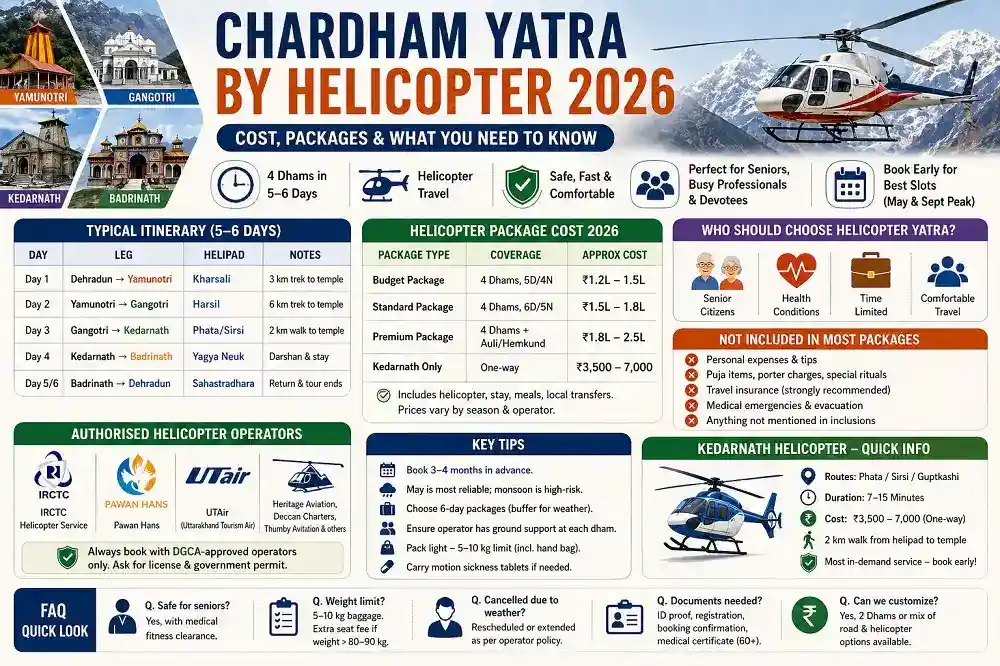
| Kedarnath helicopter (one way) | ₹8,000–12,000 |
| Badrinath helicopter (new 2026) | ₹10,000–15,000 |
| Tempo traveller full circuit | ₹1,90,000–2,50,000 total |
| Yatra registration | ₹0 — completely free |
| Emergency buffer | 15–20% of total budget |
A comfortable mid-range trip from Delhi — private vehicle, decent hotels, no helicopter — works out to roughly ₹50,000–60,000 per person for 12 days, all inclusive.
Best Time for Chardham Yatra from Delhi in 2026
| Window | Conditions | Crowd Level | Verdict |
|---|---|---|---|
| 19 Apr – 15 May | Good weather, cool nights, some snow patches | High but manageable | ✅ Good for early starters |
| 16 May – 30 Jun | Peak season, warm days, very high pilgrim volume | Very high | ⚠️ Book everything months ahead |
| July – August | Monsoon, frequent landslides, road closures | Low (forced) | ❌ Avoid |
| September – October | Clear skies, cool air, excellent roads | Moderate | ✅ Best overall experience |
| November onwards | Temples close, snow begins | — | ❌ Not possible |
September–October is the smartest window. Post-monsoon skies are clearer, mountain views are sharper, and temple queues are a fraction of what they are in May–June. Many experienced pilgrims skip the summer rush entirely and plan for this season instead.
10 Important Tips Before You Leave Delhi
- Register early — 1.26 lakh people registered on Day 1 itself. Daily caps are real. Slots fill fast.
- Carry your original Aadhaar card — not just a photocopy. Checkpoints verify it physically.
- Print your Registration Letter. Mobile networks are unreliable between Uttarkashi and Gangotri, and near Kedarnath base camp.
- Night driving in hills is banned 8 PM to 4 AM. Aim to reach your night halt by 7 PM every single day.
- Altitude sickness hits differently at Kedarnath (3,583 m) and Badrinath (3,133 m). Walk slowly, hydrate consistently. Carry Diamox if your doctor recommends it.
- Book Kedarnath helicopter only via IRCTC — heliyatra.irctc.co.in. Badrinath helicopter from Jolly Grant is also available in 2026. Avoid unverified agents — scams are reported every year.
- Download the Tourist Care Uttarakhand app before leaving Delhi — live road conditions, registration management, and emergency contacts all in one place.
- A tempo traveller or SUV handles mountain roads far better than a sedan. If hiring privately, confirm the vehicle has valid Hill Road permits.
- Always keep a 15–20% emergency budget buffer. Landslide blockages can force 1–2 unplanned nights with zero warning — this happens almost every season.
- For special pujas like Rudrabhishek at Kedarnath, book your token online in advance. Walk-in bookings are no longer guaranteed in 2026.
Frequently Asked Questions
Q1. What are the confirmed kapat opening dates for Chardham Yatra 2026?
Yamunotri and Gangotri open on 19 April 2026 (Akshaya Tritiya). Kedarnath opens on 22 April 2026. Badrinath opens on 23–24 April 2026. All dates are officially confirmed by the Char Dham Temple Committee.
Q2. When did Chardham Yatra 2026 registration open and how do I register?
Registration opened on 6 March 2026 — about six weeks before the temples open. It’s completely free. Register at registrationandtouristcare.uk.gov.in, via the Tourist Care Uttarakhand app, or by sending “YATRA” on WhatsApp to +91-8394833833.
Q3. Is Aadhaar card compulsory for Chardham Yatra 2026 registration?
Yes — for the first time in 2026, Aadhaar is the mandatory ID. Previously, Voter ID, PAN, or Passport were also accepted. Carry the original Aadhaar card with you throughout the yatra.
Q4. What is the total distance of the Chardham Yatra from Delhi?
The complete round trip from Delhi covers approximately 1,800 to 2,000 km. The inner circuit from Haridwar through all four Dhams and back to Rishikesh is roughly 1,600 km. Delhi adds another 450–500 km for the entry and exit legs.
Q5. How many days does the Chardham Yatra take from Delhi in 2026?
Standard itinerary is 11–12 days. With helicopter service for both Kedarnath and Badrinath, it can be done in 9–10 days. Rushing is never advisable — altitude, long drives, and unpredictable weather all require buffer time built into the plan.
Q6. Is there a new Badrinath helicopter service in 2026?
Yes — new for 2026. Helicopter service to Badrinath from Jolly Grant Airport in Dehradun has been launched. Previously only Kedarnath had helicopter access. This significantly reduces travel time and improves accessibility for elderly pilgrims and those with health limitations.
Q7. Can senior citizens do the Chardham Yatra from Delhi?
Absolutely — thousands do it every year. Yamunotri and Kedarnath have ponies and palanquins available for those who can’t trek. Gangotri and Badrinath are fully road-accessible with no trekking required. A full helicopter package eliminates trekking from the yatra entirely.
Q8. Is there a daily pilgrim limit at the Chardham temples in 2026?
Yes. Daily caps are enforced at all four Dhams to prevent overcrowding. Your registration effectively works as a dated slot for each temple. This is why early registration — especially for peak May–June dates — is critical in 2026.
Q9. What healthcare facilities are available on the Chardham Yatra route in 2026?
This year has the most comprehensive setup ever — 20 Medical Relief Posts, 31 health check-up centres, 154 ambulances (including 17 advanced life support units), and helicopter ambulances from AIIMS Rishikesh for critical emergencies. The new e-Health Dham portal enables real-time health monitoring at high-altitude points.
Q10. Can I do the Chardham Yatra in my own private car from Delhi?
Yes. Roads are generally well-maintained, though some sections near the temples are narrow and steep. Your vehicle must be in good mechanical condition. Night driving between 8 PM and 4 AM is prohibited in all hill regions. Commercial vehicles need a Green Card Permit — check greencard.uk.gov.in for compliance before you leave.
📞 Key Contacts:
- Registration portal: registrationandtouristcare.uk.gov.in
- Toll-free helpline: 0135-1364
- WhatsApp Yatra help: +91-8394833833 (type YATRA)
- Helicopter booking: heliyatra.irctc.co.in