
Delhi is not just a capital city. It is layered history in physical form. And nowhere is that more visible than in the Colonial Charm of India Gate and Rashtrapati Bhavan.
These two landmarks form the ceremonial spine of New Delhi. Built during British rule, they were meant to project power and permanence. Today, they symbolize democratic India. That contrast — imperial design, republican identity — is what makes them architecturally and culturally fascinating.
If you are planning to visit, researching Delhi’s colonial architecture, or simply curious about how empire shaped India’s capital, this guide covers everything in depth.
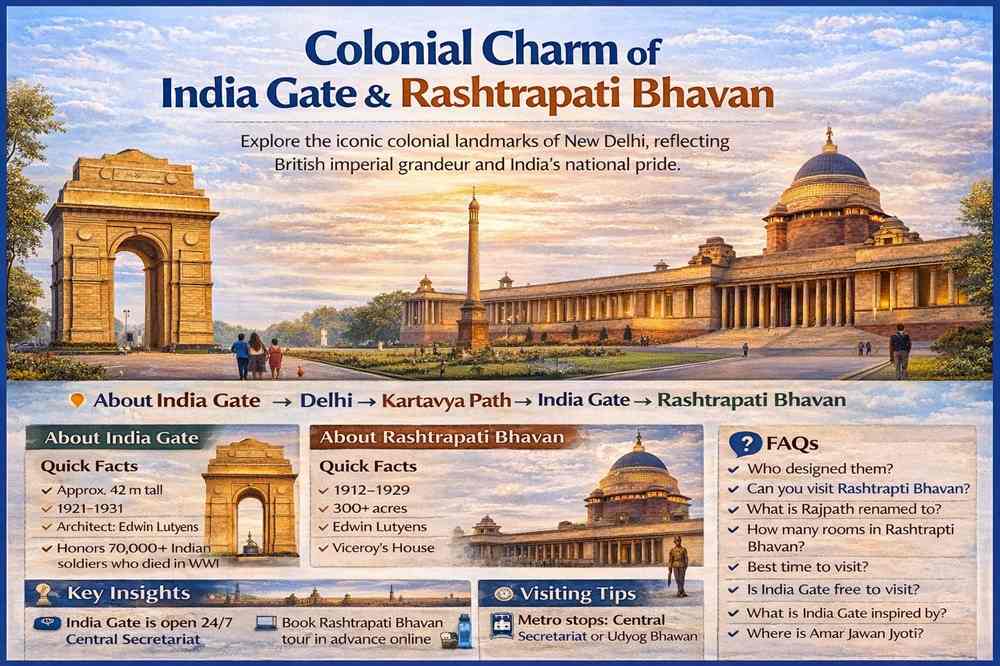
Colonial Charm of India Gate and Rashtrapati Bhavan: Why It Still Captivates Visitors
What most people don’t realize is that these monuments were never isolated structures. They were part of a carefully designed urban plan.
In 1911, the British shifted India’s capital from Calcutta to Delhi. The planning responsibility went to architect Edwin Lutyens along with Herbert Baker.
Their vision:
- Wide ceremonial avenues
- Symmetrical government buildings
- Elevated authority structures
- Visual dominance through geometry
The result was New Delhi — a city planned around power projection.
At the center of this design:
India Gate (war memorial) and the Viceroy’s House (now Rashtrapati Bhavan).
India Gate: War Memorial Turned National Symbol
India Gate was completed in 1931 as the All India War Memorial. It commemorates over 70,000 Indian soldiers who died fighting in World War I and other campaigns.
Quick Facts Table
| Feature | Details |
|---|---|
| Height | 42 meters |
| Architect | Edwin Lutyens |
| Built | 1921–1931 |
| Material | Red & pale sandstone |
| Inspired by | Arc de Triomphe |
The structure stands at the eastern end of Kartavya Path. Its clean lines and restrained ornamentation reflect classical European design principles.
Yet it does not feel foreign.
The sandstone tone matches Delhi’s environment. The scale feels grand but not overwhelming.
Amar Jawan Jyoti and Post-Independence Identity
After the 1971 Indo-Pak war, the Amar Jawan Jyoti eternal flame was installed beneath the arch. This transformed its meaning.
Originally colonial.
Now national.
In recent years, the nearby National War Memorial has become the official site of homage. Still, India Gate remains emotionally powerful for Indians.
Evenings here feel different.
Families gather. Vendors sell street snacks. The monument glows under floodlights. It becomes both solemn and social — a rare combination.
Rashtrapati Bhavan: From Viceroy’s Palace to People’s House
If India Gate symbolizes sacrifice, Rashtrapati Bhavan symbolizes authority.
Originally called the Viceroy’s House, it was built between 1912 and 1929. Its elevated position on Raisina Hill was intentional. Authority was meant to sit above the city.
Today it is the official residence of the President of India.
Structural Overview
| Feature | Details |
|---|---|
| Rooms | 340+ |
| Estate Size | 300+ acres |
| Architectural Style | Classical + Indian fusion |
| Dome Inspiration | Sanchi Stupa |
The dome dominates the skyline. The chhatris and jaalis reflect Indian design elements. Lutyens may have been British, but he understood adaptation.
This fusion is central to the Colonial Charm of India Gate and Rashtrapati Bhavan. It is European structure blended with Indian context.
Important Areas Inside Rashtrapati Bhavan
Visitors (with prior booking) can explore:
- Durbar Hall (Presidential oath ceremonies)
- Ashoka Hall (State events)
- Banquet Hall (Diplomatic dinners)
- Amrit Udyan (Seasonal public gardens)
Durbar Hall is particularly striking. The symmetry, the dome overhead, and the circular layout create a sense of institutional gravitas.
Kartavya Path: The Power Axis
Formerly called Rajpath, Kartavya Path connects Rashtrapati Bhavan to India Gate.
This ceremonial boulevard was designed for visual drama. The straight alignment creates perspective depth — making both structures appear even more monumental.
Every Republic Day Parade moves along this axis.
Tanks roll where colonial processions once passed.
History reuses space.
Best Time to Visit India Gate and Rashtrapati Bhavan
Approach 1: October to March (Best Season)
- Pleasant weather
- Clear skies
- Ideal for walking tours
Approach 2: Evening Visits (Year-Round)
- Illuminated monuments
- Cooler temperatures
- Active public atmosphere
Avoid peak summer afternoons (May–June). Delhi heat can be intense.
How to Reach
By Metro
- Nearest to India Gate: Central Secretariat Station
- Rashtrapati Bhavan access via guided tour entry points
By Car
Parking is available near India Gate lawns, but weekends can get crowded.
By Bus
DTC buses run regularly through Central Delhi.
Entry Fees & Timings
| Monument | Entry Fee | Timings |
|---|---|---|
| India Gate | Free | Open 24/7 |
| Rashtrapati Bhavan | Paid guided entry | Slot-based |
Bookings for Rashtrapati Bhavan tours must be made online in advance.
Common Mistakes Visitors Make
- Visiting in peak afternoon heat
- Not booking Rashtrapati Bhavan tour slots early
- Ignoring security checks
- Missing the sunset view
From practical experience, sunset is when the architecture feels most dramatic.
Safety & Travel Tips
- Carry water in summer
- Wear comfortable walking shoes
- Keep ID proof for guided tours
- Avoid overcrowded lawn areas late night
Delhi Police maintain strong security around the area, especially during national events.
Why Colonial Architecture Still Draws Tourists
The Colonial Charm of India Gate and Rashtrapati Bhavan lies in contrast.
These were symbols of empire.
Today they represent democracy.
Instead of demolishing colonial structures, India redefined them. That reinterpretation itself attracts scholars, photographers, architects, and travelers.
Architecture does not disappear with politics. It adapts.
Architectural Comparison
| Aspect | India Gate | Rashtrapati Bhavan |
|---|---|---|
| Function | War memorial | Presidential residence |
| Design Tone | Minimalist classical | Grand imperial fusion |
| Public Access | Fully open | Guided entry |
| Symbolism | Sacrifice | Authority |
Photography & Visual Appeal
Best photography angles:
- Long shot from Kartavya Path lawns
- Dome silhouette at dusk
- India Gate reflection after rainfall
- Republic Day parade visuals
Winter fog adds a cinematic quality.
Historical Significance in Modern Context
What makes the Colonial Charm of India Gate and Rashtrapati Bhavan is rising search interest in:
- Colonial architecture in India
- Delhi heritage walk
- Lutyens Delhi landmarks
- Best monuments in New Delhi
These sites consistently rank among the most photographed landmarks in the capital.
Key Takeaways
- Built between 1912–1931
- Designed by Edwin Lutyens
- Blend of European classical and Indian motifs
- Symbolism evolved post-independence
- Open public space with strong security
10 FAQs
1. Why is India Gate famous?
It commemorates Indian soldiers who died in World War I.
2. Who designed Rashtrapati Bhavan?
British architect Edwin Lutyens.
3. Can tourists enter Rashtrapati Bhavan?
Yes, through pre-booked guided tours.
4. What architectural style is used?
Classical European mixed with Indian elements.
5. Is India Gate free to visit?
Yes, open 24/7 without entry fee.
6. What is the dome inspired by?
The Sanchi Stupa.
7. Best time to visit?
October to March evenings.
8. How far are they from each other?
Approximately 2.5 km along Kartavya Path.
9. Why was Rajpath renamed?
To reflect post-colonial identity as Kartavya Path.
10. Are photography and videography allowed?
Yes, except during restricted security events.