Delhi to Badrinath
There’s a reason people say “Badrinath ek baar toh zaroor jaana chahiye.” This isn’t just another temple. Badrinath, located in Chamoli district of Uttarakhand at an altitude of 3,133 metres, is one of the four sacred Char Dhams — and by most accounts, the most architecturally grand of them all.
The temple is dedicated to Lord Vishnu in his meditative form as Badrinarayan. According to legend, Lord Vishnu meditated here in such deep absorption that Goddess Lakshmi stood by his side in the form of a Badri (berry) tree to shield him from the elements — which is how the place got its name. The 1-metre tall black stone idol of Lord Vishnu inside is believed to be one of eight swayam vyakta kshetras — self-manifested sacred images.
Unlike Kedarnath, which requires a 16 km trek, Badrinath is directly accessible by road. Your car drives right up to the temple town. No trekking, no pony rides. This makes the Delhi to Badrinath journey uniquely suited for families with elderly members, people with physical limitations, and first-time pilgrims who want a spiritually rich but physically manageable yatra.
Badrinath Temple — Quick Facts
| Detail | Info |
|---|---|
| Deity | Lord Vishnu (Badrinarayan) |
| Location | Chamoli District, Uttarakhand |
| Altitude | 3,133 metres (10,279 feet) |
| River | Alaknanda |
| 2026 Opening | 23 April 2026 at 6:15 AM |
| 2026 Closing (Est.) | ~13 November 2026 |
| Entry Fee | Free for all visitors |
| Annual Pilgrims | 10+ lakh (1 million+) |
Delhi to Badrinath: Exact Distance & Travel Time
The Delhi to Badrinath distance by road is approximately 525–540 kilometres, depending on your exact starting point in Delhi NCR and the route taken. The journey typically takes 12 to 16 hours of driving — which is why most travellers sensibly break it into two days with an overnight halt at Haridwar or Rishikesh.
Trying to drive Delhi to Badrinath in one shot is possible on paper, but it’s genuinely exhausting — and dangerous. Mountain roads begin after Rishikesh, and driving fatigued on narrow Himalayan highways after dark is how accidents happen. The night driving ban in the hills (8 PM to 5 AM) makes it practically impossible anyway.
| Segment | Distance | Drive Time |
|---|---|---|
| Delhi → Haridwar | ~206–230 km | 5–6 hours |
| Haridwar → Rishikesh | ~24 km | 45–60 min |
| Rishikesh → Devprayag | ~74 km | 2–3 hours |
| Devprayag → Rudraprayag | ~67 km | 2 hours |
| Rudraprayag → Karnaprayag | ~31 km | 1 hour |
| Karnaprayag → Joshimath | ~79 km | 3 hours |
| Joshimath → Badrinath | ~42 km | 1.5–2 hours |
| Total (Delhi to Badrinath) | ~525–540 km | 12–16 hours |
The nearest airport is Jolly Grant Airport, Dehradun — about 310–317 km from Badrinath. The nearest major railway station is Haridwar Junction, roughly 322 km away.
The Road Route, Stop by Stop
The standard route runs via NH-58 (Badrinath Highway) through Haridwar, Rishikesh, and the five sacred Prayags — confluences where Himalayan rivers meet. It’s not just a highway. Each stop has its own history and energy.
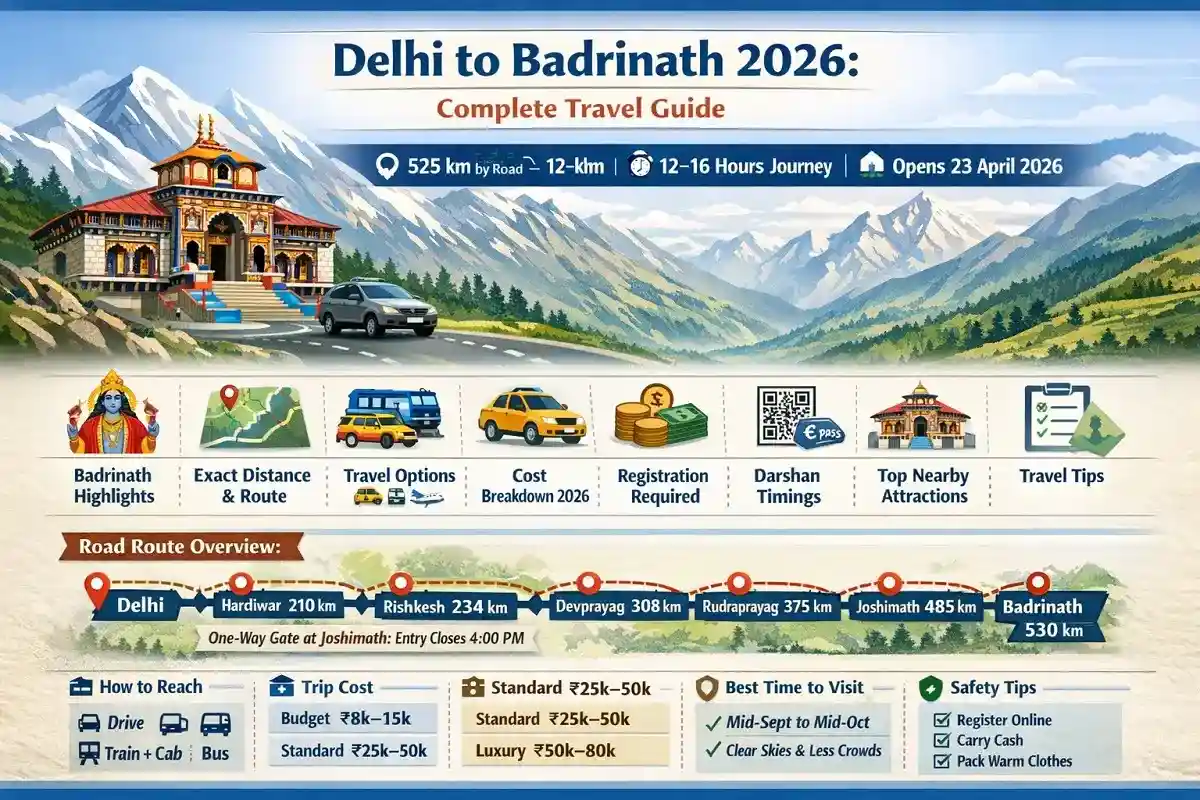
Route strip: Delhi (0 km) → Haridwar (~210 km) → Rishikesh (~234 km) → Devprayag (~308 km) → Rudraprayag (~375 km) → Joshimath (~485 km) → Badrinath (~530 km)
Haridwar (Day 1 overnight halt): Most travellers from Delhi halt here after a 5–6 hour drive. Attend the Ganga Aarti at Har Ki Pauri in the evening — it puts the yatra in the right frame of mind before you enter the mountains. Book your hotel in advance during April–June.
Rishikesh: Just 24 km from Haridwar. The last proper town before roads start climbing seriously. Fill up fuel here. Withdraw cash — ATMs become unreliable beyond this point.
Devprayag: Where the Bhagirathi and Alaknanda rivers meet to officially become the Ganga. The sight of two distinctly different-coloured rivers merging is something most people aren’t prepared for. Stop for 20 minutes — it’s worth it.
Rudraprayag: A popular overnight halt if you’re splitting the journey from Delhi over two days. About 9–10 hours of driving from Delhi. Clean hotels, decent food.
Joshimath: The last major town before Badrinath, 42 km away. Many pilgrims stay here and visit Badrinath as a day trip. Important: the Joshimath–Badrinath stretch is one-way gated with fixed timings. Arrive before 4 PM or you stay in Joshimath overnight.
⚠️ Gate Timing Alert: The 42 km Joshimath–Badrinath road is a one-lane stretch with timed entry. If you arrive at Joshimath after 4:00 PM, you cannot proceed to Badrinath that day. Roads close at 5:30 PM. Plan your driving schedule around this hard cutoff.
The Five Sacred Prayags on Route
| Prayag | Rivers Meeting | Distance from Delhi |
|---|---|---|
| Devprayag | Bhagirathi + Alaknanda = Ganga | ~308 km |
| Rudraprayag | Mandakini + Alaknanda | ~375 km |
| Karnaprayag | Pindar + Alaknanda | ~406 km |
| Nandprayag | Nandakini + Alaknanda | ~427 km |
| Vishnuprayag | Dhauliganga + Alaknanda | ~478 km |
How to Reach Badrinath from Delhi — All Options
By Road (Self-Drive or Hired Cab) The most popular option. SUVs are recommended for comfort on narrow mountain stretches. Sedans can manage, but avoid low-clearance vehicles. Ensure brakes are serviced before departure. Hiring a cab from an experienced hill driver removes all the stress of gate timings and route knowledge.
Current taxi rates (one-way, Delhi to Badrinath): ₹6,000–₹16,000 depending on vehicle type.
By Bus No direct buses from Delhi to Badrinath. Take a bus from ISBT Kashmiri Gate to Haridwar or Rishikesh (₹200–₹400), then connect to Joshimath or Badrinath via Uttarakhand Roadways. Total journey: 18–20 hours. Total bus fare: roughly ₹700–₹1,200. Economical but not comfortable for elderly pilgrims.
By Train + Road Train from New Delhi or Hazrat Nizamuddin to Haridwar Junction (2.5–4 hours, multiple daily trains). Then hire a cab or take shared taxis to Badrinath. Saves 4–5 hours of plains driving — popular with families.
By Flight + Road Fly Delhi to Jolly Grant Airport, Dehradun (35–40 minutes). Hire a cab to Badrinath — about 6–7 hours of mountain driving (~310 km). Reduces total travel time but adds flight cost.
| Mode | Time | Cost (approx) | Best For |
|---|---|---|---|
| Self-Drive (SUV) | 2 days with halt | Fuel + hotel | Flexible travellers |
| Hired Cab | 2 days | ₹6,000–₹16,000 | Families, senior pilgrims |
| Bus | 18–20 hours total | ₹700–₹1,200 | Budget pilgrims |
| Train + Cab | 1.5–2 days | ₹500–₹2,000 train + cab | No-driving preference |
| Flight + Cab | 1 day | ₹3,000–₹8,000 flight + cab | Time-constrained travellers |
Delhi to Badrinath: Cost Breakdown 2026
Budget Trip: ₹8,000–₹15,000 per person — bus, shared taxis, dharamshalas, self-planned.
Standard Trip: ₹25,000–₹50,000 per couple — private cab, 3-star hotels en route, 2 nights in Badrinath area, meals included.
Package Tour: ₹50,000–₹80,000 per couple — all-inclusive: cab, hotels, breakfast + dinner, tolls, driver TA/DA.
Itemized Costs
| Expense | Approx Cost | Notes |
|---|---|---|
| Delhi–Haridwar cab (one way) | ₹2,500–₹4,500 | Sedan or Innova |
| Haridwar–Badrinath cab (one way) | ₹4,000–₹9,000 | Shared or private |
| Accommodation en route (per night) | ₹800–₹4,000 | Budget to 3-star |
| Stay in Badrinath (per night) | ₹800–₹8,000+ | Dharamshalas to Sarovar Portico |
| Temple entry | Free | No ticket required |
| Special puja / Abhishek | ₹500–₹5,000+ | Booked at temple counter |
| Meals per day | ₹300–₹800/person | Dhabas to restaurant meals |
| Registration (e-pass) | Free | Mandatory, no charges |
Cash is king here. ATMs in Joshimath often run dry during peak season. UPI works but connectivity is patchy near Badrinath. Carry at least ₹3,000–₹5,000 in cash before leaving Rishikesh.
Mandatory Registration: Don’t Skip This Step
Every pilgrim visiting Badrinath in 2026 must register online and carry a QR-coded e-pass. This has been mandatory since the 2013 Kedarnath floods and is strictly enforced at checkpoints. Registration is completely free and opened on 6 March 2026.
- Official portal: registrationandtouristcare.uk.gov.in
- WhatsApp: Send “Yatra” to +91-8394833833
- App: “Tourist Care Uttarakhand” on Google Play / App Store
- Toll-Free: 0135-1364
Steps to Register:
- Visit the official portal and create a free account using your mobile number.
- Enter personal details — name, age, Aadhaar number (mandatory in 2026), and emergency contact.
- Upload a government-issued photo ID (Aadhaar, Voter ID, Passport, or PAN card).
- Select your travel dates for Badrinath and other Dhams if applicable.
- Add co-pilgrims — one application covers your entire family or group.
- Download and print the e-pass with its unique QR code. Save a digital copy too.
⚠️ Fraud Alert: Many people at Haridwar bus stands and outside temples offer “registration help” for ₹100–₹500. The government portal is free. Nobody is authorised to charge for this. Don’t pay.
Badrinath Temple: Darshan Timings & Rituals
The temple’s daily schedule is more elaborate than most people realise. Rituals begin at 4:30 AM — long before many pilgrims are even awake.
| Time | Activity | For Pilgrims? |
|---|---|---|
| 4:30 AM | Temple opens — Mangala Aarti begins | ✅ Highly auspicious; very few people |
| 4:30–6:30 AM | Maha Abhishek + Abhishek Puja (ritual bathing with milk, curd, ghee, honey) | ✅ Open — darshan may be partial during rituals |
| 6:30 AM–12:00 PM | Morning general darshan | ✅ Open — most crowded window |
| 12:00–3:00 PM | Afternoon closure for Bhog rituals and rest | ❌ Closed |
| 3:00–9:00 PM | Evening general darshan | ✅ Open — less crowded, colder |
| 6:00–8:30 PM | Geet Govinda recital + Sandhya Aarti | ✅ Highly recommended — deeply moving |
| 8:30–9:00 PM | Shayan Aarti — temple closes for the night | ✅ Last darshan of the day |
Queue wait times during peak season (May–June) can stretch to 3–4 hours for general darshan. The best slot is 4:30–6:30 AM — join the queue before opening for the calmest, most spiritually rich experience. The evening Geet Govinda and Aarti (6:00–8:30 PM) is another excellent window — less crowded and deeply atmospheric. VIP darshan passes (₹1,500–₹3,000) are available at the temple counter during peak months.
Photography: Strictly prohibited inside the temple. Permitted in the outer courtyard, Tapt Kund area, and Mana Village.
Best Time to Visit Badrinath from Delhi
| Period | Weather | Crowd | Verdict |
|---|---|---|---|
| Late April–May | Cool, some snow; 5–18°C | Very high | Spiritually charged. Book everything early. |
| June | Pleasant; 10–22°C | Peak crowds | Best weather, long queues. Prepare to wait. |
| July–August | Monsoon; landslides frequent | Low — routes often closed | ❌ Avoid. Real safety risk on mountain roads. |
| September–mid October | Clear skies; 8–20°C | Moderate | ✅ Best time. Lush hills, short queues, great visibility. |
| Late October | Cold; 2–12°C | Low | Good for solitude. Carry heavy woolens. |
If you’re asking for one recommendation: mid-September to mid-October. The monsoon has cleared, the Himalayas are draped in green, Neelkanth Peak is visible in all its snow-capped glory, and you won’t spend three hours in a queue.
What to See & Do in and Around Badrinath
Badrinath is not just a temple town — the entire valley is layered with mythology, natural beauty, and sacred sites. Most are within 3–9 km of the main temple.
- Tapt Kund: A natural hot spring right beside the temple. Pilgrims traditionally bathe here before darshan. The sulphur-rich water is naturally heated. The early morning dip in cold Himalayan air is bracing in the best possible way.
- Mana Village: Just 3 km from Badrinath, Mana is the last Indian village before the Indo-Tibetan border. You’ll find a local market selling woolens, the Vyas Gufa (cave where sage Vyasa reportedly dictated the Mahabharata), Ganesh Gufa, and Bheem Pul — a natural rock bridge over the Saraswati River.
- Vasudhara Falls: A stunning 400-foot waterfall at around 12,000 feet altitude, roughly 8–9 km from Badrinath and about 5 km trek from Mana Village. There’s a belief that the water only touches those who are pure of heart. Whether or not you believe it, the falls and the high-altitude meadow trek are genuinely spectacular.
- Brahma Kapal: A sacred flat rock on the Alaknanda bank where Hindus perform pind daan (ancestral rituals). Many pilgrims visit Badrinath specifically to perform these rites for departed family members.
- Neelkanth Peak: The 6,596-metre snow-covered Neelkanth Peak forms a breathtaking backdrop to the temple. The early morning light on its glaciers — especially in September–October — is one of those views that stays with you.
- Charan Paduka: A rock with footprint-shaped impressions believed to be Lord Vishnu’s, about 3 km from the temple. A gentle 2 km uphill walk with excellent mountain views.
Practical Tips for the Delhi to Badrinath Journey
Before You Leave Delhi
- Register on registrationandtouristcare.uk.gov.in as soon as your dates are confirmed. Print your e-pass.
- Get a basic medical check-up if you have BP, heart, or lung conditions. At 3,133 m, altitude can trigger symptoms even in otherwise healthy adults.
- Service your vehicle — brake checks are non-negotiable. The downhill stretches near Joshimath are long and steep.
- Download offline maps for the Rishikesh–Badrinath stretch before you leave. Network disappears regularly on this route.
On the Road
- Start by 4–5 AM from Delhi if doing Day 1 straight to Rudraprayag. This gets you there before dark.
- Never drive on the mountain section after 8 PM — the night driving ban in Uttarakhand hills is enforced.
- Fill up fuel at Rishikesh. The next reliable fuel station is Chamoli — don’t wait that long.
- Keep ₹3,000–₹5,000 cash before leaving Rishikesh. Cards and UPI are unreliable beyond this point.
In Badrinath
- Reach the temple by 4:30–6:30 AM for the most peaceful darshan. Queues build significantly after 9 AM and can stretch to 3–4 hours in peak season.
- Even in May and June, carry a heavy fleece or down jacket — nights drop to near-freezing at 3,133 m.
- Dress code: shoulders and knees must be covered for both men and women. Pilgrims in shorts or sleeveless clothing are turned away at the entrance.
- Give Mana Village 2–3 hours. Most people underestimate how much there is to explore.
- GMVN guest houses at Badrinath offer solid value — book online at gmvnl.in. Most private hotels fill up weeks in advance during peak season.
Important: Joshimath Land Subsidence Joshimath has been experiencing land subsidence since January 2023. Parts of the town sank by over 30 cm between 2022 and 2024, with cracks appearing in roads and hundreds of buildings. The town is currently functional and the Badrinath highway is open, but the situation is ongoing. Before your trip, check the latest advisories from Uttarakhand Police or NDRF. When staying overnight in Joshimath, avoid visibly cracked or structurally compromised buildings.
Frequently Asked Questions
Q1: What is the distance from Delhi to Badrinath by road?
Approximately 525–540 km depending on your starting point in Delhi NCR. The drive takes 12–16 hours total. Most travellers break it into 2 days with an overnight halt at Haridwar, Rishikesh, or Rudraprayag.
Q2: Is it safe to drive from Delhi to Badrinath by car?
Yes — Badrinath is one of the most road-accessible Char Dhams. No trekking required. However, the mountain section from Rishikesh onwards needs an alert driver. Never drive on hill roads after dark. Avoid July–August due to landslide risk. SUVs with well-maintained brakes are recommended.
Q3: When does Badrinath temple open in 2026?
23 April 2026 at 6:15 AM. The closing date is tentatively 13 November 2026. Exact dates are confirmed by BKTC on Basant Panchami based on astrological calculations — always verify on the official portal closer to your travel date.
Q4: Is registration mandatory to visit Badrinath in 2026?
Yes. Every pilgrim must register on registrationandtouristcare.uk.gov.in and carry a QR-coded e-pass. Registration is completely free. Without it, you will be stopped at checkpoints. Registration opened on 6 March 2026.
Q5: What is the total cost of a Delhi to Badrinath trip?
Budget travellers can complete the trip for ₹8,000–₹15,000 per person. A standard family trip with private cab and decent hotels costs ₹25,000–₹50,000 per couple. All-inclusive tour packages start at ₹50,000 per couple. Temple entry is free.
Q6: What is the best time to visit Badrinath?
Mid-September to mid-October. Post-monsoon skies are clear, the landscape is lush, and crowds are significantly lower than the May–June peak. Strictly avoid July–August due to monsoon landslides and road closures.
Q7: Is there any trekking involved to reach Badrinath?
No. Unlike Kedarnath (16 km trek) or Yamunotri (6 km trek), Badrinath is directly accessible by motorable road. Your vehicle drives right to the temple town — making it the most accessible Char Dham for senior citizens and families.
Q8: Are there ATMs in Badrinath?
ATMs in Joshimath exist but frequently run dry during peak season. ATMs in Badrinath itself are limited and unreliable. Always carry sufficient cash from Rishikesh — minimum ₹3,000–₹5,000. UPI works in some places but network connectivity is patchy.
Q9: Can senior citizens visit Badrinath comfortably?
Yes — Badrinath is the most senior-friendly Char Dham. Road access right to the temple, no trekking involved. The temple management provides assistance to elderly visitors. Travel in September–October for the mildest weather and shortest queues. Book accommodation within walking distance of the temple.
Q10: What should I pack for a Delhi to Badrinath trip?
Thermal innerwear, a warm fleece or down jacket, waterproof outer layer, sturdy walking shoes (not sandals), power bank, printed e-pass and government ID, cash, personal medications, sunscreen, sunglasses, and a reusable water bottle. Even in May–June, nights at 3,133 m drop close to freezing. Pack warmer than you think you need.
Suggested to Read: