Delhi to Kedarnath 2026: Complete Travel Guide
Of all the four Char Dhams, Kedarnath demands the most from you. It sits at 3,583 metres in the Rudraprayag district of Uttarakhand, nestled in a glacial basin beneath the Kedarnath Peak and the Chorabari Glacier. Getting there requires a 16 km mountain trek after the road ends. There is no shortcut by land — only by helicopter.
Kedarnath is considered one of the twelve Jyotirlingas of Lord Shiva — the most sacred manifestations of Shiva across India — and is also part of the Panch Kedar circuit of five Shiva temples in the Garhwal Himalayas. The temple itself is believed to be over 1,200 years old in its current stone structure, with the original shrine dating back to the Mahabharata period. The black stone Shivlinga inside is the centrepiece — austere, ancient, and unlike any other in the country.
Every year, over 15–20 lakh pilgrims make this journey from all corners of India. During the 2025 season, the first 10 days after opening alone recorded over 20,000 pilgrims per day. The numbers are only going up. Planning carefully isn’t optional — it’s what separates a meaningful yatra from a chaotic one.
Kedarnath Temple — Quick Facts
| Detail | Info |
|---|---|
| Deity | Lord Shiva (Jyotirlinga) |
| Location | Rudraprayag District, Uttarakhand |
| Altitude | 3,583 metres (11,755 feet) |
| River | Mandakini |
| 2026 Opening | 22 April 2026 at 8:00 AM |
| 2026 Closing (Tentative) | 11 November 2026 (Bhai Dooj) |
| Trek Length | 16 km from Gaurikund |
| Entry Fee | Free |
Delhi to Kedarnath Distance & Time: Full Breakdown
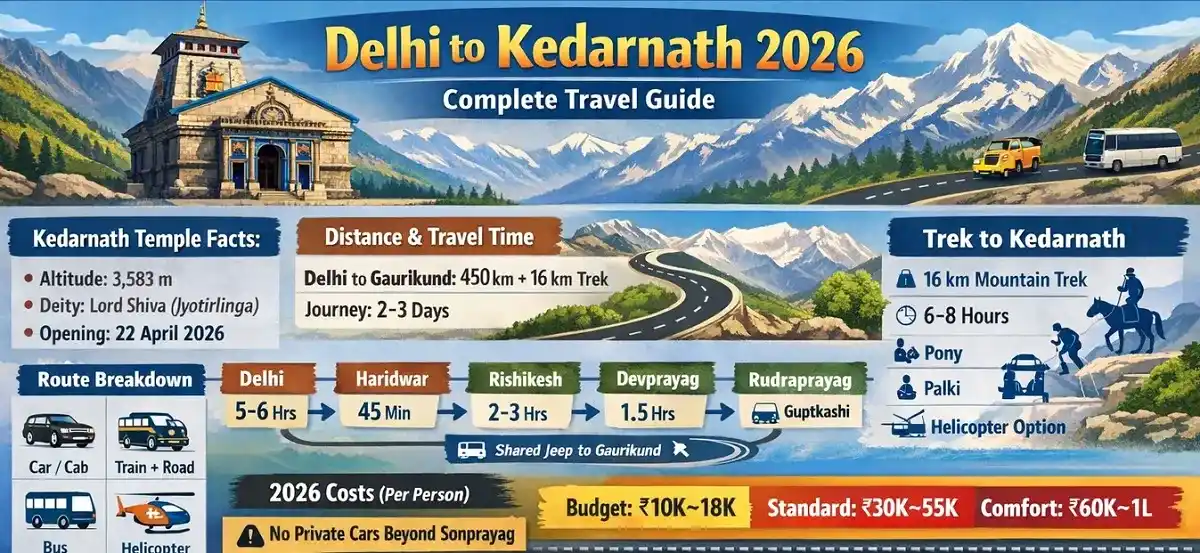
The Delhi to Kedarnath distance by road is approximately 450 km to Gaurikund — the last motorable point — followed by a 16 km mountain trek to the temple. Add the trek and you’re covering close to 466 km in total distance from Delhi to the temple door.
The road journey from Delhi to Gaurikund takes around 14–17 hours of driving. The trek then adds another 6–8 hours on foot. This is why the journey is always planned across 2–3 days minimum — attempting to drive and trek in a single day is dangerous and exhausting.
| Segment | Distance | Time |
|---|---|---|
| Delhi → Haridwar | ~220–230 km | 5–6 hours |
| Haridwar → Rishikesh | ~24 km | 45 min |
| Rishikesh → Devprayag | ~74 km | 2–3 hours |
| Devprayag → Rudraprayag | ~67 km | 2 hours |
| Rudraprayag → Guptkashi | ~41 km | 1.5 hours |
| Guptkashi → Sonprayag | ~27 km | 1 hour |
| Sonprayag → Gaurikund | ~5 km | 15–20 min (shared jeep) |
| Gaurikund → Kedarnath | 16 km trek | 6–8 hours |
| Total (Delhi to Kedarnath) | ~466 km + trek | 2–3 days |
One important rule that catches many first-timers off guard: private vehicles must park at Sonprayag. Beyond Sonprayag, only government-operated shared jeeps are permitted to Gaurikund. This rule is strictly enforced by the Uttarakhand government. Plan for this — you cannot drive your own car to the trek start.
The Road Route, Stop by Stop
The best and most commonly used route is: Delhi → Haridwar (NH334) → Rishikesh → Devprayag → Rudraprayag → Guptkashi → Sonprayag → Gaurikund → Kedarnath trek.
Delhi to Haridwar: The smoothest leg. NH334 allows speeds of 60–80 km/h with well-maintained roads and regular fuel stations and eateries throughout. Most travellers cover this in 5–6 hours. Many choose to halt in Haridwar overnight and attend the Ganga Aarti at Har Ki Pauri — a fitting mental preparation before the real journey begins the next morning.
Haridwar to Rishikesh (24 km): Quick 45-minute drive. Fill up fuel here — this is your last truly reliable petrol station. Withdraw cash too. Mobile network is best with Airtel and Jio; it becomes patchy after Rudraprayag.
Rishikesh to Rudraprayag (~165 km): This is where the road transforms. The highway climbs into the hills after Rishikesh and the scenery changes completely. You pass through Devprayag — where the Bhagirathi and Alaknanda merge to become the Ganga — and then on to Rudraprayag. Roads are mostly paved but have steep climbs and sharp turns. Plan for 5–6 hours for this stretch. Rudraprayag is a popular overnight halt — about 9–10 hours from Delhi.
Rudraprayag to Guptkashi (~41 km): The road follows the Mandakini River uphill. Guptkashi is significant — it has a helipad (one of the departure points for Kedarnath helicopter shuttles), good hotels, and the Vishwanath Temple. Many pilgrims stay here rather than pushing to Sonprayag.
Guptkashi to Sonprayag (~27 km) — the toughest road leg: Steep inclines, single-lane sections, and occasional landslide-prone zones are common after monsoon season. In 2026, road widening work continues in some sections, so minor delays are possible. Always check BRO (Border Roads Organisation) updates before this stretch.
Sonprayag to Gaurikund (5 km, shared jeep only): Park your vehicle at the designated Sonprayag parking area and board a government shared jeep to Gaurikund. The 5 km ride costs ₹30–₹50 per person and takes about 15–20 minutes.
All Travel Options from Delhi
By Road — Self-Drive or Hired Cab The most popular and flexible option. SUVs like Innova Crysta, Scorpio, or Ertiga are recommended for the hill sections. Cabs from Delhi to Sonprayag (one way): ₹10,000–₹18,000 depending on vehicle and season.
By Bus No direct Delhi–Kedarnath bus. Take a bus from Delhi ISBT to Haridwar (₹300–₹600) or Rishikesh (₹400–₹800), then take shared taxis or Uttarakhand Roadways buses to Sonprayag. Total time by bus: 18–22 hours. Cheapest option but demanding for elderly travellers.
By Train + Road Take a train from Delhi to Haridwar Junction (2.5–4 hours; multiple daily trains) or Rishikesh Railway Station. Then hire a cab or shared taxi to Sonprayag. This is a popular combination for families avoiding the long Delhi-to-Haridwar highway drive.
By Flight + Road Jolly Grant Airport in Dehradun is the nearest airport, approximately 235 km from Kedarnath. Fly from Delhi (35–40 minutes), then hire a cab to Sonprayag — about 5–6 hours of mountain driving.
| Mode | Time Delhi–Gaurikund | Cost (approx) | Best For |
|---|---|---|---|
| Self-Drive SUV | 2 days | Fuel + hotels | Flexible groups |
| Hired Cab | 2 days | ₹10,000–₹18,000 | Families |
| Bus | 18–22 hours | ₹700–₹1,200 | Budget pilgrims |
| Train + Road | 1.5–2 days | ₹400–₹700 train + cab | No-driving preference |
| Flight + Cab | 1 day | ₹3,000+ flight + cab | Time-short travellers |
The Trek from Gaurikund to Kedarnath
This is the part that makes Kedarnath what it is. From Gaurikund, devotees must trek approximately 16–18 km to reach Kedarnath Temple. The trail gains around 1,500 metres in altitude over this distance — a sustained climb through forests, ridgelines, and increasingly dramatic Himalayan scenery.
The trek is well-marked and has been significantly upgraded since the 2013 floods. Several improvements have been made to the trek route — better facilities, medical aid stations, and shelter points make it more comfortable and safer than in previous years. You’ll find tea stalls, toilet facilities, and first-aid posts at regular intervals.
Realistic trekking time: 6–8 hours going up. Coming down: 4–5 hours. Most pilgrims start at 4–5 AM from Gaurikund to reach in time for morning darshan.
If You Cannot Trek — Your Options
- Pony (Ghoda): Available at Gaurikund. Takes you most of the way. Cost: ₹3,000–₹7,000 one way depending on season and demand.
- Palki (Palanquin/Doli): Four porters carry you on a chair. The most comfortable non-helicopter option. Cost: ₹8,000–₹15,000 one way.
- Kandi: A porter carries you on their back in a specially designed basket. Available for those who can’t manage pony or palki. Cost: ₹5,000–₹8,000.
All three are available at Gaurikund. Rates are officially fixed by the district administration each year — don’t pay above the posted rates.
⚠️ Important: Gaurikund to Kedarnath by pony or palki is one way only. You still need to walk or arrange a return ride for the descent. Book your return pony before starting up — they fill fast during peak season.
Helicopter Option: What You Need to Know
For pilgrims who genuinely cannot trek — due to age, health conditions, or time constraints — the helicopter is not a luxury. It’s a necessity.
Helicopter services for Kedarnath operate from Phata, Guptkashi, and Sirsi helipads during the open season. The flight takes approximately 10–15 minutes and offers aerial views of the Mandakini valley and Himalayan peaks that are genuinely unforgettable.
Helicopter booking rules (very important):
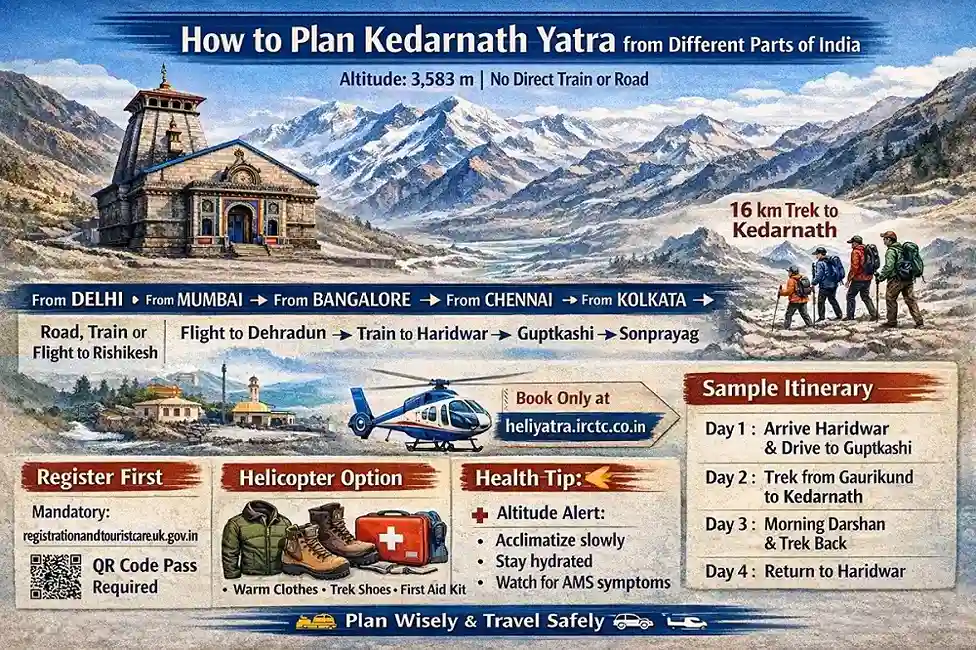
- Book only through the official IRCTC helicopter portal (heliyatra.irctc.co.in). No other booking channel is authorized for the shuttle service.
- Slots open weeks in advance and fill within hours for peak-season dates. Set a calendar reminder and book the day slots open.
- Names on tickets must exactly match your government ID. Discrepancies = denied boarding.
- Weight limit per passenger: typically 80 kg including luggage.
- Weather cancellations happen regularly — always have a contingency plan. You’ll be refunded, but you may need to rebook.
⚠️ Helicopter booking scam alert: Fake websites impersonating the official IRCTC portal have defrauded thousands of pilgrims. BKTC and IRCTC have issued repeated official warnings. Only use heliyatra.irctc.co.in. Do not book through WhatsApp agents, unknown travel websites, or anyone who calls you unsolicited.
Shuttle helicopter cost (Phata/Guptkashi to Kedarnath, one way): approximately ₹4,500–₹9,000 depending on the helipad and season. Full Char Dham helicopter packages from Dehradun are separate and much more expensive.
Cost Breakdown 2026
Budget Trip (per person): ₹10,000–₹18,000 — bus, shared taxis, dharamshalas, trekking on foot.
Standard Trip (per couple): ₹30,000–₹55,000 — private cab to Sonprayag, mid-range hotels en route, 1 night in Kedarnath area, trekking or pony.
Comfortable/Package Tour (per couple): ₹60,000–₹1,00,000 — private cab, 3-star hotels, helicopter shuttle from Guptkashi/Phata, VIP darshan.
| Expense | Approx Cost | Notes |
|---|---|---|
| Delhi–Sonprayag cab (one way) | ₹10,000–₹18,000 | SUV or Innova; advance booking advisable |
| Sonprayag–Gaurikund shared jeep | ₹30–₹50/person | Government fixed rate |
| Trek (on foot) | Free | Best fitness required |
| Pony (one way, Gaurikund–Kedarnath) | ₹3,000–₹7,000 | Rates fixed by administration |
| Palki (one way) | ₹8,000–₹15,000 | Most comfortable non-heli option |
| Helicopter shuttle (one way) | ₹4,500–₹9,000 | Book via IRCTC only |
| Stay at Kedarnath | ₹800–₹3,000/night | GMVN tents, dharamshalas, basic lodges |
| Accommodation en route | ₹800–₹4,000/night | Rudraprayag, Guptkashi options |
| Special puja / Rudrabhishek | ₹1,500–₹7,000 | Book at temple counter; advance recommended |
| Registration (e-pass) | Free | Mandatory; registrationandtouristcare.uk.gov.in |
Temple: Opening Date, Darshan Timings & Rituals
The Kedarnath Temple Kapat opens on 22 April 2026 at 8:00 AM, officially announced by the Badrinath-Kedarnath Temple Committee (BKTC) at the Omkareshwar Temple in Ukhimath on Maha Shivratri.
The Kapat opening is preceded by the Doli Yatra — the ceremonial procession carrying the idol of Lord Kedarnath from its winter home at Ukhimath back to Kedarnath. The Panchmukhi Doli begins its journey from Omkareshwar Temple in Ukhimath, halts overnight at Vishwanath Temple in Guptkashi, and then travels to Phata before arriving at Kedarnath. Witnessing the Doli Yatra is itself considered highly auspicious.
The closing date for 2026 is tentatively 11 November 2026, on Bhai Dooj. The final date is confirmed by BKTC on Vijayadashami (Dussehra). After closing, the deity’s idol is returned to Ukhimath’s Omkareshwar Temple for the winter.
Daily Darshan Timings
| Session | Timing | Notes |
|---|---|---|
| Maha Abhishek begins | 4:00 AM | Ritual bathing of Shivlinga with milk, curd, ghee, honey |
| Morning general darshan | 6:00 AM–3:00 PM | Peak crowd 7–11 AM |
| Sparsh Darshan (touch Shivlinga) | 6:00 AM–10:00 AM only | Not permitted after 10 AM — arrive early |
| Afternoon closure | 3:00 PM–5:00 PM | Temple closed for rituals |
| Evening darshan | 5:00 PM–8:30 PM | Quieter, deeply atmospheric |
| Shayan Aarti | 6:30–7:30 PM | Final aarti of the day |
| Temple closes | 9:00 PM | No entry after this |
Sparsh Darshan — touching the holy Shivlinga — is only allowed during morning hours until around 10:00 AM. If you wish to touch the Shivlinga and experience its spiritual energy, join the darshan line early in the morning. Sparsh Darshan is not permitted during evening darshan hours. This is one of the most important details most pilgrims don’t know until they arrive.
Best Time to Visit Kedarnath from Delhi
| Period | Weather | Crowd | Verdict |
|---|---|---|---|
| 22 April–May | Cold (5–18°C), snow on trail | Very high — opening rush | Spiritually intense. Pack for cold. |
| June | Pleasant (10–22°C) | Peak — 20,000+ pilgrims/day | Best weather, heaviest crowds |
| July–August | Monsoon, frequent landslides | Low — frequent closures | ❌ Avoid — dangerous trek |
| September–mid Oct | Clear, cool (8–20°C) | Moderate | ✅ Best overall — lush, shorter queues |
| Late Oct–Nov | Cold (0–10°C), early snow | Low — closing season | Last chance; heavy woolens essential |
September–October is the clear winner for most travellers. The monsoon has passed, the trail is clean and well-maintained, visibility of surrounding peaks is exceptional, and the queues at the temple are significantly shorter. For Sparsh Darshan specifically — arriving in mid-September gives you the best combination of manageable weather and a realistic shot at reaching the Shivlinga.
Practical Tips
Before Leaving Delhi
- Register free at registrationandtouristcare.uk.gov.in. Print your e-pass — you will need it at Sonprayag and Gaurikund checkpoints.
- Start trek preparations at least 2–3 weeks before. Walk 5–8 km daily on inclines. Kedarnath at 3,583 m hits differently if your body isn’t ready.
- Get a medical check if you have heart, BP, or lung conditions. Altitude aggravates all three.
- Download offline Google Maps for the Rishikesh–Sonprayag stretch before departure. Network vanishes regularly.
On the Road
- Leave Delhi by 4–5 AM on Day 1 to reach Rudraprayag or Guptkashi before nightfall.
- Fill fuel at Rishikesh. Next reliable pump: Rudraprayag. Don’t push beyond that.
- Keep ₹5,000–₹8,000 cash from Rishikesh. Cards and UPI become unreliable beyond Rudraprayag.
- Check BRO road status updates before the Guptkashi–Sonprayag section — this stretch is the most prone to weather-related closures.
On the Trek
- Start from Gaurikund no later than 5:00 AM. This gets you to the temple by 11–12 AM — enough time for Sparsh Darshan and morning puja.
- Walk slowly. Stop every 20–30 minutes. The altitude is real — rushing leads to headaches, nausea, and in severe cases, HAPE (High Altitude Pulmonary Edema).
- Dress in layers. Temperature at the top can be 5–8°C even in May–June with wind chill.
- Carry your own water. Dehydration at altitude is faster than you expect.
- Do not feed or taunt the mules on the trail — the path is narrow, drops are steep, and panicked mules have caused serious accidents.
At the Temple
- For Sparsh Darshan, be in queue by 6:00 AM at the latest. After 10 AM this window closes.
- Dress modestly — traditional attire preferred. Shoulders and knees should be covered.
- Book Rudrabhishek or special puja in advance at the temple counter or online via BKTC’s official portal to avoid waiting in a second queue after darshan.
- Photography is strictly prohibited inside the inner sanctum.
Frequently Asked Questions
Q1: What is the distance from Delhi to Kedarnath?
The distance from Delhi to Kedarnath is approximately 450 km by road to Gaurikund, followed by a 16 km trek to the temple. Total distance including the trek is roughly 466 km. The road journey takes 14–17 hours; the trek adds 6–8 hours. Plan the trip across 2–3 days minimum.
Q2: When does Kedarnath temple open in 2026?
The Kedarnath Temple Kapat opens on 22 April 2026 at 8:00 AM, officially announced by BKTC at Omkareshwar Temple in Ukhimath on Maha Shivratri. The closing date for 2026 is tentatively 11 November 2026, confirmed on Vijayadashami.
Q3: Can private cars go to Gaurikund?
No. Private vehicles must be parked at Sonprayag. Only government-operated shared jeeps are permitted beyond Sonprayag to Gaurikund. This rule is strictly enforced. The 5 km jeep ride costs ₹30–₹50 per person.
Q4: What is the trek difficulty level?
The Kedarnath trek is rated moderate to difficult. It is 16 km each way with a total altitude gain of approximately 1,500 metres from Gaurikund (1,982 m) to Kedarnath (3,583 m). Fit adults without altitude experience can manage it with adequate preparation. Those with heart or lung conditions should opt for helicopter or pony/palki.
Q5: How do I book the Kedarnath helicopter?
Ans: Only through the official IRCTC portal: heliyatra.irctc.co.in. No other booking source is authorised for the shuttle service. Slots open weeks in advance and fill very fast. Beware of fake websites and WhatsApp agents — official warnings have been issued repeatedly by BKTC and IRCTC.
Q6: What is the total cost of Delhi to Kedarnath trip?
Ans: Budget travellers can manage ₹10,000–₹18,000 per person using buses, shared transport, and trekking. A standard family trip with private cab, mid-range hotels, and pony on the trek costs ₹30,000–₹55,000 per couple. With helicopter shuttle and comfortable hotels, expect ₹60,000–₹1,00,000 per couple.
Q7: Is registration mandatory for Kedarnath in 2026?
Ans: Yes — mandatory for every pilgrim. Register free at registrationandtouristcare.uk.gov.in. You need a QR-coded e-pass to pass checkpoints at Sonprayag and Gaurikund. Registration opened on 6 March 2026. Offline counters are available at Haridwar, Rishikesh, Guptkashi, and Sonprayag.
Q8: What is Sparsh Darshan and when is it available?
Ans: Sparsh Darshan means physically touching the Shivlinga inside the inner sanctum. It is only permitted during morning darshan hours until approximately 10:00 AM. After 10 AM, touching is not allowed — only visual darshan from a distance. If Sparsh Darshan matters to you, start the trek by 4–5 AM from Gaurikund.
Q9: Are there ATMs or medical facilities at Kedarnath?
Ans: One ATM exists near the Kedarnath base camp area but it frequently runs dry. Carry sufficient cash from Rishikesh — minimum ₹5,000–₹8,000. Medical facilities include a government health centre and SDRF (State Disaster Response Force) post at Kedarnath. Oxygen cylinders and basic emergency care are available, but for serious conditions, helicopter evacuation to Guptkashi or Dehradun is needed.
Q10: What should I pack for the Kedarnath trek?
Ans: Sturdy trekking shoes with ankle support (not sandals, not running shoes), thermal innerwear, fleece jacket, waterproof outer shell, woollen cap and gloves, sunscreen (SPF 50+), sunglasses, personal medicines, ORS sachets, light snacks for the trek, power bank, printed e-pass and ID, and a small daypack. Even in June, night temperatures at Kedarnath drop to 0–5°C. Pack accordingly.
Suggested Tour