
Chardham Yatra of Uttarakhand
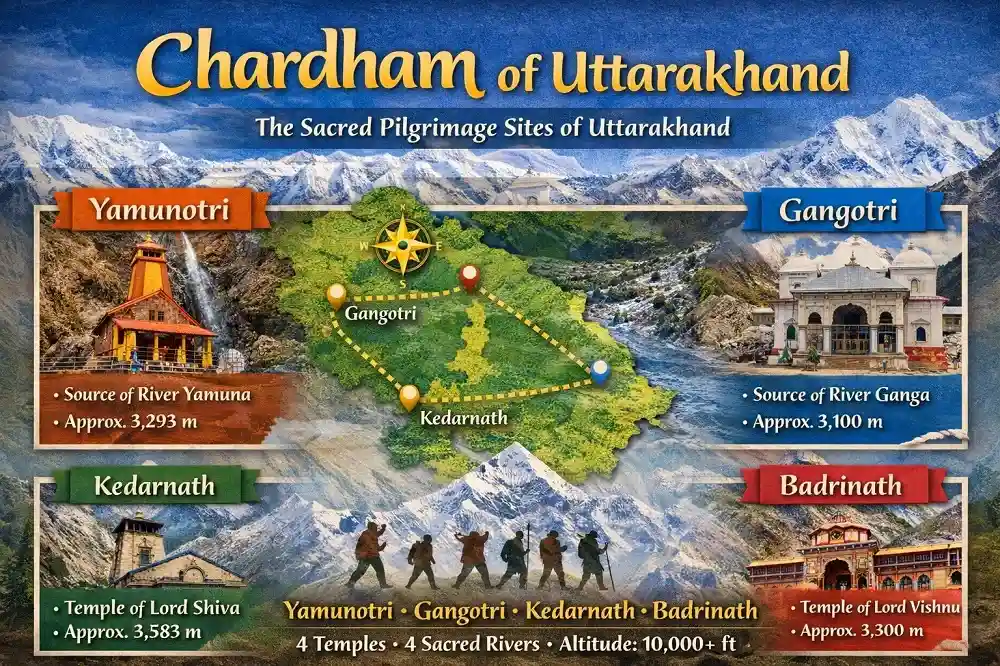
There are journeys you take for leisure, and then there are journeys that change something inside you. The Chardham Yatra of Uttarakhand belongs firmly to the second kind.
Nestled deep in the Garhwal Himalayas, four sacred shrines — Yamunotri, Gangotri, Kedarnath, and Badrinath — form what is collectively called the Chota Char Dham. Pilgrims have been walking these routes for centuries. They come through narrow mountain passes, across rivers in full monsoon fury, up glacial slopes where the air gets thin and cold — all for a moment of darshan at one of these ancient temples. For devout Hindus across India, completing the Chardham Yatra is a lifelong aspiration, believed to wash away sins, free the soul from the cycle of rebirth, and ultimately lead to moksha.
Uttarakhand is known as Devbhoomi — the Land of Gods — for good reason. These four dhams sit across the state’s Garhwal region, each at a dramatically different altitude, each with its own mythology, its own river, and its own way of overwhelming you.
This guide covers everything you need to know about the Chardham — the history, the mythology, the practical details, and what actually makes each dham worth the journey.
The Origin of the Chardham Yatra
The concept of the Char Dham pilgrimage was established by Adi Shankaracharya, the great 8th-century philosopher, theologian, and spiritual reformer from Kerala. His vision was to unify Hindu pilgrimage culture across the country through a sacred circuit of four cardinal shrines — Badrinath in the north, Dwarka in the west, Puri in the east, and Rameshwaram in the south. This became the original Char Dham of India.
The four temples of Uttarakhand — Yamunotri, Gangotri, Kedarnath, and Badrinath — came to be known as the Chota Char Dham (small Char Dham), a name that distinguishes them from the all-India circuit. The “Chota” prefix was added in the mid-20th century. But in common usage, especially in northern India, these four Himalayan shrines are simply called the Chardham. Adi Shankaracharya himself revived and consolidated several of these temples, most notably Kedarnath and Badrinath, which he is credited with restoring in the 8th century CE.
The Chardham Yatra follows a traditional clockwise sequence — pilgrims begin at Yamunotri in the west, proceed to Gangotri, then Kedarnath, and complete the circuit at Badrinath. This order mirrors the movement of the sun and is believed to amplify the spiritual merit of the journey. Most pilgrims begin their yatra from Haridwar or Rishikesh, which serve as the gateways to the sacred Himalayan belt. The complete route from Haridwar covers approximately 1,607 kilometres.
Yamunotri: Where the Yamuna Begins
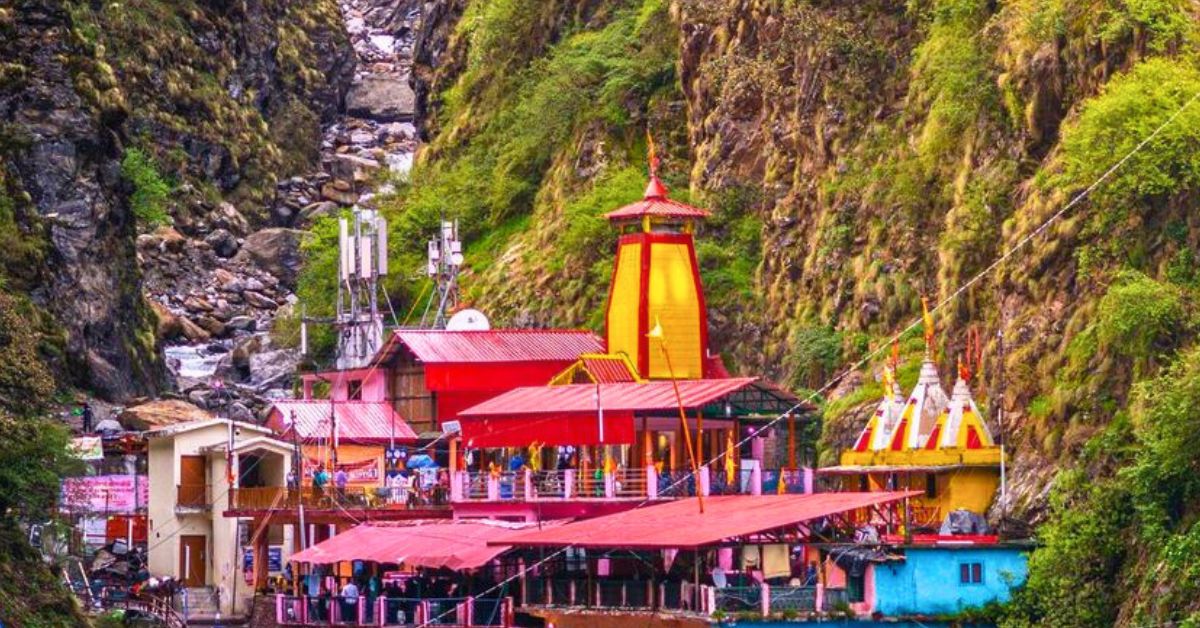
The Setting
Yamunotri is the westernmost shrine in the Char Dham circuit and the traditional starting point of the yatra. It sits at an altitude of 3,293 metres (10,804 feet) above sea level in the Uttarkashi district of Uttarakhand, nestled in a narrow gorge on the flanks of the Bandarpunch mountain. The temple is dedicated to Goddess Yamuna, the sacred river that flows from here through Uttarakhand, Haryana, Delhi, and Uttar Pradesh before merging with the Ganga at the Triveni Sangam in Prayagraj.
The actual source of the Yamuna River lies at the Champasar Glacier on Kalind Mountain, at an altitude of approximately 4,421 metres above sea level. Because this glacial source is difficult and dangerous to access, the temple was established lower on the mountain flank. The nearest motorable point is Janki Chatti, from where pilgrims trek approximately 6 kilometres on foot, by pony, or by palanquin to reach the shrine.
History and Mythology
The present Yamunotri temple was built in the 19th century. The original structure was constructed by Maharaja Sudarshan Shah of Tehri Garhwal around 1839. After it was damaged by natural calamities, Maharani Gularia of Jaipur rebuilt it. The temple has been reconstructed multiple times over the years due to floods and earthquakes, a reflection of the extreme conditions in this part of the Himalayas.
In Hindu mythology, Yamunotri holds deep significance. Goddess Yamuna is considered the daughter of Surya (the Sun God) and the twin sister of Yama, the God of Death. There is a powerful belief among pilgrims that bathing in the icy waters of the Yamuna and seeking her blessings protects them from untimely death. The river is considered the most sacred in Hinduism after the Ganga.
An ancient legend associated with Yamunotri involves the sage Asit Muni, who had his hermitage at this location. In his old age, when he could no longer travel to the Gangotri to bathe in the Ganga, the river Ganga herself appeared beside the Yamuna near his ashram so he could continue his daily ritual. This legend is why, even today, devotees believe that a visit to Yamunotri is equivalent to bathing in both the Yamuna and the Ganga.
What to See at Yamunotri
The most famous attraction near the Yamunotri temple is Surya Kund, a boiling hot spring whose water temperature reaches approximately 90 degrees Celsius. Pilgrims dip rice and potatoes tied in cloth into this spring, cooking them as a prasad offering to the Goddess. The cooked rice is taken home as a sacred blessing.
Another notable site is the Divya Shila, a sacred pillar near the temple where devotees offer prayers before entering the main shrine. Saptarishi Kund, a high-altitude lake about 6 kilometres from the temple, is another revered spot associated with the seven sages of Hindu tradition.
The deity inside the Yamunotri temple is a black marble idol of Goddess Yamuna, flanked by a silver idol adorned with garlands. During winter, when the temple closes on Yama Dwitiya (the second day after Diwali), the idol is transferred to Kharsali village, where it is worshipped until the temple reopens the following spring.
Gangotri: The Source of the Sacred Ganga
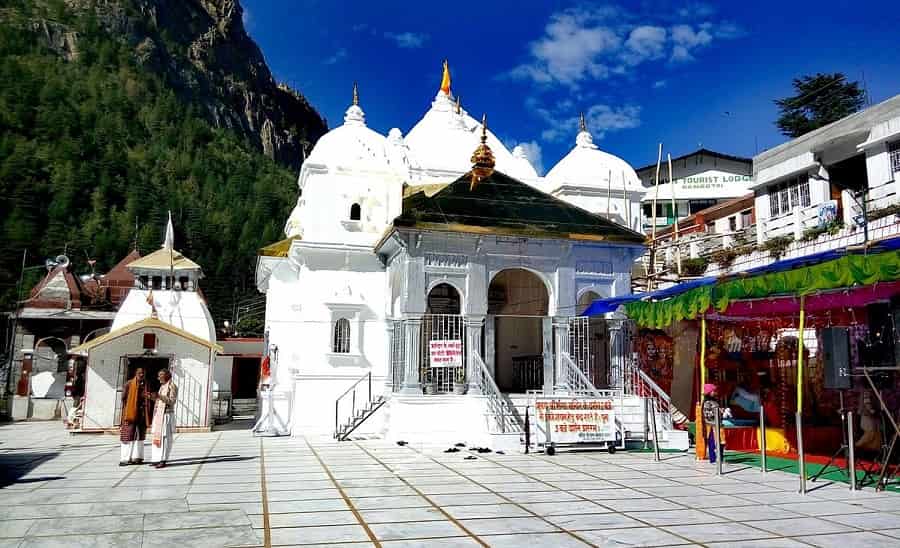
The Setting
Gangotri is the second dham on the Chardham Yatra and is dedicated to Goddess Ganga. It is located in the Uttarkashi district at an altitude of approximately 3,415 metres (11,200 feet) above sea level, on the banks of the Bhagirathi River — the name the Ganga carries at its source before it meets the Alaknanda at Devprayag and officially becomes the Ganga.
The temple is surrounded by magnificent deodar and pine forests, and the backdrop of snow-covered Himalayan peaks creates an atmosphere of extraordinary stillness. The actual source of the Ganga is at Gaumukh, a glacier located about 19 kilometres from the Gangotri temple. The name Gaumukh means “cow’s mouth,” referring to the shape of the glacier’s snout, from which the icy waters of the Bhagirathi River emerge. A trek to Gaumukh takes pilgrims through Bhojbasa and is one of the most rewarding mountain treks in India.
History and Mythology
The Gangotri temple was originally built in the 18th century by Amar Singh Thapa, a general of the Gorkha army of Nepal. It is a relatively simple white granite structure, but its setting — on a rocky promontory above the rushing Bhagirathi, surrounded by mountains — gives it a grandeur that no architecture could rival. The temple was later restored and expanded in the early 20th century by Maharaja Madho Singh II of Jaipur.
The mythology of Gangotri is one of the most celebrated stories in all of Hindu tradition. It tells of King Bhagirath, who performed intense penance for thousands of years to persuade the celestial Ganga to descend to earth, so her sacred waters could release the souls of his ancestors from a curse. When Ganga finally agreed to come, her force was so powerful it could have destroyed the earth. Lord Shiva received her in his matted hair to break her fall, and she flowed gently from his locks onto the mountains. This is why the spot at Gangotri is considered the place where Ganga touched earth.
Bhagirath Shila, a rocky prominence near the temple, is the stone where King Bhagirath is said to have meditated. Pandava Gufa, nearby, is a cave traditionally associated with the Pandavas from the Mahabharata, who are believed to have rested here during their journey to the Himalayas.
The word Bhagirathi — the name of the river at its source — comes from Bhagirath himself, preserving his name across millennia as a tribute to his devotion.
What to See at Gangotri
The Gangotri temple, dedicated to the goddess in her benevolent form, is the main attraction. Devotees take a holy dip in the Bhagirathi before entering the shrine. The priests performing rituals at the temple belong to the village of Mukhwa, where the temple’s idol is also transferred each winter when the shrine closes.
For the adventurous pilgrim, the trek to Gaumukh is an unforgettable experience — a 19-kilometre walk through the Gangotri National Park, past moraines and glacial valleys, to the source of one of the world’s most sacred rivers. This trek requires a permit from the Forest Department and should only be attempted by those in reasonable physical fitness.
Kedarnath: The Highest Jyotirlinga

The Setting
Of all four dhams, Kedarnath is the most remote and the most dramatic. Situated at an altitude of 3,583 metres (11,755 feet) above sea level in the Rudraprayag district, the Kedarnath temple stands on the banks of the Mandakini River, beneath the towering Kedarnath peak (6,940 metres). Behind the temple, the Kedar Dome (6,831 metres) and other snow-capped peaks form a wall of mountains that makes the location feel like the edge of the known world.
The temple is accessible only by trekking 16 kilometres from Gaurikund, the last motorable point on the route. The trek is well-marked, challenging, and passes through landscapes of extraordinary beauty. Pilgrims can also hire ponies, palkis (palanquins), or porters. Helicopter services operate from helipads at Phata, Guptkashi, and Sitapur for those who need a faster or less physically demanding option.
History and Mythology
Kedarnath is one of the 12 Jyotirlingas of Lord Shiva — the cosmic manifestations of Shiva as pillars of light — and is regarded as the highest-altitude Jyotirlinga among them. The temple is also part of the Panch Kedar, a group of five Shiva shrines in the Garhwal Himalayas, each associated with a part of Shiva’s body as described in the mythological story of the Pandavas.
The most famous legend of Kedarnath involves the Pandavas seeking Lord Shiva’s forgiveness after the Kurukshetra War. Having killed their own kin — the Kauravas — in the great battle, the Pandavas were consumed by guilt and sought Lord Shiva as the only deity capable of absolving them of this sin. Shiva, unwilling to grant them easy redemption, disguised himself as a bull and hid in the Kedarnath region. When the Pandavas found him and the divine bull dived into the ground, only the hump of the bull remained above the earth. This hump is what is worshipped today at Kedarnath. The remaining parts of Shiva’s body reappeared at four other locations — Tungnath (arms), Rudranath (face), Madhyamaheshwar (navel), and Kalpeshwar (hair) — forming the Panch Kedar circuit.
The current temple structure is traditionally attributed to Adi Shankaracharya, who is believed to have revived the temple in the 8th century CE and integrated it into a pan-Indian Shaiva pilgrimage network. According to some traditions, Adi Shankaracharya attained Mahasamadhi near the Kedarnath mountains. A monument behind the temple marks this site. In 2024, more than 1.6 million pilgrims visited Kedarnath — a testament to its enduring spiritual pull.
The 2013 Flood and the Miracle of Bhim Shila
On June 16–17, 2013, catastrophic flash floods triggered by excessive rainfall and a cloud burst struck Kedarnath, one of the worst natural disasters in Uttarakhand’s history. The floodwaters, carrying massive boulders, destroyed the town surrounding the temple. Thousands were killed and many more were reported missing. Yet the ancient Kedarnath temple itself survived virtually intact. A large boulder — now reverently called Bhim Shila — came to rest directly behind the temple during the flood and acted as a natural shield, deflecting the floodwaters around the structure. Devotees view the survival of the temple as a divine miracle, and Bhim Shila is now itself an object of worship.
Architecture and Darshan
The Kedarnath temple is constructed from massive grey stone slabs, interlocked without the use of mortar, using only iron clamps. The interior houses a conical rock formation — the hump of the divine bull — worshipped as Lord Shiva in his Sadashiva form. The temple has a Garbha Griha (sanctum) and a pillared Mandap (assembly hall) whose walls are decorated with carvings of deities and scenes from Hindu mythology. A large Nandi statue stands guard at the entrance. The head priest, or Raval, of Kedarnath traditionally belongs to the Veerashaiva community of Karnataka.
- Must Read: Delhi to Kedarnath
Badrinath: The Abode of Lord Vishnu
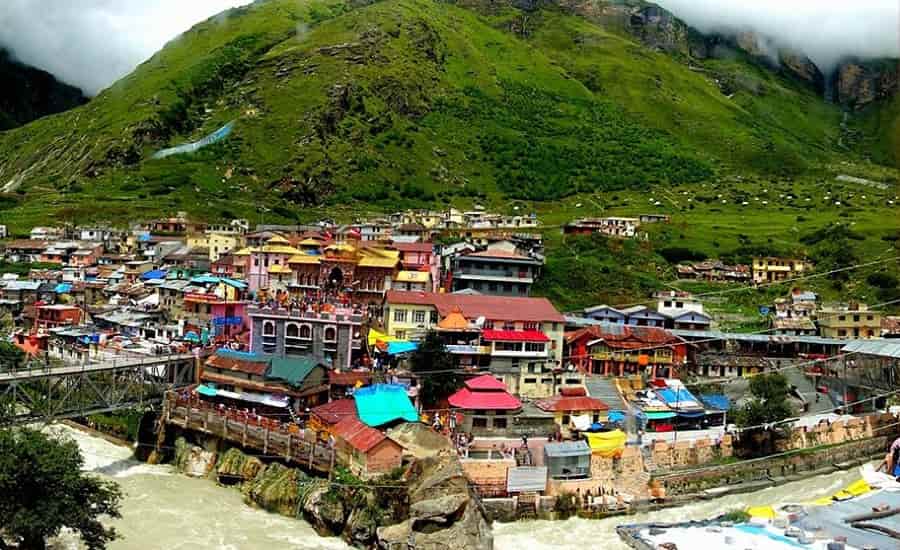
The Setting
Badrinath is the final and, in the traditional sequence, the most spiritually significant of the four dhams. It is located in the Chamoli district of Uttarakhand at an altitude of approximately 3,133 metres (10,279 feet), on the banks of the Alaknanda River. The temple sits between the Nar and Narayan mountain peaks of the Garhwal Himalayas and is dedicated to Lord Vishnu, worshipped here as Badrinarayan.
Unlike Kedarnath, Badrinath is accessible by road almost to the temple itself, making it the most pilgrim-friendly of the four dhams. In 2022, a record 2.8 million devotees visited in just two months, making it one of the most visited pilgrimage centres in India.
History and Mythology
Badrinath holds a unique place in Hindu scripture. It is mentioned in the Bhagavata Purana, Skanda Purana, and Mahabharata. It is one of the 108 Divya Desams — sacred Vaishnava shrines mentioned in the Divya Prabandham — and is also part of the Panch Badri group of five Vishnu temples in the Garhwal region.
The most prominent legend of Badrinath tells of Lord Vishnu performing intense meditation at this location for thousands of years. Goddess Lakshmi, his consort, to protect him from the harsh Himalayan climate, transformed herself into a Badri tree (Indian jujube or berry tree) and stood over him as shelter. In recognition of her devotion, Vishnu named the sacred site Badrikashram, and the place became known as Badrinath — Lord of the Badri.
Another legend says that Badrinath was originally the abode of Lord Shiva and Parvati. When Lord Vishnu chose it as his meditation site, Shiva graciously moved to the neighbouring mountains — specifically to Kedarnath — which is why these two temples are so deeply interlinked in pilgrimage tradition.
The idol worshipped at Badrinath — a 1-foot black Shaligram stone image of Lord Vishnu in a meditative padmasana posture — is believed to be one of the eight svayam vyakta kshetras, or self-manifested forms of Vishnu. According to tradition, Adi Shankaracharya discovered the idol submerged in the Alaknanda River in the 8th century and enshrined it in a cave near the Tapt Kund hot spring. Later, the Garhwal kings moved the idol to its current temple location.
The head priest (Rawal) of Badrinath, by centuries-old tradition, must be a Nambudiri Brahmin from Kerala — a connection believed to stem from Adi Shankaracharya’s own Kerala origins.
What to See at Badrinath
Tapt Kund, a natural hot spring just below the temple, is where pilgrims take a ritual bath before proceeding for darshan. The water is warm due to geothermal activity and is believed to have purifying properties. Narad Kund, a pool nearby, is where Adi Shankaracharya is said to have found the idol of Badrinarayan.
Mana Village, 3 kilometres from the Badrinath temple, is India’s last inhabited village before the Tibet border and is rich in mythological significance. It is associated with the Mahabharata — Vyas Gufa (the cave where Sage Vyasa is said to have composed the Mahabharata), Ganesh Gufa, and Bhim Pul (a natural stone bridge said to have been created by Bhima over the Saraswati river) are all located here.
Vasudhara Falls, about 5 kilometres from Badrinath, is a waterfall that plunges 122 metres and is believed to be where the Pandavas rested during their final journey. The Neelkanth peak (6,596 metres), visible from Badrinath, is one of the most sacred peaks in the Garhwal Himalayas, associated with Lord Shiva.
- Also Read on: Delhi to Badrinath
Best Time to Visit the Chardham
The Chardham temples open each spring — typically on the auspicious occasion of Akshaya Tritiya (usually April or May) — and close in October or November before the onset of winter. The exact opening and closing dates are announced each year by the temple priests based on the Hindu calendar.
The best time to undertake the Chardham Yatra is from May to June and September to October. During these months, the weather is relatively stable, the roads are clear, and the mountain scenery is at its most spectacular. May and June bring out spring wildflowers across the valleys, while September and October offer crisp air and the clearest views after the monsoon season.
The monsoon months of July and August are generally best avoided. Heavy rainfall makes roads dangerous due to frequent landslides, and the journey becomes physically challenging and unpredictable. While pilgrimage traffic does continue through the monsoon, the Uttarakhand government regularly issues advisories about road conditions during this period.
All four temples close for winter — typically between Diwali and Bhai Dooj in October-November — and remain shut through April. During winter, the temple idols are moved to designated winter seats: the Kedarnath idol goes to Ukhimath, the Badrinath idol to the Narasimha Temple in Joshimath, the Yamunotri idol to Kharsali village, and the Gangotri idol to Mukhba village.
How to Reach the Chardham
By Air: The nearest airport is Jolly Grant Airport in Dehradun, approximately 35 kilometres from the city. From Dehradun, pilgrims travel by road to the various dhams.
By Train: Haridwar and Rishikesh are the main railway stations serving the Chardham route. Haridwar has better train connectivity to Delhi and other major cities. From these railway stations, pilgrims take taxis, buses, or shared jeeps toward the dhams.
By Road: The preferred route from Haridwar follows the sequence Haridwar → Barkot → Yamunotri → Uttarkashi → Gangotri → Guptkashi → Gaurikund → Kedarnath → Joshimath → Badrinath, covering approximately 1,607 kilometres in total. The Uttarakhand government has been steadily improving road infrastructure under the Char Dham Road Project — widening highways, building tunnels, and improving safety infrastructure across the route.
By Helicopter: Helicopter services are available for all four dhams. The Kedarnath helicopter operates from Phata, Guptkashi, and Sitapur. Yamunotri has helicopter services from Kharsali. Helicopter packages for all four dhams in 5–6 days have become increasingly popular for older pilgrims and those with health constraints.
- Must Read: Chardham Yatra Route Map from Delhi
Registration for the Chardham Yatra
The Uttarakhand government requires pilgrims to register for the Chardham Yatra. Registration can be completed online through the official Uttarakhand Tourism portal or at on-site counters along the route. Carrying a government-issued photo ID and Aadhaar card is mandatory, as they are checked at multiple points during the yatra.
Registration helps the state government manage pilgrim flow, provide safety support, and coordinate medical aid at remote locations along the route. Given the altitude and physical demands of the journey, the government also maintains medical facilities and health checkpoints at key points along the route.
Practical Tips for the Chardham Yatra
Planning a Chardham Yatra requires more preparation than a typical pilgrimage. These are things that matter in practice:
- Acclimatise before ascending. Altitude sickness is a real risk, especially at Kedarnath (3,583 m) and Yamunotri (3,293 m). Spend at least one day in Haridwar or Rishikesh before starting the ascent, and move slowly between dhams.
- Carry warm clothing. Even in May and June, temperatures drop sharply after sunset at all four dhams. Carry layered clothing, a good windproof jacket, and gloves.
- Consult a doctor before travelling. This is especially important for senior citizens, those with cardiovascular conditions, or anyone with respiratory issues. The physical exertion at altitude can be demanding.
- Book accommodation in advance. Especially during peak season (May–June), hotels and guesthouses along the route fill up quickly. GMVN (Garhwal Mandal Vikas Nigam) operates government guest houses at most stops along the Chardham route.
- Avoid the monsoon if possible. Landslides are common in July and August and can delay or completely block stretches of the route. Track Uttarakhand road conditions regularly if travelling during this period.
- Start each day early. Mountain weather changes rapidly in the afternoon. Reaching dhams early ensures better visibility, smaller darshan queues, and safer driving on mountain roads.
- Night driving is restricted. On hill roads in Uttarakhand, driving is generally not permitted from 8 PM to 4 AM. Plan your itinerary with this in mind.
The Spirit of the Chardham
What strikes every pilgrim who completes the Chardham — whether they’re a devout believer or someone who started the journey half-skeptical — is how much the journey itself becomes the experience, not just the destination.
The Panch Prayag — five sacred river confluences en route to Badrinath — speak of a geography stitched together by rivers. The mountain roads that wind through Rudraprayag, Karnaprayag, Nandaprayag, Vishnuprayag, and Devprayag are not just transit. They are part of the pilgrimage. The aarti at Har Ki Pauri in Haridwar at sunset, the sound of the Mandakini river on the Kedarnath trek, the first sight of Badrinath’s colourful facade after the long mountain drive — these are moments that stay.
The Chardham Yatra of Uttarakhand is one of the most physically demanding, spiritually charged, and visually magnificent journeys a person can make in India. For millions, it is the journey of a lifetime — taken once with full devotion, and remembered forever.