
Agrasen ki Baoli
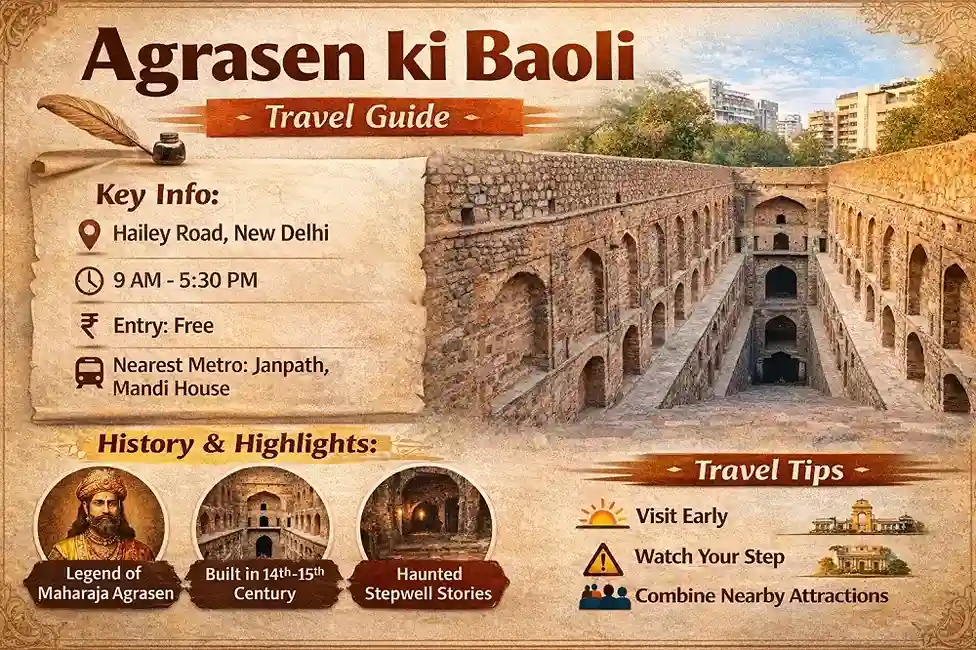
Hidden between busy roads and modern office buildings in New Delhi lies a structure that feels like a doorway into another era. Agrasen ki Baoli is one of the most fascinating historical monuments in the city — an ancient stepwell that quietly survives in the middle of modern urban chaos.
Located close to the commercial hub of Connaught Place, this stepwell attracts photographers, history lovers, and curious travelers every day. The monument stretches roughly 60 meters long and 15 meters wide, with more than a hundred steps descending deep into the ground.
But Agrasen ki Baoli is more than just an architectural relic. It tells a story of ancient water management, medieval engineering, folklore, and the cultural life of old Delhi.
This guide explores the history, architecture, myths, and visiting tips for Agrasen ki Baoli, based on verified historical references and ground-level travel observations.
What is Agrasen ki Baoli?
Agrasen ki Baoli is an ancient stepwell built to store water and provide a reliable source during dry seasons. In earlier centuries, such structures were common across northern and western India.
The baoli stands on Hailey Road near Jantar Mantar in central Delhi. It is now protected by the Archaeological Survey of India and officially recognized as a historical monument.
The structure features:
-
Around 108 stone steps
-
Three levels of arched corridors
-
A deep well at the bottom
-
Long rectangular design instead of the typical circular well
Although the exact date of construction remains uncertain, historians believe the structure was rebuilt during the 14th–15th century in the Tughlaq or Lodi period.
History of Agrasen ki Baoli
The history of Agrasen ki Baoli blends documented facts with legend.
The legend of Maharaja Agrasen
Many local traditions link the stepwell to the legendary king Maharaja Agrasen. According to community folklore, the well was originally built in his name by members of the Agrawal community, who consider him their ancestor.
However, historians note that no definitive historical record confirms this claim.
Medieval reconstruction
Most historians believe the current structure was rebuilt during the Delhi Sultanate era, likely in the 14th century.
During this period, stepwells served several purposes:
-
Water storage
-
Community gathering places
-
Cooling shelters during extreme heat
-
Resting spots for travelers
Ancient stepwells were also important social spaces where people met, prayed, and performed rituals.
Why Stepwells Were Important in Ancient India
Before modern pipelines and reservoirs, water supply depended heavily on seasonal rainfall.
Stepwells like Agrasen ki Baoli played a crucial role in urban life.
These structures worked by:
-
Collecting groundwater and rainwater
-
Allowing people to access water even when levels dropped
-
Maintaining cool temperatures underground
Across India, stepwells were also architectural masterpieces.
According to travel features in The Times of India, many historic baolis combined engineering with artistic design and became important cultural landmarks.
Architecture of Agrasen ki Baoli
The architecture of Agrasen ki Baoli is simple but striking.
Unlike many stepwells in Rajasthan or Gujarat that are richly decorated, this baoli follows a minimalist rectangular design.
Key architectural features
-
Length: about 60 meters
-
Width: about 15 meters
-
Steps: roughly 108 descending steps
-
Structure: rubble masonry and stone blocks
The steps gradually descend into the well, forming a dramatic perspective when viewed from the top.
Three levels of arched niches and corridors line the walls, creating shaded resting spaces.
Unique design advantage
This design had practical benefits:
-
Easy access to water at different levels
-
Natural cooling effect inside the structure
-
Protection from sunlight and evaporation
Even today, the temperature inside the baoli often feels cooler than the surrounding city.
The Haunted Stories of Agrasen ki Baoli
One reason Agrasen ki Baoli attracts curious visitors is its reputation as one of Delhi’s haunted places.
Local legends claim the well once contained mysterious black water that hypnotized people and lured them to jump into the well.
These stories have circulated for decades.
However, historians and researchers emphasize that there is no verified evidence supporting paranormal claims. The stories are simply part of local folklore.
Still, the quiet atmosphere, echoing footsteps, and dark stone corridors give the place a slightly eerie vibe — especially during quiet hours.
Agrasen ki Baoli in Movies and Popular Culture
Over the years, Agrasen ki Baoli has appeared in several Bollywood films and television shows.
Movies shot here include:
-
PK
-
Sultan
-
Kabhi Alvida Naa Kehna
Because of its symmetrical steps and dramatic depth, the monument has become a favorite location for photographers and filmmakers.
The site also appeared in international television programs like The Amazing Race Australia.
Visiting Agrasen ki Baoli – Travel Guide
Visiting Agrasen ki Baoli is surprisingly easy because it is located in the center of Delhi.
Location
Hailey Road, near Connaught Place
Opening hours
9:00 AM – 5:30 PM daily.
Entry fee
Entry is generally free for visitors.
Nearest metro stations
-
Janpath Metro Station
-
Mandi House Metro Station
From either station, the monument is about a 10–15 minute walk.
Best Time to Visit Agrasen ki Baoli
Although the monument is open all year, certain times offer a better experience.
Morning hours
Early morning visits are peaceful and less crowded.
Winter months
October to March provides pleasant weather for exploring outdoor monuments in Delhi.
Weekdays
Weekdays are quieter compared to weekends when photographers and tourists gather here.
Practical Travel Tips
If you plan to visit Agrasen ki Baoli, these tips can improve your experience.
Photography tips
-
Visit around sunrise or late afternoon
-
Use the stair symmetry for dramatic shots
-
Wide-angle lenses work best here
Safety advice
-
Watch your step while descending
-
Avoid leaning over edges for selfies
-
Stay within marked areas
Travel suggestion
Combine your visit with nearby attractions such as:
-
Jantar Mantar
-
India Gate
Both are located within a short distance.
Why Agrasen ki Baoli Still Matters Today
In a city full of malls, highways, and skyscrapers, Agrasen ki Baoli offers a rare glimpse into how people managed water centuries ago.
It demonstrates:
-
Ancient engineering skills
-
Sustainable water management
-
Urban architecture designed for climate
Modern architects often study such structures to understand how traditional designs managed heat, airflow, and water storage.
Even today, the monument quietly reminds visitors that ancient cities were far more environmentally aware than we often assume.
FAQs
1. Where is Agrasen ki Baoli located?
Agrasen ki Baoli is located on Hailey Road in central New Delhi, close to Connaught Place.
2. Who built Agrasen ki Baoli?
The monument is traditionally associated with Maharaja Agrasen, but historians believe the existing structure was rebuilt during the Delhi Sultanate period.
3. How old is Agrasen ki Baoli?
The stepwell is believed to date back to around the 14th or 15th century, though earlier origins are sometimes suggested in legends.
4. How many steps are there in Agrasen ki Baoli?
The structure has approximately 108 stone steps leading down to the well.
5. Is Agrasen ki Baoli haunted?
There are popular ghost stories about the baoli, but there is no scientific evidence supporting paranormal activity.
6. Is entry free at Agrasen ki Baoli?
Yes, entry is generally free as the monument is maintained by the Archaeological Survey of India.
7. What is the best time to visit Agrasen ki Baoli?
Morning or late afternoon is ideal for photography and a quieter experience.
8. Which metro station is closest to Agrasen ki Baoli?
Janpath and Mandi House metro stations are the nearest.
9. Why were stepwells built in ancient India?
Stepwells were constructed to store water, provide cooling spaces, and serve as social gathering points.
10. Can Agrasen ki Baoli be visited in one day with other attractions?
Yes. Visitors often combine it with Connaught Place, India Gate, and Jantar Mantar in a single day.