Rajpath — Now Kartavya Path
Rajpath. The name itself carried a certain weight — three syllables that conjured images of a nation marching in formation, tanks rolling past saluting generals, schoolchildren waving flags in the January cold. For over seven decades after independence, Rajpath was the ceremonial spine of the Indian Republic. It was where India showed the world who it was, once a year, every Republic Day.
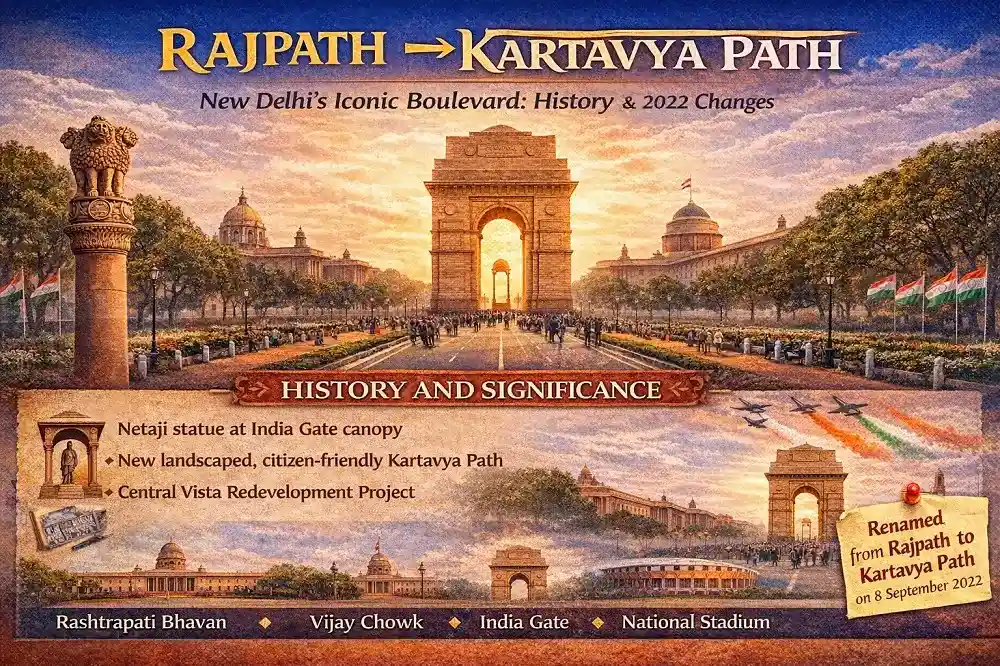
In September 2022, that name changed. The 3-kilometre stretch running from Rashtrapati Bhavan on Raisina Hill through Vijay Chowk and India Gate to the National Stadium was officially renamed Kartavya Path — the Path of Duty. The road did not move. The trees did not shift. But the name above it — and the symbolism behind it — changed entirely.
To understand why that matters, you have to go back more than a century. To 1911. To the moment a colonial empire decided it needed a new capital — and built an entire city around a single, monumental road.
Rajpath: A History Written in Three Names
Kingsway — Built for Empire (1911–1947)
In 1911, King George V visited India for the Delhi Durbar — a grand imperial ceremony marking the transfer of the British capital from Calcutta to Delhi. The announcement was dramatic, the ambition enormous. And so the British turned to one of the greatest architects of the age: Sir Edwin Lutyens.
Lutyens conceived New Delhi as an imperial city built around a single ceremonial axis — a broad, tree-lined boulevard stretching from the Viceroy’s House (now Rashtrapati Bhavan) on Raisina Hill all the way to the war memorial arch at the eastern end. He called it Kingsway. The name was direct. Unambiguous. This was the King’s road, in the King’s city, built to remind everyone who was in charge.
The second architect, Sir Herbert Baker, designed the flanking Secretariat buildings — the North and South Blocks — that rise on either side as you climb Raisina Hill. The layout was calculated: the view from Rashtrapati Bhavan runs unobstructed down the full length of the avenue, through India Gate, to the National Stadium. Standing at the top on a clear day, you understand exactly what Lutyens was doing. He built a stage for power.
Construction continued through the 1910s and 1920s, and New Delhi was formally inaugurated as the capital of British India in 1931. The road contractor who actually built Kingsway and the other broad avenues of New Delhi — a detail almost no one remembers — was Sardar Narayan Singh, who mobilised labourers from Rajasthan and Uttar Pradesh for the task.
Rajpath — Independence and Continuity (1947–2022)
When India became free on 15 August 1947, Kingsway was renamed Rajpath. In Hindi, ‘raj’ means rule or government — so the translation was essentially exact. Kingsway became the King’s Path became the Government’s Path. The colonial symbolism of power remained, even if the rulers had changed.
For decades, this did not particularly trouble anyone. Rajpath became synonymous with Republic Day — the 26 January parade that began at Rajpath in 1951 (the first Republic Day parade in 1950 was held at the National Stadium) and has continued there ever since. The road became the stage on which India’s military strength, cultural diversity, and national pride were displayed before the world every single year.
In real life, Rajpath was also simply a place. Families brought children here on winter evenings. Office workers jogged along the canal-lined paths. Ice cream vendors set up carts near India Gate. The National War Memorial, built in 2019, stood a short distance behind the arch, honouring more than 25,000 soldiers who died in post-Independence conflicts. Rajpath was grand — but it was also ordinary, in the best way.
Kartavya Path — A Deliberate Break (September 2022)
On 8 September 2022, Prime Minister Narendra Modi inaugurated the redeveloped Central Vista Avenue and simultaneously renamed it Kartavya Path. ‘Kartavya’ means duty — specifically, the duty of citizens and institutions toward the nation. The shift in language was intentional: from ‘Raj’ (rule/power) to ‘Kartavya’ (duty/responsibility).
The renaming came as part of the Central Vista Redevelopment Project — a broader overhaul of the Lutyens Delhi corridor that also included a new Parliament building. On the same day, a 28-foot bronze statue of Netaji Subhas Chandra Bose was unveiled at the India Gate canopy — the same spot that had housed a statue of King George V until 1968. The symbolism was layered and deliberate: colonial ruler replaced by freedom fighter.
The Three Names of Rajpath — A Quick Reference
| Name | Period | Meaning | Symbolic Context |
| Kingsway | 1911–1947 | King’s Way | British imperial power over colonial India |
| Rajpath | 1947–2022 | Government’s Path / King’s Path (Hindi) | Post-independence, but colonial symbolism retained |
| Kartavya Path | 2022–Present | Path of Duty | Democratic responsibility; citizen duty over state power |
The Architecture and Layout of Rajpath / Kartavya Path
The boulevard runs east to west — approximately 3 kilometres from Rashtrapati Bhavan to the National Stadium. It is not just a road. It is a carefully orchestrated spatial sequence.
- Rashtrapati Bhavan (Raisina Hill): The President’s official residence, designed by Lutyens. The visual anchor of the entire axis, commanding a view down the full length of the avenue.
- North and South Blocks (Secretariat Buildings): Flanking Rajpath as it descends from Raisina Hill, housing key ministries including Finance and Home Affairs. Designed by Herbert Baker.
- Vijay Chowk: The roundabout at the foot of Raisina Hill, where the Beating Retreat ceremony takes place every year in late January. Janpath crosses Rajpath at this point.
- India Gate: The 42-metre sandstone war memorial designed by Lutyens, commemorating 70,000 Indian soldiers who died in World War I and the Third Anglo-Afghan War. The Amar Jyoti (eternal flame) burns beneath the arch.
- National War Memorial: Built in 2019 just behind India Gate. Carved with the names of 25,942 soldiers who died in post-Independence wars including the 1947, 1962, 1965, 1971 conflicts and the Kargil War.
- National Stadium (Dhyan Chand National Stadium): The eastern end of the axis, about 3 km from Rashtrapati Bhavan.
What gives Rajpath its visual power is the deliberate spatial planning: the lawns, water channels (canals), and tree rows on either side create a sense of ceremony and openness simultaneously. The view from Vijay Chowk toward India Gate — especially at dusk, when the arch is lit — is one of the most recognisable sights in India.
The Central Vista Redevelopment: What Changed in 2022
The redevelopment inaugurated on 8 September 2022 was not just a name change. The physical transformation of the boulevard was substantial — and controversial in some quarters, given the debate around redeveloping a heritage precinct.
| What Was Added / Improved | Why It Matters |
| New landscaped lawns and walkways | Made the area genuinely walkable and accessible to the public |
| Refurbished canals and water channels | Restored visual continuity with original Lutyens design |
| Vending kiosks and amenity blocks | Formal infrastructure for vendors — previously informal |
| New pedestrian underpasses | Safer road crossing for the thousands who visit daily |
| Rainwater harvesting and waste management systems | Sustainability infrastructure beneath the aesthetic upgrade |
| Foldable seating for Republic Day parade | Improved spectator experience for 26 January events |
| Upgraded night lighting | The avenue is now visually spectacular after dark |
On the ground, the change is real. Kartavya Path today feels like a proper public space in a way that the old Rajpath — more fenced-off, less pedestrian-friendly — often did not. Whether that justified the scale of expenditure involved is a debate that continues.
Rajpath and Republic Day — The Annual Moment That Defined the Road
For most Indians, Rajpath and 26 January are inseparable. From 1951 onwards, the Republic Day parade has moved down this boulevard every year without exception — military contingents, tableaux from every state, camel-mounted border guards, fighter jets trailing tricolour smoke overhead.
The President of India takes position at Vijay Chowk to receive the salute. Foreign heads of state are invited as chief guests. The parade covers the full length from Vijay Chowk to the National Stadium, and is broadcast live to an audience of hundreds of millions across television and digital platforms.
What most people don’t realise: the road is closed to public traffic for days before and after Republic Day for security, rehearsals, and setup. If you plan to visit Delhi in late January expecting to walk the full stretch, plan around this — or embrace the experience of watching the parade live, which is entirely worthwhile.
Visiting Rajpath / Kartavya Path — Practical Information
- Location: Central New Delhi. The nearest Metro stations are Central Secretariat (Yellow and Violet Lines) and Udyog Bhawan (Yellow Line).
- Entry: Free and open to the public throughout the day. No tickets required.
- Best time to visit: October to February — the cool months when walking the full length is comfortable. Avoid peak summer (April–June) — the open ground gets extremely hot.
- Timings: No fixed closing time for the open lawns. India Gate and the surrounding precinct is accessible at all hours.
- Republic Day parade tickets: Available through the Aamantran portal (aamantran.mod.gov.in) — booking opens approximately one month before 26 January each year.
- Photography: Allowed freely on the lawns and along the boulevard. Restrictions apply near certain government buildings (North and South Blocks).
- Food: Multiple vending kiosks now operate along the redeveloped stretch. The ice cream and chaat vendors near India Gate are something of a Delhi institution.
Frequently Asked Questions — Rajpath / Kartavya Path
What is the current name of Rajpath?
Rajpath was officially renamed Kartavya Path on 8 September 2022, when Prime Minister Narendra Modi inaugurated the redeveloped Central Vista Avenue. The name translates to ‘Path of Duty’ and was chosen to replace the colonial-era symbolism of ‘Raj’ (rule/power) with the idea of civic responsibility.
Who designed Rajpath (Kingsway)?
Rajpath was designed by British architect Sir Edwin Lutyens as the central ceremonial axis of New Delhi, which became the capital of British India in 1931. The flanking Secretariat buildings were designed by Sir Herbert Baker. The road itself was constructed under contractor Sardar Narayan Singh, with labourers largely from Rajasthan and Uttar Pradesh.
Why was Rajpath renamed Kartavya Path?
The renaming was part of Prime Minister Narendra Modi’s broader decolonisation initiative — a push to remove colonial-era names and symbols from Indian public life. ‘Rajpath’ was a direct Hindi translation of ‘Kingsway’, the road’s British name, and retained the symbolism of royal authority. ‘Kartavya Path’, meaning Path of Duty, shifts that symbolism toward democratic responsibility and citizens’ duty to the nation — drawing from ideas rooted in the Bhagavad Gita.
What is the length of Rajpath / Kartavya Path?
The boulevard stretches approximately 3 kilometres from Rashtrapati Bhavan at the western end on Raisina Hill, through Vijay Chowk and past India Gate, to the National Stadium at the eastern end. The full walk from end to end takes about 30 to 40 minutes at a leisure pace.
When did the Republic Day parade move to Rajpath?
The very first Republic Day parade on 26 January 1950 was held at the Irwin Amphitheatre, also known as the Major Dhyan Chand National Stadium. From 26 January 1951 onwards, the parade shifted to Rajpath, where it has been held every year since. Even after the 2022 renaming to Kartavya Path, the tradition continues on the same stretch.
Is there an entry fee for Kartavya Path?
No. The public lawns and the full length of Kartavya Path are free to access at all times. Republic Day parade tickets are a separate matter — those are allocated through the Aamantran portal (aamantran.mod.gov.in) and have a nominal charge depending on the seating category.
Rajpath in Memory, Kartavya Path in Practice
There is something interesting about what happens when a famous road changes its name. The road does not change. The lawns and canals and the sandstone arch at the end do not change. But the story that the name tells — about who built it, who it was built for, and what it means now — shifts.
Kingsway said: the King is here. Rajpath said: the government is here. Kartavya Path says: duty is here. Whether that linguistic shift translates into something felt on the ground is a question India is still answering. What is not in question is the road itself — one of the most deliberately, beautifully designed public spaces in Asia, built over a century ago and still capable of stopping you in your tracks on a clear winter morning with the sun rising over India Gate.
That is the thing about great urban spaces. They outlast the names given to them.
Nearby: India Gate | Rashtrapati Bhavan | National War Memorial | Vijay Chowk