Gurudwara Bangla Sahib, Delhi
Gurudwara Bangla Sahib — At a Glance
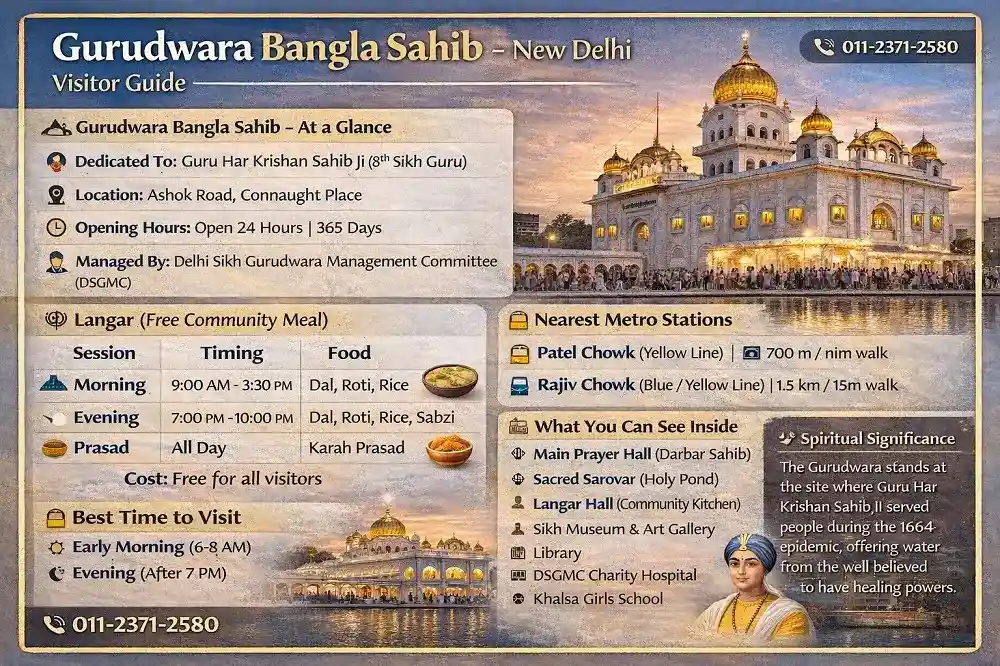
| Detail | Information |
| Dedicated To | Guru Har Krishan Sahib Ji (8th Sikh Guru) |
| Location | Ashok Road, Hanuman Road Area, Connaught Place, New Delhi – 110001 |
| Opening Hours | Open 24 hours, 7 days a week, 365 days a year |
| Entry Fee | Completely Free — for all visitors, all faiths, all nationalities |
| Langar Timings | 9:00 AM – 3:00 PM | 7:00 PM – 10:00 PM |
| Langar Cost | Free |
| Photography | Prohibited inside the main prayer hall and sanctum |
| Dress Code | Modest clothing; head must be covered (scarves available free at entrance) |
| Nearest Metro | Patel Chowk (Yellow Line) — 700 metres | Rajiv Chowk (Blue/Yellow) — 1.5 km |
| Contact | 011-2371-2580 |
| Managed By | Delhi Sikh Gurudwara Management Committee (DSGMC) |
| Best Time to Visit | Weekday early mornings (6–8 AM) or evenings after 7 PM |
Gurudwara Bangla Sahib — More Than a Religious Monument
In the middle of one of the world’s most chaotic capital cities, Gurudwara Bangla Sahib stands as something remarkable — a place where the noise simply stops. The moment you step off Baba Kharak Singh Marg, remove your shoes, cover your head, and walk through the entrance, the shift is immediate. The city falls away. What replaces it is the sound of Gurbani, the smell of incense and fresh flowers, and the sight of the golden dome reflected in the still waters of the Sarovar.
Gurudwara Bangla Sahib is one of the most significant Sikh shrines in India. Located near Connaught Place in central Delhi, it is dedicated to Guru Har Krishan Sahib Ji — the eighth Sikh Guru — and draws thousands of visitors every day, from devout Sikhs making a pilgrimage to curious tourists stopping mid-sightseeing to first-time visitors who arrived without expectation and stayed for hours.
It is open 24 hours, charges nothing to enter, feeds thousands of people free meals twice a day, runs a hospital, a school, and a museum — all within the same complex. There is genuinely no place like it in Delhi.
History of Gurudwara Bangla Sahib
The Bungalow of Raja Jai Singh
The story begins in the 17th century, in what was then called Jaisinghpura — a culturally significant neighbourhood in Mughal Delhi. The area was home to the bungalow (bangla) of Raja Jai Singh, the ruler of Amber (Jaipur) and a senior noble in Emperor Aurangzeb’s court. It was a place of some influence and considerable comfort.
In 1664, the eighth Sikh Guru, Guru Har Krishan Sahib Ji, was summoned to Delhi by Aurangzeb. He was just eight years old at the time — the youngest Sikh Guru to hold the position, having been appointed by his father Guru Tegh Bahadur at the age of five. Raja Jai Singh, a devotee of the Guru, offered his bungalow as the residence during the visit. Guru Har Krishan accepted.
The Epidemic and the Guru’s Sacrifice
Delhi in 1664 was suffering through a devastating epidemic of cholera and smallpox. The disease was cutting across all social strata — from the poorest quarters to the courts of the powerful. The young Guru, despite his age, began personally serving the sick. He carried water from the well on the property — water that came to be considered sacred — and distributed it to the afflicted, regardless of their faith, caste, or background. Hindus, Muslims, Sikhs — whoever was suffering, the Guru served.
What most people don’t realise is that in doing so, the Guru himself contracted the disease. He fell seriously ill with smallpox, and before he passed away in Nanded (Maharashtra) at the age of eight, he uttered his last words: ‘Baba Bakale’ — directing the Sikhs to look for the next Guru in the village of Bakala, where Guru Tegh Bahadur was eventually found. His service in Delhi had lasted weeks. His impact lasted centuries.
The well from which Guru Har Krishan drew water is still within the Gurudwara complex. The Sarovar (sacred pond) built around and incorporating that well is one of the holiest spots on the premises — its water is still believed by many devotees to carry healing properties.
From Bungalow to Gurudwara
After the Guru’s departure, Raja Jai Singh preserved the bungalow as a site of reverence. Over time, the building was converted into a memorial and then a formal Gurudwara. The current structure — the gleaming white marble complex with its iconic golden dome — was built in the early 20th century and expanded over subsequent decades. It is now managed by the Delhi Sikh Gurudwara Management Committee (DSGMC), the body that administers all major Gurudwaras in Delhi.
Architecture — What Makes Bangla Sahib Visually Unmistakable
The Gurudwara Bangla Sahib skyline is instantly recognisable across central Delhi. The dominant feature is the large gold-plated dome at the centre — a hallmark of Sikh sacred architecture — rising above an entirely white marble structure. Flanking the dome is the tall Nishan Sahib, the Sikh triangular flag on a high flagpole, which can be seen from several hundred metres in every direction.
The building blends Mughal and Sikh architectural traditions. The marble facade, the arched gateways, and the intricate stone carvings reflect the Mughal influence of the original era, while the golden dome, the Nishan Sahib, and the internal layout follow the principles of Sikh sacred architecture. Inside, the prayer hall is spacious and cool — pale marble, natural light, no ornamentation for its own sake. The focus is entirely on the Guru Granth Sahib (the eternal living scripture of Sikhism) placed on a elevated throne at the centre, draped in rich fabric and flowers.
The Sarovar — the large rectangular sacred pool in the complex — is framed by marble walkways and reflects the golden dome above it. At sunrise and after dark when the complex is lit, this reflection is the most photographed image of Bangla Sahib. The combination of gold, white, and still water has a quality that stops people mid-step.
What Is Inside the Gurudwara Bangla Sahib Complex
| Facility | What It Is | Open To |
| Main Prayer Hall (Darbar Sahib) | Houses the Guru Granth Sahib; continuous Gurbani kirtan performed throughout the day | All visitors |
| Sarovar (Sacred Pond) | The holy pond built around the well used by Guru Har Krishan; believed to have healing properties | All visitors |
| Langar Hall | Free community kitchen serving meals twice daily to thousands; run entirely by sevaks (volunteers) | All visitors — any religion, any nationality |
| Baba Baghel Singh Museum & Art Gallery | India’s first religious multimedia Sikh museum — paintings, digital screens, murals, multi-language audio | All visitors; no separate fee |
| Library | Repository of Sikh religious texts, history, and literature | Open to all |
| DSGMC Hospital (Basement) | Charity hospital run by Delhi Sikh Gurudwara Management Committee; subsidised treatment for the underprivileged | Medical facility |
| Khalsa Girls’ Senior Secondary School | School for girls operating within the complex premises | Educational institution |
| Yatri Niwas (Pilgrim Accommodation) | Simple, affordable rooms for pilgrims and volunteers; AC and non-AC options | Pilgrims and devotees |
| Shoe Stand | Managed shoe storage outside the main entrance — free, staffed by volunteers | All visitors |
The Langar — Free Food for Every Human Being
The langar at Gurudwara Bangla Sahib is one of the largest free community kitchens in Delhi. Every day, the kitchen feeds thousands of people — estimates suggest around 180 people are served every 15 minutes during peak langar hours. The math adds up to tens of thousands of meals per day. No one is turned away. No one is asked their name, religion, caste, or nationality. You sit down on the floor, you are served, you eat.
The menu is deliberately simple — dal, roti, rice, seasonal vegetable sabzi, and Karah Prasad (a sweet halwa made from flour, ghee, and sugar that is distributed as blessed food). Simple food, made with care, by volunteers who believe the act of cooking and serving is itself a form of worship. The kitchen operates entirely on seva — voluntary service — and the number of Hindus, Christians, and people of other faiths who volunteer regularly in the kitchen is notable.
Langar Rules — What You Should Know Before Sitting Down
- Langar is open to all — no exceptions based on religion, caste, gender, or nationality
- You must sit on the floor (pattal) as everyone eats together as equals — there is no hierarchy at the langar
- Finish what is on your plate — requesting more is welcome; wasting food is not
- After eating, you wash your own plate at the designated washing area — this is part of the seva
- Strict vegetarian food only — no eggs, no meat, no fish
- No alcohol consumption on the premises before or after langar
| Langar Session | Timings | Typical Menu |
| Morning–Afternoon Session | 9:00 AM – 3:00 PM | Dal, roti, rice, seasonal sabzi, Karah Prasad |
| Evening Session | 7:00 PM – 10:00 PM | Dal, roti, rice, seasonal sabzi, Karah Prasad |
| Prasad (all hours) | Available throughout the day | Karah Prasad (wheat halwa with ghee and sugar) |
What to Expect When You Visit — A Ground-Level Picture
The Sarovar at Sunrise
If you can manage one early morning during your Delhi trip, come to Bangla Sahib before 7 AM. The complex is quiet. The Gurbani begins before dawn. The golden dome, still lit from the night, begins to catch the first grey-orange light of sunrise and its reflection shifts colour on the Sarovar’s surface. People sit along the marble edges of the pond, some with eyes closed, some reading from the Gutka Sahib, some simply watching the water. It is a different place at this hour than at noon in full tourist traffic. Both versions are worth experiencing. But the morning is the one most people remember.
The Prayer Hall — How to Behave
Inside the main Darbar Sahib, the Guru Granth Sahib is always present and always active — a ragi (musician) is seated before it performing kirtan (devotional singing) throughout the day and night. There are screens around the hall displaying the Gurbani text and translations in multiple languages. You do not need to understand Punjabi or Gurmukhi script to sit there. The music is designed to carry you somewhere regardless of what you understand linguistically.
- Bow before the Guru Granth Sahib (Matha Tekna) when you enter — the way to do this is to kneel on both knees and touch your forehead to the floor briefly; it is a sign of respect, not a religious obligation for non-Sikhs, but most visitors follow this gesture naturally
- Sit on the floor — there are no chairs inside the prayer hall
- Maintain silence or speak in a very low voice
- Switch off your phone or keep it on silent — calls inside the hall are not acceptable
- Photography inside the prayer hall is strictly prohibited
Best Time to Visit Gurudwara Bangla Sahib
| Time / Season | Conditions | Recommended? |
| Early Morning (5–8 AM) | Quietest hour; Gurbani begins before dawn; Sarovar reflections at their best; fewer tourists | Best for spiritual experience and photography |
| Weekday mornings | Manageable crowd; full access to all parts of complex; langar begins at 9 AM | Ideal for first-time visitors |
| Evenings (7–9 PM) | Complex lit up; cooler in summer; evening langar; less intense sunlight for the dome and Sarovar | Great for second visit or photography |
| Weekends and public holidays | Very heavy footfall; long queues for langar; more waiting at shoe counter | Visit early morning only |
| Guru Purab / Gurpurabs | Spectacular atmosphere; special kirtans, processions, extended langar; huge crowds | Memorable but plan for extra time |
| Summer afternoons (May–June) | Delhi heat is brutal (40°C+); marble floors inside are cool but getting there is uncomfortable | Avoid peak afternoon; come early or after 6 PM |
| Monsoon (July–September) | Cooler temperatures; occasional rain makes the marble shine; Sarovar looks stunning | Very pleasant if you carry an umbrella |
| Winter (November–February) | Delhi winters are crisp and clear; mornings are cold but the complex is especially beautiful | Excellent — particularly for the golden dome in winter light |
How to Reach Gurudwara Bangla Sahib
By Metro — The Easiest Way
Delhi Metro is the most practical way to reach Bangla Sahib. The nearest station is Patel Chowk on the Yellow Line — approximately 700 metres from the Gurudwara, a 10-minute walk. Rajiv Chowk (Blue and Yellow Lines) is 1.5 km away and connects to a wider range of metro lines, making it useful if you are coming from a different part of the city.
| Mode of Transport | Nearest Point | Distance / Time | Notes |
| Delhi Metro (Yellow Line) | Patel Chowk Station | 700 m / 10 min walk | Closest station; exit Gate 1 and walk straight |
| Delhi Metro (Blue/Yellow) | Rajiv Chowk Station | ~1.5 km / 15 min walk or rickshaw | More connections; larger interchange station |
| Bus (DTC) | Gurudwara Bangla Sahib Bus Stop | 100 metres | Bus numbers: 73, 114, 207, 316, 712, 840, 910, 988 and others |
| Auto Rickshaw / Cab | Direct to gate | From Connaught Place: 5–10 min | Easy to find from CP or Janpath |
| Personal Vehicle | Parking on-campus | Dedicated multi-storey parking available | Free parking; enter from Baba Kharak Singh Marg |
Address: Ashok Road, Hanuman Road Area, Connaught Place, New Delhi – 110001. The Gurudwara is adjacent to Jantar Mantar and within 1 km of Connaught Place, making it easy to combine with other central Delhi sightseeing.
Rules and Etiquette — What You Must Know Before Entering
- Cover your head — this is mandatory for all visitors. Scarves and dupattas are available free of charge in a basket at the entrance. Return them before leaving.
- Remove footwear — shoes and sandals must be removed and left at the designated shoe stand before entering the complex.
- Wash hands — a hand-washing station is available at the entrance; use it before entering the prayer hall.
- No photography inside the prayer hall or the inner sanctum — outside in the Sarovar courtyard, photography is generally permitted.
- Modest clothing — shoulders and knees should be covered. Sleeveless tops and shorts are not appropriate. Most visitors in light summer clothes cover up with the provided scarves.
- No smoking or tobacco — the entire Gurudwara complex is a strictly no-smoking, no-tobacco zone.
- No alcohol — do not arrive visibly intoxicated; alcohol is prohibited on the premises.
- Silence in the prayer hall — conversations should be kept to a whisper; phone calls are not permitted inside.
- Non-vegetarian food — do not carry non-veg food into the complex.
- Sarovar bathing — some devotees take a ritual dip in the Sarovar; if you wish to do so, modest swimwear or simply entering in full clothing is the norm. The water is cold.
Accommodation at Gurudwara Bangla Sahib — Yatri Niwas
The Gurudwara offers simple, clean accommodation in the Yatri Niwas (pilgrim rest house) for devotees and volunteers. It is not a hotel — it is functional, peaceful, and managed by the DSGMC with the same spirit of seva that runs the rest of the complex.
| Room Type | Cost Per Day | Notes |
| Dormitory Hall | Free | Basic sleeping hall; no privacy; for volunteers and the needy |
| Non-AC Room | ₹800 per day | Simple room; attached or shared bathroom |
| AC Room | ₹1,000 per day | Basic AC room |
Rooms can fill up quickly, especially during Gurpurabs and major Sikh festivals. Contact the Gurudwara directly at 011-2371-2580 for room availability and booking. This is not available through online travel portals.
Festivals Celebrated at Gurudwara Bangla Sahib
On ground, the most extraordinary time to visit Bangla Sahib is during a Gurpurab — the birth or death anniversary of a Sikh Guru. The entire complex is decorated with lights, flowers, and Sikh flags. Special extended kirtans run through the night. The langar scales up enormously. Processions pass through the streets outside. The crowd is large but the spirit is something entirely different from a regular day.
- Guru Nanak Jayanti (Gurpurab): Celebrated in October–November (Kartik Purnima); the most significant Sikh festival, marking the birth of the first Guru
- Guru Har Krishan Ji’s Prakash Utsav: Birthday of the eighth Guru, the patron of this Gurudwara — special puja, extended kirtan, decorated premises
- Baisakhi (April 13–14): Harvest festival and the anniversary of the founding of the Khalsa Panth by Guru Gobind Singh Ji in 1699; celebrated with great energy
- Guru Gobind Singh Ji Jayanti: Birth anniversary of the tenth Sikh Guru — processions, special kirtan, extended langar
- Gurpurab of Guru Tegh Bahadur Ji: Martyrdom anniversary of the ninth Guru, who gave his life for religious freedom — solemn and deeply moving
Places to Visit Near Gurudwara Bangla Sahib
| Place | Distance | Type |
| Jantar Mantar | ~200 metres | Historic astronomical observatory (UNESCO tentative list) |
| Connaught Place (CP) | ~500 metres | Shopping, dining, colonial architecture |
| Rashtrapati Bhavan | ~2.5 km | President’s official residence; museum and Mughal Gardens (February) |
| India Gate | ~3 km | National war memorial; evening visit recommended |
| National Museum | ~2 km | India’s largest museum; ancient civilisation to modern history |
| Gurudwara Rakab Ganj Sahib | ~2.5 km | Another significant Sikh shrine near Parliament House |
FAQs — Gurudwara Bangla Sahib
Is there an entry fee for Gurudwara Bangla Sahib?
No. Entry is completely free for every visitor — regardless of religion, nationality, or background. This applies to the prayer hall, the Sarovar, the museum, and the langar. Voluntary donations are accepted but never solicited at the entrance.
What are the timings of Gurudwara Bangla Sahib?
The Gurudwara is open 24 hours a day, 7 days a week, 365 days a year — including all national holidays. The langar serves from 9:00 AM to 3:00 PM and again from 7:00 PM to 10:00 PM.
Can non-Sikhs visit Gurudwara Bangla Sahib?
Absolutely. Bangla Sahib explicitly welcomes people of all faiths, communities, and nationalities. Thousands of Hindus, Muslims, Christians, and foreign tourists visit every day. The only requirement is covering your head and removing footwear — which all visitors, including Sikhs, must do.
Is photography allowed inside?
Photography is prohibited inside the main prayer hall (Darbar Sahib) and near the Guru Granth Sahib. Outside in the Sarovar courtyard and the complex grounds, photography is generally permitted. Do not point your camera at the Guru Granth Sahib under any circumstances.
What is the nearest metro station?
Patel Chowk Metro Station on the Yellow Line — approximately 700 metres from the Gurudwara, about a 10-minute walk. This is the most convenient option for most visitors coming from central or south Delhi.
How much time should I spend at Gurudwara Bangla Sahib?
A focused visit covering the prayer hall, Sarovar, and museum takes about 1.5–2 hours. If you sit through a full kirtan session and have langar, add another hour. Most people end up staying longer than they planned — that is normal here.
Is the Sarovar open for bathing?
Yes. Devotees may take a ritual dip in the Sarovar. The water is cold. There are steps leading into the pond. Modest clothing is worn while bathing; changing facilities are available within the complex.
Final Word
What makes Gurudwara Bangla Sahib different from most religious sites is not the architecture — though it is beautiful. It is not the history — though it is remarkable. It is the fact that at 3 AM, when most of Delhi is asleep, this place is still open. The Gurbani is still playing. Someone is still cleaning the floors. And if you walk in off the street hungry, they will feed you.
In a city that can feel overwhelming, Bangla Sahib is a place where the rules are simple — cover your head, remove your shoes, and sit down. Everything else takes care of itself.