How to Plan Kedarnath Yatra from Different Parts of India
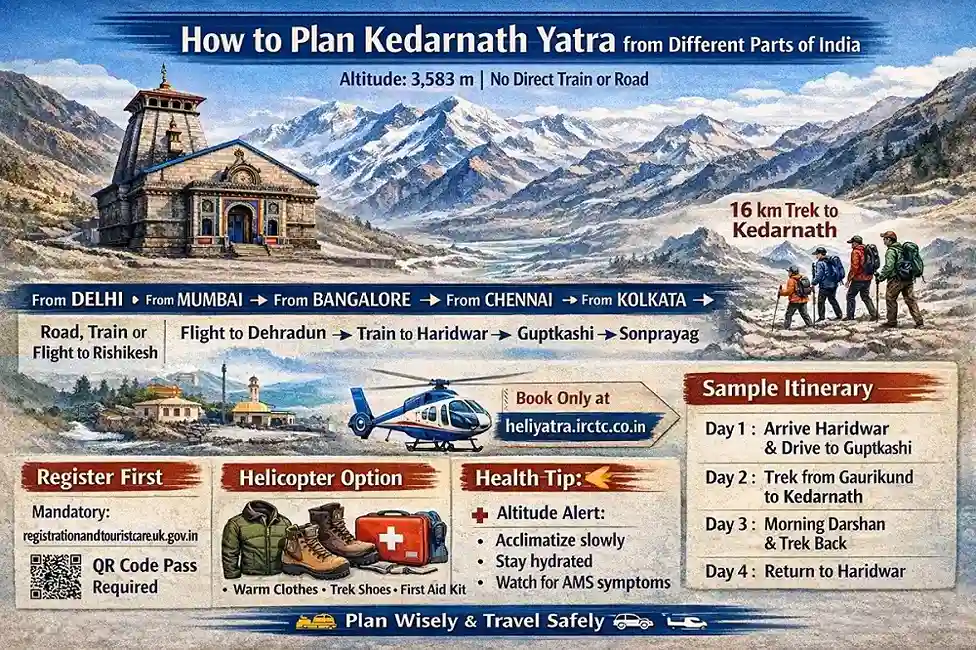
Every year, crores of devotees ask one question before everything else: how do I actually get to Kedarnath? The temple sits at 3,583 metres in the Rudraprayag district of Uttarakhand. No direct train. No direct flight. No road beyond Gaurikund. The journey demands planning — and the planning looks very different depending on where in India you’re starting from.
This guide covers everything: the full route from major cities, trek details, helicopter booking, registration, costs, packing, health prep, and a day-by-day itinerary. Verified facts only — no fluff.
Kedarnath at a Glance — Essential Facts First
| Detail | Info |
|---|---|
| Temple Location | Rudraprayag district, Uttarakhand |
| Altitude | 3,583 m (11,755 ft) |
| Dedicated To | Lord Shiva — one of 12 Jyotirlingas |
| 2026 Opening Date | 22 April 2026 |
| Closing Date | ~November 2026 (around Bhai Dooj) |
| Trek Distance | 16 km (one way from Gaurikund) |
| Trek Duration | 6–8 hours (one way) |
| Nearest Railway Station | Rishikesh (~215 km) / Haridwar (~241 km) |
| Nearest Airport | Jolly Grant Airport, Dehradun (~250 km) |
| Last Motorable Point | Sonprayag (private vehicles) / Gaurikund (shared shuttle) |
| Helicopter Booking Portal | heliyatra.irctc.co.in (IRCTC official only) |
| Registration Portal | registrationandtouristcare.uk.gov.in |
The 2013 Kedarnath floods changed everything. Nearly 5,000 lives were lost, partly because there was no reliable count of pilgrims on the route. Since then, Char Dham registration has been mandatory — and it’s now a well-managed, GPS-tracked system that every pilgrim must complete before setting foot on the yatra.
- Suggested to Read: How to Plan Chardham Yatra from Delhi
Complete Your Registration (Do This First, Before Anything Else)
Registration is mandatory. QR scanning happens at checkposts, so without registration you cannot go ahead.
Register at registrationandtouristcare.uk.gov.in or via the Tourist Care Uttarakhand mobile app. It’s free. You get a QR-code pass that must be shown at multiple checkpoints — Sonprayag, Gaurikund, and the temple entry.
What you need:
- Aadhaar card (mandatory from 2026), Voter ID, or Passport
- Mobile number for OTP
- Emergency contact details
- Photo (for offline registration)
More than 1.26 lakh registrations were done on the first day of Char Dham Yatra registration opening on 6 March 2026. Don’t leave this for the last minute. Register at least 2–3 weeks before travel.
How to Reach Kedarnath from Different Cities
The universal gateway to Kedarnath is Haridwar or Rishikesh. Every route from every Indian city eventually passes through one of these two towns. From there, the road goes: Rishikesh → Devprayag → Srinagar (Uttarakhand) → Rudraprayag → Guptkashi → Sonprayag → Gaurikund → 16 km trek → Kedarnath.
Here’s how to reach that gateway from different corners of India:
From Delhi (Distance to Kedarnath: ~470 km)
The most straightforward route in India. Delhi is exceptionally well-connected to the Kedarnath base.
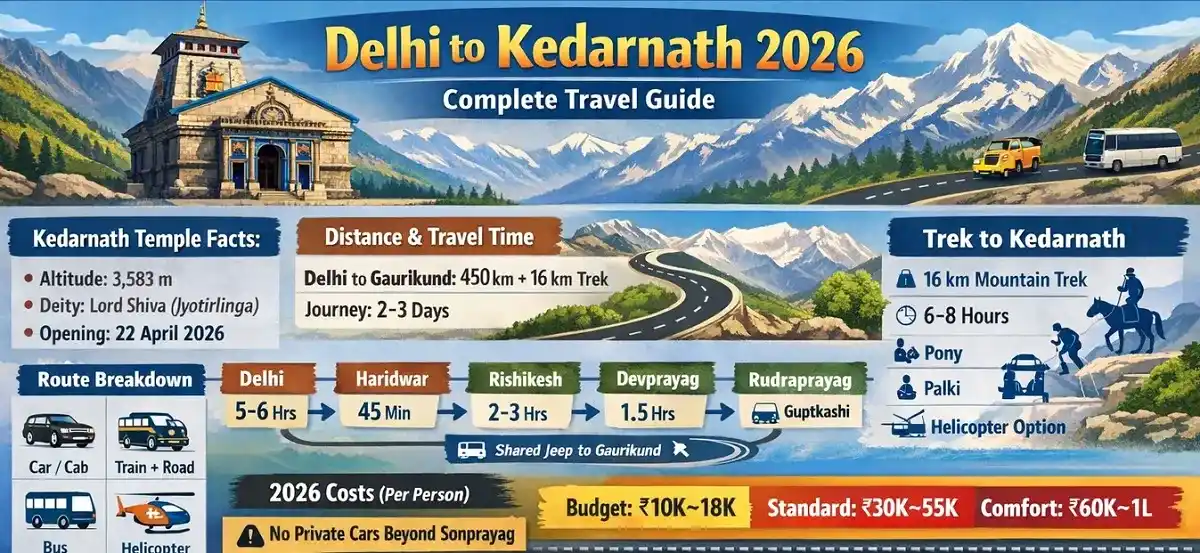
By Road (Best for groups and families): Delhi → Haridwar (~206 km, 5–6 hrs via NH-58) → Rishikesh (+24 km) → Devprayag → Rudraprayag → Guptkashi → Sonprayag → Gaurikund. Total road distance from Delhi to Gaurikund is approximately 450–470 km, taking 10–12 hours. Leave Delhi by 3–4 AM — you’ll clear the city before traffic and reach Guptkashi or Sonprayag by evening.
By Train: The closest railway stations to Kedarnath are Rishikesh (215 km), Haridwar (241 km), Kotdwar (246 km), and Dehradun (257 km). Haridwar Railway Station is generally the most convenient starting point. While Rishikesh is technically closer, Haridwar is a bigger junction with better train frequency. Multiple daily trains from New Delhi to Haridwar — journey ~4.5–5 hours. Then hire a cab or shared taxi from Haridwar to Sonprayag (~6 hrs, ~250 km).
By Air + Road: Fly Delhi to Dehradun (Jolly Grant Airport) — 45–60 minutes, fares from ₹2,500. Then taxi to Guptkashi (~220 km, 5–6 hrs). Or fly + helicopter: land at Dehradun, drive to Phata helipad, take helicopter to Kedarnath.
Recommended 4-Day Delhi Itinerary:
- Day 1: Delhi → Guptkashi (overnight halt)
- Day 2: Guptkashi → Gaurikund → Trek to Kedarnath (overnight at temple)
- Day 3: Morning darshan → trek back → drive to Rishikesh
- Day 4: Return to Delhi
From Mumbai (Distance to Kedarnath: ~1,900 km)
Mumbai pilgrims have two main approaches — fly to Dehradun, or take an overnight train to Haridwar and continue by road.
By Flight (Fastest): Jolly Grant Airport is well connected to major cities such as Delhi, Mumbai, Bangalore, Chennai, Kolkata and Lucknow. Individuals may select from the following carriers — IndiGo, SpiceJet and Air India. Mumbai → Dehradun flight takes ~2 hours; fares typically ₹4,000–₹9,000. From Jolly Grant, road to Guptkashi takes 5–6 hours. This is the fastest door-to-base route from Mumbai.
By Train: Several trains connect Mumbai to Haridwar — Haridwar Express, Yoga Nagri Express. Journey is ~24–28 hours. Comfortable for budget travellers or those who prefer overnight travel. From Haridwar, road to Gaurikund takes another 8–9 hours.
Recommended Route: Mumbai → Fly to Dehradun → Road to Guptkashi → Trek/Helicopter to Kedarnath. Plan 5–6 days minimum for a comfortable yatra with no rush.
From Bangalore (Distance to Kedarnath: ~2,400 km)
By Flight (Strongly Recommended): Bangalore to Dehradun has direct flights (~2.5–3 hours, fares ₹4,000–₹12,000). This is the most practical option from Bangalore given the distance. From Dehradun, road journey to Gaurikund takes 8–10 hours via Haridwar and Rishikesh.
By Train: Bangalore to Haridwar by train is ~45–50 hours. Trains like the Dehradun Express or connections via Delhi are available. It’s a very long journey — most travellers from Bangalore prefer flying.
Practical tip: Fly into Dehradun, spend Day 1 in Rishikesh for acclimatization, drive to Guptkashi on Day 2, trek Kedarnath on Day 3–4. Return via same route.
From Chennai (Distance to Kedarnath: ~2,500 km)
By Flight: Chennai to Dehradun — direct or via Delhi. IndiGo, Air India, and SpiceJet operate this route. Flight time is 3–4 hours depending on connection. From Dehradun, the standard road-to-Gaurikund journey applies.
By Train: Chennai to Delhi is ~28 hours (Chennai Central to Hazrat Nizamuddin on several fast trains). From Delhi, onward to Haridwar by train (~4.5 hrs) then road to Gaurikund. This two-train combination works for those avoiding flights, but takes 40+ hours one way.
Recommended: Fly Chennai → Delhi → Dehradun (or direct Chennai → Dehradun if available). Then road journey. Keep 6–7 days minimum for a comfortable yatra.
From Kolkata (Distance to Kedarnath: ~1,600 km)
Kolkata has decent train and flight connections to the Kedarnath base.
By Train: Multiple trains from Howrah or Sealdah to Haridwar — Doon Express, Upasana Express. Journey is ~20–24 hours. From Haridwar, road to Gaurikund takes another full day. This two-day approach (train + road) is popular among budget pilgrims from eastern India.
By Flight: Kolkata to Dehradun — direct or via Delhi. Flight time ~2.5–3 hours. IndiGo and Air India cover this route. From Dehradun, standard road route to Gaurikund.
Recommended: For groups, a Kolkata → Haridwar overnight train + Haridwar → Guptkashi private cab is a cost-effective combination that many families from Bengal and Odisha prefer.
From Hyderabad
By Flight: Hyderabad to Dehradun — direct flights available via IndiGo (~2.5 hours). Alternatively, Hyderabad → Delhi → Dehradun. From Jolly Grant Airport, taxi to Guptkashi or Haridwar.
By Train: Hyderabad to Haridwar by train is 30–36 hours. Multiple connection options via Delhi. Budget-friendly but time-consuming — fly if you can.
The Road Route to Kedarnath (From Haridwar/Rishikesh Onwards)
Once you reach Haridwar or Rishikesh, the route is the same for everyone:
Haridwar → Rishikesh → Devprayag → Srinagar → Rudraprayag → Agastmuni → Guptkashi → Sonprayag → Gaurikund → 16 km trek → Kedarnath
| Segment | Distance | Time |
|---|---|---|
| Haridwar → Rishikesh | 24 km | 45 min |
| Rishikesh → Rudraprayag | 141 km | 4–5 hrs |
| Rudraprayag → Guptkashi | 58 km | 2 hrs |
| Guptkashi → Sonprayag | 25 km | 1 hr |
| Sonprayag → Gaurikund (shuttle) | 5 km | 20 min |
| Gaurikund → Kedarnath (trek) | 16 km | 6–8 hrs |
Important: All private vehicles must stop at Sonprayag — no private cars or taxis are permitted beyond this point during the Yatra season. From Sonprayag, only government-authorized shuttles and shared jeeps cover the final 5 km stretch to Gaurikund. Park at Sonprayag, take the government shuttle.
The Kedarnath Trek
The Kedarnath trek distance is approximately 16 kilometers one way, starting from Gaurikund, the last motorable point. The trek begins at Gaurikund and passes through important halting points such as Jungle Chatti, Bheem Bali, Linchauli, and Kedarnath Base Camp. The entire route is well-marked and maintained by local authorities, especially during the yatra season.
The trek is categorised as moderate — stone-paved for large sections, consistent uphill gradient, high-altitude air. Don’t underestimate it. 16 km uphill with an altitude gain of ~1,600 metres on thin air is harder than 16 km at sea level.
Key halting points with facilities:
| Stop | Distance from Gaurikund | Facilities |
|---|---|---|
| Jungle Chatti | 4 km | Tea stalls, basic food, rest area |
| Bheem Bali | 7.5 km | Hotels, food, medical camp |
| Rambara | ~9 km | Rest area (bridge crossing point) |
| Linchauli / Lincholi | 12 km | Rest area, tea stalls |
| Kedarnath Base Camp | 16 km | Hotels, GMVN camps, temple |
Best time to start: 4–6 AM. Reasons — avoid afternoon cloud buildup, finish the ascent before midday heat, and reach darshan queues early. Night trekking is not allowed. Cut-off for climbing is approximately 5 PM.
Non-trekking options:
- Pony / Mule: ₹3,000–₹5,000 one way. Book at Gaurikund counter — arrive early, queues form quickly.
- Palki / Doli (hand-carried palanquin): ₹8,000–₹15,000 one way. Best for elderly or physically restricted pilgrims.
- Helicopter: The fastest way. More on this below.
Helicopter Booking for Kedarnath
For senior citizens, physically challenged pilgrims, or anyone with time constraints, the helicopter converts an 8-hour trek into a 7–10 minute flight. But the booking process has strict rules — and fake sites are everywhere.
The only official booking portal: heliyatra.irctc.co.in
If you search “Kedarnath helicopter booking”, you’ll find 50 fake sites. Fraud is extremely high — the government recently blocked 100+ fake portals. Kedarnath registration FIRST, then helicopter booking SECOND. Without Yatra registration, helicopter booking is impossible.
2026 Helicopter Booking Key Facts:
Helicopter ticket bookings opened on 11th April 2026, at 12:00 noon for journeys from 22nd April to 15th June 2026. Char Dham and Hemkund Sahib Yatra Registration is mandatory for booking helicopter services.
Helipad options and 2026 approximate fares (round trip):
| Helipad | Flight Time to Kedarnath | Approx Round Trip Fare |
|---|---|---|
| Sirsi | ~11 minutes | ₹6,086 (most economical) |
| Phata | ~9 minutes | ₹9,680 |
| Guptkashi | ~15 minutes | ₹12,154 |
Sirsi fare was reduced significantly (earlier around ₹8,839 to now ₹6,086), making it the most budget-friendly helipad for pilgrims. Phata fare increased. This shift is designed to balance passenger traffic across different helipads.
Rules that matter:
- Maximum 6 seats per booking ID; up to 12 for group bookings
- 80 kg per passenger weight limit including baggage — strictly enforced
- Arrive at helipad at least 1 hour before slot time
- Carry physical printed ticket — digital screenshots are NOT accepted
- Weather cancellations are common — always keep a buffer day
Booking process (step by step):
- Complete Char Dham Yatra registration at registrationandtouristcare.uk.gov.in
- Generate your Group ID (match the exact helicopter travel date — wrong date = booking failure)
- Create account on heliyatra.irctc.co.in using your registered mobile number
- Enter Group ID or Yatra Registration Number
- Select helipad, date, and time slot
- Complete payment via IRCTC-approved gateway
- Download ticket — print it before travel
Accommodation Along the Route
Book early. May–June darshan season sees full occupancy across the route weeks in advance.
| Location | Options | Price Range |
|---|---|---|
| Haridwar | Hotels, ashrams | ₹600–₹5,000/night |
| Rishikesh | Hotels, ashrams, guesthouses | ₹700–₹6,000/night |
| Guptkashi | Hotels (good base for helicopter pilgrims) | ₹800–₹4,000/night |
| Sonprayag | Basic guesthouses, lodges | ₹500–₹2,500/night |
| Kedarnath (at top) | GMVN tented camps, basic lodges | ₹500–₹2,000/night |
GMVN guesthouses are government-run, reliable, and bookable online at gmvnonline.com. Kedarnath accommodation fills in hours after opening — book on GMVN the moment their seasonal bookings start.
Best Time to Visit Kedarnath
| Season | Months | Conditions | Verdict |
|---|---|---|---|
| Opening Season | Late April–May | Cool, some snow, fresh | Good — temple just opened |
| Peak Season | May–June | Warm, clear roads, maximum crowd | Best weather, most crowded |
| Monsoon | July–August | Landslide risk, slippery roads | Risky — avoid if possible |
| Post-Monsoon | September–October | Clear sky, fewer pilgrims, cool nights | Best overall experience |
| Pre-Closing | October–November | Very cold, temple closes | Last chance — plan carefully |
Day-by-Day Itinerary — 5 Days (Haridwar Base)
| Day | Segment | Stay |
|---|---|---|
| Day 1 | Arrive Haridwar. Evening Ganga Aarti at Har Ki Pauri | Haridwar |
| Day 2 | Drive Haridwar → Guptkashi (220 km, ~7–8 hrs) | Guptkashi |
| Day 3 | Drive to Sonprayag → shuttle to Gaurikund → Trek to Kedarnath | Kedarnath |
| Day 4 | Early morning darshan at Kedarnath Temple → trek back → drive to Guptkashi/Rishikesh | Rishikesh or Guptkashi |
| Day 5 | Return to Haridwar / onward journey home | — |
Add Day 6 as buffer — weather and pilgrim quotas can delay plans unexpectedly.
Packing Checklist — What to Actually Carry
The Kedarnath trek is not a casual walk. Pack thoughtfully.
Clothing:
- Heavy down jacket or fleece (mandatory — even June nights drop below 5°C at Kedarnath)
- Thermal innerwear (top and bottom)
- Waterproof rain jacket or poncho
- 2–3 moisture-wicking T-shirts, 2 trek pants
- Warm socks (2–3 pairs), gloves, wool cap
Footwear:
- Trekking shoes with ankle support and rubber sole grip — not sports shoes, not sandals
- Light flip-flops for resting
Health Essentials:
- Personal medications + basic first aid kit
- Diamox (acetazolamide) for altitude — consult your doctor before the trip
- Sunscreen SPF 50+, UV sunglasses, lip balm
- ORS sachets, electrolyte powder
- Oxygen spray / portable inhaler if recommended by doctor
Documents:
- Printed Yatra registration letter (QR code)
- Original government ID (Aadhaar / Passport / Voter ID)
- Helicopter ticket (printed, not digital)
- Health insurance / emergency contact card
Other Must-Carries:
- Power bank — charging points are scarce at Kedarnath
- Offline downloaded maps (phone signal fails above Sonprayag)
- Sufficient cash — ATMs are unreliable beyond Guptkashi
- Energy bars, dry fruits, glucose biscuits for trek day
- Reusable water bottle (plastic is restricted near the shrine)
- Headlamp with spare batteries (for early 4 AM trek starts)
Health & Safety — Non-Negotiable
The single biggest reason pilgrims face medical emergencies on this yatra is altitude — not fitness. You jump from 300 metres (Delhi) to 3,583 metres (Kedarnath) within 2 days. That’s a serious altitude gain, and your body needs time.
AMS (Acute Mountain Sickness) — Warning Signs:
- Persistent headache not relieved by water or rest
- Nausea, vomiting, or loss of appetite
- Shortness of breath at rest
- Dizziness or feeling disoriented
If symptoms appear — descend immediately. Do not push forward.
Medical aid camps and emergency services are available at key stops such as Jungle Chatti, Bheembali, Rambara, and Lincholi during the yatra season.
People with severe heart conditions, uncontrolled asthma, serious knee problems, or recent major surgeries should avoid attempting the Kedarnath trek without medical consultation.
Emergency Helpline: 1364 / 0135-1364 (Uttarakhand Yatra Control Room)
FAQs
1. What is the Kedarnath temple opening date in 2026?
22 April 2026. The announcement was made on Maha Shivratri by the Badrinath-Kedarnath Temple Committee (BKTC).
2. Is Kedarnath registration mandatory?
Yes. You cannot enter the temple precinct without a valid Char Dham Yatra registration. Register free at registrationandtouristcare.uk.gov.in or via the Tourist Care Uttarakhand app.
3. Which is the closest railway station to Kedarnath?
The closest railway stations to Kedarnath are Rishikesh (215 km), Haridwar (241 km), Kotdwar (246 km), and Dehradun (257 km). Haridwar has the best train frequency from major cities.
4. Can I go to Kedarnath without trekking?
Yes — via helicopter from Phata, Sirsi, or Guptkashi helipads. Pony and palki services are also available from Gaurikund. All three alternatives let you reach the temple without the 16 km trek.
5. How do I book a Kedarnath helicopter ticket?
Only through the official IRCTC portal: heliyatra.irctc.co.in. Complete Char Dham registration first, then generate your Group ID, then log into the IRCTC portal to book. The most common reason helicopter bookings fail is an incorrect Group ID. Always generate the Group ID only after finalizing your helicopter travel date — creating it for a different date causes an “Invalid Group ID” error at checkout.
6. How many days are needed for Kedarnath Yatra?
Minimum 4 days from Haridwar (2 days travel, 1 day trek/darshan, 1 day return). Recommended is 5–6 days to allow buffer for weather delays and recovery.
7. What is the best month to visit Kedarnath?
May–June for pleasant weather and clear roads; September–October for fewer crowds, cleaner skies, and a more peaceful experience. Avoid July–August due to monsoon landslide risk.
8. Can senior citizens do the Kedarnath Yatra?
Thousands of senior citizens between the age of 60–85 complete the trek every year. With proper medical assessment and correct assistance, the journey is completely possible. Helicopter, pony, and palki services make it manageable for elderly pilgrims. Get a medical fitness clearance from your doctor before planning.
9. What are the darshan timings at Kedarnath Temple?
General darshan: 7:00 AM onwards. The temple closes midday for a few hours. Morning is the best time — arrive before 7 AM to avoid hours-long queues. VIP darshan slots are also available through official temple booking.
10. Is it safe to visit Kedarnath during monsoon?
It carries higher risk than other seasons. The Rishikesh–Guptkashi road is landslide-prone in July–August. Helicopter services face frequent weather cancellations. If you must travel in monsoon, keep 2–3 extra buffer days and stay updated on Uttarakhand road conditions via the NHAI helpline (1033) and state police updates.
The Kedarnath Yatra is one of those journeys that changes something in you — not always in words, but in feeling. The trek demands something real from your body. The altitude tests your patience. And then you reach the temple, and whatever you came looking for tends to find you first.
Plan it right. Register early. Carry your printed QR pass everywhere. And keep one buffer day — because the mountains operate on their own schedule, not yours.
Suggested Tour: