
Lotus Temple Delhi: Complete 2026 Visitor Guide
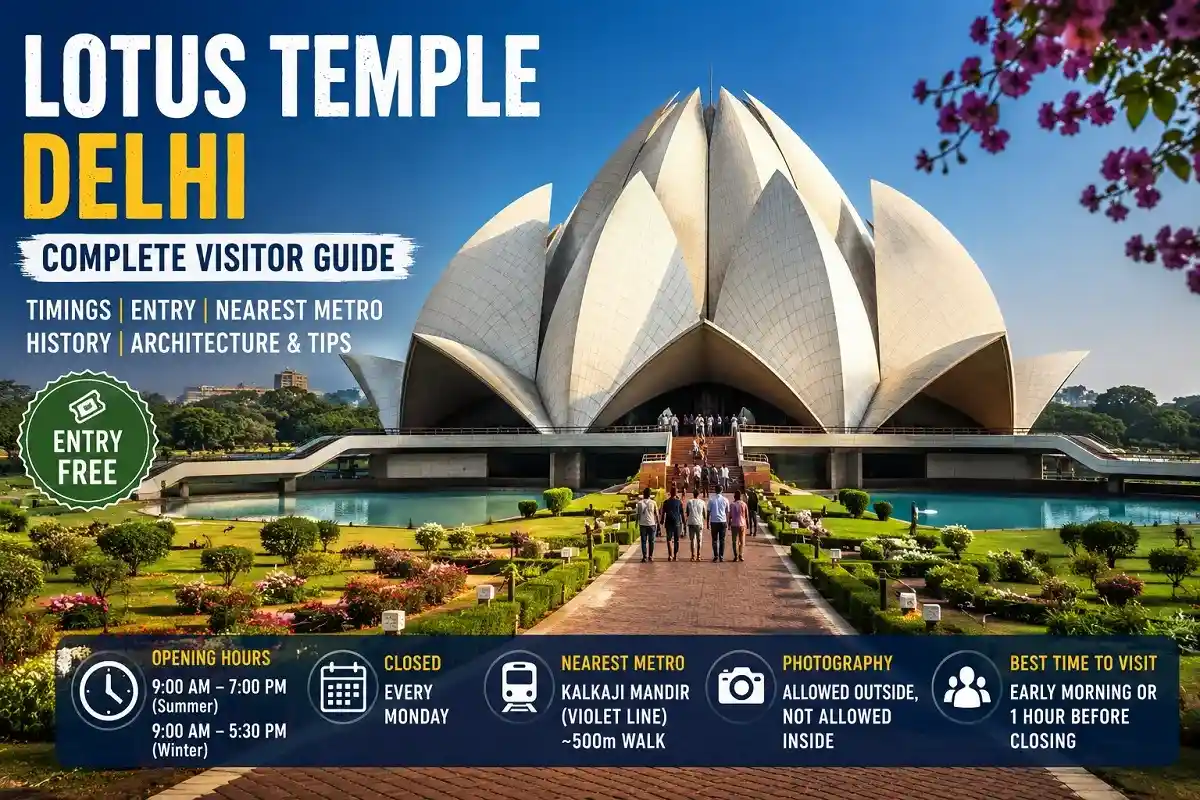
Walk into the Lotus Temple in Delhi and the first thing that hits you isn’t the architecture — it’s the silence. Thousands of people pass through this Bahai House of Worship every single day, and somehow the inside still feels like a library mid-exam. No idols. No sermons. No entry fee. Just 27 white marble petals folded around a hall where you can sit and pray in whatever language or tradition you brought with you.
During a recent visit in early 2026, what stood out most wasn’t the building itself — it was watching a busload of school kids go from running and laughing outside to completely silent the moment they stepped through the entrance. If you’re planning a Lotus Temple visit, here’s what actually matters: it’s completely free, it’s closed every Monday without exception, and the best time to go is either right at opening or in the last hour before closing.
Quick Overview
| Detail | Information |
|---|---|
| Opening Hours (Summer, Apr–Sep) | 9:00 AM – 7:00 PM |
| Opening Hours (Winter, Oct–Mar) | 9:00 AM – 5:30 PM |
| Closed | Every Monday (weekly maintenance day, no exceptions) |
| Entry Fee | Free for everyone — no ticket required |
| Last Entry | 30–45 minutes before closing time |
| Nearest Metro | Kalkaji Mandir (Violet Line) — about 500m walk |
| Photography | Allowed outside (gardens, pools); not allowed inside the prayer hall |
| Prayer Sessions | Conducted multiple times daily — verify exact timings on arrival, as schedules can shift seasonally |
| Avg. Visit Duration | 1–2 hours |
One thing worth flagging upfront: timings can shift slightly around Bahai holy days or special maintenance closures. If you’re travelling from outside Delhi specifically for this, a quick check on the day before your visit saves a wasted trip.
What People Actually Ask
Is Lotus Temple worth visiting?
Yes. It’s free, architecturally significant, and one of the few Delhi attractions built around genuine quiet rather than crowds and sales pitches. Most visitors call it one of the more memorable stops on their Delhi trip.
How much time is needed at Lotus Temple?
Budget 1 to 2 hours — about 10–15 minutes inside the prayer hall, plus time walking the gardens and nine reflecting pools surrounding the structure.
Can tourists enter Lotus Temple?
Yes, absolutely. Tourists, pilgrims, and locals of any religion or none are equally welcome. There’s no entry restriction based on nationality, faith, or background.
What Is the Lotus Temple?
The Lotus Temple is officially the Bahai House of Worship of New Delhi — the Continental House of Worship for Asia. It’s not a Hindu temple despite the name — it belongs to the Bahai Faith, a religion founded in 19th-century Persia that centers on the idea that all major religions share one spiritual source.
That belief shapes everything about the building. There’s no idol inside. No clergy. No fixed rituals. Anyone — Hindu, Muslim, Christian, Sikh, atheist, doesn’t matter — can walk in, sit on a wooden bench, and pray silently in their own tradition. The temple doesn’t ask anything of you except quiet.
Why It’s Called the Lotus Temple
The building takes the shape of a half-opened lotus flower, India’s most recognized symbol of purity across Hinduism, Buddhism, Jainism, and Islam alike. Architect Fariborz Sahba chose this form deliberately — a flower that rises clean out of muddy water, mirroring the Bahai idea of spiritual unity rising above religious division. It’s also informally called Kamal Mandir by locals.
Lotus Temple History: From Concept to Construction
Iranian-Canadian architect Fariborz Sahba was approached in 1976 to design the temple. He spent months travelling across India studying temple architecture before settling on the lotus concept. Structural engineering was handled by the British firm Flint and Neill, with construction involving a team of around 800 engineers, technicians, and artisans over roughly a decade.
The ECC Construction Group of Larsen & Toubro completed the build in 1986 at a verified cost of $10.56 million. The temple was consecrated on 24 December 1986 and opened to the public on 1 January 1987. CNN referred to it as the most visited building in the world in a widely cited 2001 report — cumulative visitor estimates have ranged from around 70 million by 2001 to over 100 million by April 2014, according to Government of India figures.
Key Historical Milestones
- 1976 — Fariborz Sahba commissioned to design the temple
- 1976–1986 — Design and construction, including 18 months of structural engineering by Flint and Neill
- November 1986 — Construction completed
- 24 December 1986 — Temple consecrated and formally dedicated
- 1 January 1987 — Opened to the general public
- 1987 — Won the Institution of Structural Engineers award (UK) for religious architecture
- 2001 — CNN report names it the world’s most visited building
- 2017 — Education Centre added to the temple complex
Is Lotus Temple the Only Bahai Temple in Asia?
This is a common misconception worth clearing up directly: no, Lotus Temple is not the only Bahai House of Worship in Asia anymore. It is the Continental House of Worship for Asia — the senior, original temple for the continent, completed in 1986.
Since then, the Bahai community has built a local House of Worship in Battambang, Cambodia (dedicated September 2017), and another is under construction in Bihar Sharif, India, expected for completion in the mid-2020s. Lotus Temple remains the largest, oldest, and most architecturally significant Bahai temple in Asia — just not the literal only one anymore.
Lotus Temple Architecture: The Numbers Behind the Design
This is where the Lotus Temple earns its reputation as an engineering marvel, not just a pretty building. Everything is built around the number nine — sacred in the Bahai Faith — and the math behind it is genuinely impressive.
| Feature | Detail |
|---|---|
| Total Petals | 27 free-standing marble-clad petals |
| Arrangement | Grouped in clusters of 3 to form 9 sides; 3 concentric rings of 9 petals each |
| Entrances | 9 doors opening into the central prayer hall, each across a small reflecting pool |
| Interior Leaf Height | 34.3 metres above the interior platform (precise architectural measurement) |
| Central Dome Height (ground level) | Commonly cited as ~40 metres — measured from outer ground level, which is why this figure differs from the 34.3m interior measurement |
| Diameter | 70 metres (some sources cite up to 74m base diameter) |
| Seating Capacity | 1,300 seated; up to 2,500 people during peak occasions |
| Surrounding Pools | 9 reflecting pools bordered by red sandstone walkways |
| Total Complex Area | Approximately 26 acres (10.5 hectares), including gardens and ancillary buildings |
| Marble Source | Penteli mountain, Greece — the same source used for the Parthenon |
| Construction Cost | $10.56 million (verified structural engineering records) |
| Power Source | Partly solar-powered for its facilities — commonly cited as among the early adopters of solar energy among Delhi’s major public buildings |
What most people don’t realize when they’re standing in the central hall is that there are zero pillars holding up that ceiling visually — the petal structure itself is the load-bearing system, with nine arches spreading the entire structural weight around the hall. No statues, no altar, no pulpit. Bahai scripture specifically prohibits these inside a House of Worship.
Visitor Rules at Lotus Temple
The Lotus Temple maintains a fairly simple but firmly enforced set of rules to protect the quiet, devotional atmosphere inside and around the building.
- Mobile phones must be switched to silent mode before entering the complex
- Bags are checked at the entrance as a standard security measure
- Drones are strictly prohibited anywhere on the temple grounds
- Smoking is not permitted anywhere within the complex
- Food and drinks are not allowed inside the prayer hall or immediate temple grounds
- Loud conversations, phone calls, and music are discouraged throughout the gardens, and strictly not allowed inside the hall
- Children are welcome but are expected to stay quiet once inside the prayer hall
Accessibility at Lotus Temple
The Lotus Temple complex is reasonably accessible for visitors with mobility needs, though the terrain does involve some walking distance from the entrance gate to the main structure.
- Wheelchair access is available along the main approach pathways to the temple
- Pathways around the gardens and pools are paved and relatively flat, suitable for elderly visitors
- Accessible toilet facilities are available near the visitor amenities area
- Wheelchairs can be requested at the entrance for visitors who need them
- Staff and volunteers are generally helpful in assisting elderly or mobility-impaired visitors through the queue process
What Visiting Actually Feels Like
On the ground, the experience splits into two parts: outside and inside. Outside, you walk along the red sandstone paths between the nine reflecting pools, and the petal structure genuinely does look like it’s floating on water from certain angles — this is by design, not an accident of lighting.
Inside is different. You queue briefly at one of the nine entrances, and a volunteer gives a short, low-key introduction about the Bahai Faith before you’re guided in. Once you’re seated, the rule is simple: silence. Even at peak crowd times — and Lotus Temple gets genuinely crowded on weekends — that silence holds.
Prayer sessions are conducted multiple times daily, with scripture readings from different faiths during each roughly 15-minute window. Exact timings can shift seasonally, so it’s worth checking the schedule board at the entrance rather than relying on a fixed time from an old blog post. Most visitors spend 10–15 minutes inside the hall itself, then another 30–45 minutes walking the gardens outside.
Best Time to Visit Lotus Temple
| Time Slot | Crowd Level | Why |
|---|---|---|
| 9:00 – 10:30 AM | Lowest | Fewest visitors; best for a peaceful, unhurried experience |
| 11:00 AM – 3:00 PM | Highest | Peak tourist hours, especially weekends and school holidays |
| 4:00 – 5:30 PM (winter close) | Moderate, dropping | Golden hour light on the marble; cooler temperatures |
| 6:00 – 7:00 PM (summer close) | Low, dropping | Sunset lighting; pleasant temperature after Delhi’s daytime heat |
October to March is the ideal season overall — Delhi’s temperature sits comfortably between 10°C and 25°C, which makes walking the gardens genuinely enjoyable instead of something you rush through. If visiting in peak summer (April–June), go early morning or close to closing time; midday heat regularly crosses 40°C.
How to Reach Lotus Temple: Metro, Bus and Road
Lotus Temple sits in South Delhi, near Nehru Place, in the Bahapur/Kalkaji area. Getting there is straightforward regardless of which part of Delhi or NCR you’re coming from.
By Metro (Recommended)
Kalkaji Mandir Metro Station on the Violet Line is the closest stop — roughly a 500-metre walk from the temple entrance. This is by far the easiest and most reliable way to get there, especially during Delhi’s unpredictable traffic hours.
By Bus and Road
- 8–10 DTC bus routes pass near the temple — check the route number for your specific origin point
- By car or taxi: well-connected via the Outer Ring Road and Nehru Place; parking is available at the temple complex
- From Indira Gandhi International Airport: approximately 15.5 km, roughly 30–45 minutes by road depending on traffic
- From New Delhi Railway Station: approximately 15 km, around 30–40 minutes by road or a metro connection via the Violet Line interchange
Lotus Temple Location and Address
| Detail | Information |
|---|---|
| Full Address | Lotus Temple Road, Shambhu Dayal Bagh, Bahapur, Kalkaji, New Delhi, Delhi 110019 |
| Area | South Delhi, near Nehru Place |
| Coordinates (approx.) | 28.5535° N, 77.2588° E |
| Nearest Metro | Kalkaji Mandir Station, Violet Line (~500m) |
| Nearest Landmark | Directly opposite Kalkaji Mandir Temple |
Nearby Attractions: Distance Table
| Attraction | Approx. Distance from Lotus Temple | Travel Time |
|---|---|---|
| Kalkaji Mandir | 0.3 km (walking distance, directly opposite) | 5 minutes walk |
| Nehru Place Market | 1.5 km | 5–10 min by auto/cab |
| ISKCON Temple Delhi | 3 km | 10–15 min by cab |
| Humayun’s Tomb | 7 km | 20–25 min by cab/metro |
| India Gate | 12 km | 30–35 min by cab/metro |
| Qutub Minar | 13 km | 30–35 min by cab/metro |
| Akshardham Temple | 14 km | 35–40 min by cab |
If you’re building a full day around South Delhi sightseeing, pairing Lotus Temple with Kalkaji Mandir and ISKCON in the morning, then moving toward Humayun’s Tomb or Qutub Minar in the afternoon, works well logistically — all are reasonably connected by metro or a short cab ride.
Common Mistakes Visitors Make
- Showing up on a Monday — the temple is closed every Monday for maintenance, no exceptions. Plan around this before booking other activities for that day.
- Expecting to photograph inside the prayer hall — photography is not permitted once inside. Get your shots of the petals and pools from outside instead.
- Arriving right at closing time — last entry is cut off 30–45 minutes before the gates close.
- Treating it like a typical sightseeing stop — loud conversations and casual chatter inside the hall are genuinely discouraged; people are actually praying.
- Skipping the gardens — a lot of visitors rush in, see the hall, and leave. The nine pools and landscaped grounds are part of the experience.
- Assuming the temple height figure online is wrong — you’ll see both 34.3m and 40m quoted. Both are technically correct; they’re measuring from different reference points.
- Assuming Lotus Temple is the only Bahai temple in Asia — it’s the Continental House of Worship for Asia, but a local temple now exists in Battambang, Cambodia, and another is under construction in Bihar Sharif, India.
Pro Tips for a Better Visit
- Visit on a weekday if your schedule allows — weekends (especially Sunday) see noticeably heavier crowds than Tuesday through Friday.
- Wear comfortable shoes — you’ll be walking on stone pathways and stairs, with a fair amount of standing in the entry queue during busy hours.
- Carry water, especially in summer — there’s limited shade once you’re past the entrance gardens.
- Pair this with other South Delhi sights either first thing in the morning or as your last stop — it fits awkwardly into a packed midday itinerary given the silence requirement.
- The Information Centre near the entrance has free brochures on Bahai teachings if you want context before going in.
- Check the prayer session schedule board at the entrance rather than assuming fixed timings — these can shift seasonally.
Why the Lotus Temple Is Worth Your Time
Delhi has no shortage of monuments competing for your itinerary, and most come with entry fees, long queues, and souvenir hawkers at the gate. Lotus Temple offers something genuinely different: zero cost, genuinely impressive architecture that’s earned real international recognition, and an experience that’s actually about stillness rather than ticking a box.
It’s also one of the few Delhi attractions that works equally well for a religious visitor, an architecture enthusiast, a family with kids, or someone who just wants 90 minutes of quiet in a city that rarely offers it.
FAQs
Q1. What are the Lotus Temple Delhi timings in 2026?
Summer (April–September): 9 AM to 7 PM. Winter (October–March): 9 AM to 5:30 PM. Closed every Monday for maintenance, no exceptions.
Q2. Is there an entry fee for Lotus Temple?
No. Entry is completely free for everyone, regardless of nationality or religion. No ticket counter, no booking needed for individuals.
Q3. Why is Lotus Temple closed on Mondays?
Monday is the designated weekly maintenance day for cleaning the temple, gardens, and surrounding pools. This applies every week without exception.
Q4. How many petals does the Lotus Temple have?
27 free-standing marble-clad petals, arranged in clusters of three to form nine sides — reflecting the Bahai Faith’s significance of the number nine.
Q5. Who built the Lotus Temple?
Iranian-Canadian architect Fariborz Sahba designed it, commissioned in 1976. Structural engineering was by Flint and Neill (UK); construction was carried out by L&T’s ECC group, finishing in 1986.
Q6. What is the nearest metro station to Lotus Temple?
Kalkaji Mandir Metro Station, Violet Line, about a 500-metre walk from the temple entrance — the easiest way to reach it from anywhere in Delhi.
Q7. Can tourists enter the Lotus Temple?
Yes. Tourists and people of every faith or background are equally welcome to visit, sit inside the hall, and pray silently in their own tradition.
Q8. Is photography allowed inside the Lotus Temple?
Not inside the main prayer hall. The gardens, the nine reflecting pools, and the exterior petal structure are fully permitted photography spots.
Q9. How much time is needed to visit Lotus Temple?
Most visitors spend 1 to 2 hours total — around 10–15 minutes inside the prayer hall, plus time walking the gardens and surrounding grounds.
Q10. What is the height of the Lotus Temple?
The interior leaves rise 34.3 metres above the inner platform. The central dome is commonly cited as ~40 metres from outer ground level — both figures are correct depending on the reference point.
Q11. Why is Lotus Temple famous?
It’s famous for its lotus-shaped marble architecture, its message of religious unity with no idols or rituals, and its status as one of the world’s most visited buildings, drawing thousands of visitors daily.
Q12. What religion is the Lotus Temple?
It belongs to the Bahai Faith, a religion founded in 19th-century Persia. It is not Hindu, despite the lotus name — it’s open to people of every religion equally.
Q13. Is Lotus Temple the only Bahai temple in Asia?
No. It’s the Continental House of Worship for Asia, but a local Bahai temple now exists in Battambang, Cambodia (since 2017), with another under construction in Bihar Sharif, India.
Q14. Is Lotus Temple wheelchair accessible?
Yes, largely. Main pathways to the temple are wheelchair accessible, the grounds are mostly flat and paved, and wheelchairs can be requested at the entrance.
Q15. What’s the best time to visit Lotus Temple Delhi?
Early morning (9–10:30 AM) for the fewest crowds, or the last hour before closing for golden-hour light. October to March offers the most comfortable weather overall.
Conclusion
The Lotus Temple delivers on a rare combination: genuinely significant architecture, zero cost, and an experience built around quiet rather than spectacle. Whether you’re in Delhi for a day or a week, this is one of the easiest additions to any itinerary — free entry, a direct metro connection, and roughly 90 minutes of your time.
Just remember the details that trip up most first-time visitors: it’s closed every Monday, photography stops once you’re inside the prayer hall, and it’s the Continental House of Worship for Asia rather than the literal only Bahai temple on the continent. Plan around those details, go early morning or close to sunset, and the Lotus Temple Delhi visit will likely end up being one of the more memorable stops on your trip — not because of what you see, but because of how it makes you feel once you’re sitting inside this Bahai House of Worship.
- Also Reads on: Akshardham Temple Delhi