Top UNESCO World Heritage Sites in Delhi: Complete Visitor Guide
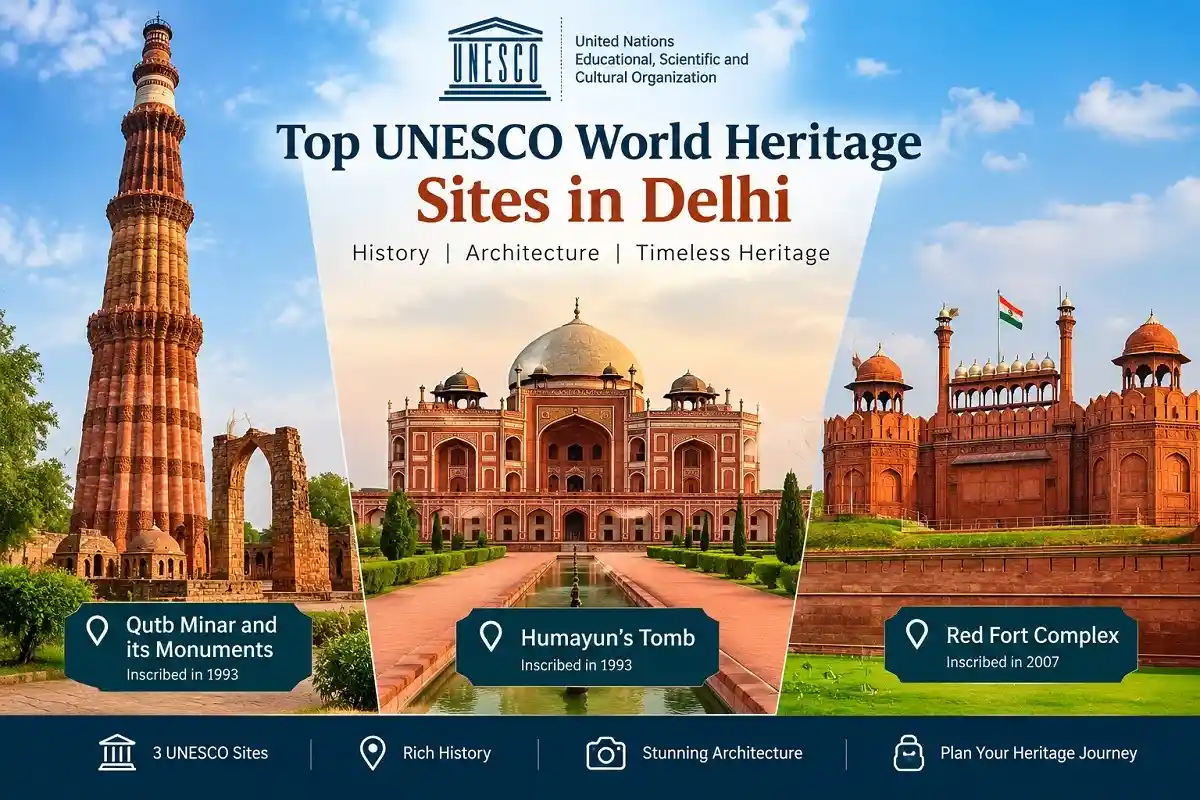
Delhi is one of India’s most important heritage destinations, with monuments representing different phases of the city’s long history. Among them, three properties are included on the UNESCO World Heritage List: Qutb Minar and its Monuments, Humayun’s Tomb, Delhi, and the Red Fort Complex. Qutb Minar and Humayun’s Tomb were inscribed in 1993, while the Red Fort Complex was added in 2007.
These three UNESCO properties also represent different stages of Delhi’s architectural history—from the early development of Indo-Islamic architecture to the refinement of Mughal garden-tomb design and the grand palace-fort architecture of Shah Jahan.
If you are planning a Delhi heritage tour, visiting all three can provide a useful overview of the city’s medieval and Mughal architectural legacy.
How Many UNESCO World Heritage Sites Are There in Delhi?
Delhi has three UNESCO World Heritage properties:
- Qutb Minar and its Monuments — inscribed in 1993
- Humayun’s Tomb, Delhi — inscribed in 1993
- Red Fort Complex — inscribed in 2007
The formal UNESCO names are worth noting because the World Heritage designation covers more than just the most famous structure at each location. For example, the UNESCO property is officially called Qutb Minar and its Monuments, while the Red Fort listing is the Red Fort Complex.
1. Qutb Minar and Its Monuments
Located in Mehrauli in southern Delhi, Qutb Minar is one of the city’s most recognizable historic landmarks. UNESCO describes the property as an archaeological ensemble containing the Qutb Minar and several other monuments associated with the development of early Islamic architecture in the Indian subcontinent. It was inscribed on the UNESCO World Heritage List in 1993 under criterion (iv).
The red sandstone tower stands 72.5 metres high. This figure refers to the monument’s height, not its altitude above sea level. UNESCO also records its diameter as approximately 14.32 metres at the base and 2.75 metres near the top.
The surrounding complex includes important structures such as the Quwwatu’l-Islam Mosque, Alai Darwaza, Iltutmish’s Tomb and the Iron Pillar. Alai Darwaza, built in 1311, is particularly significant in the architectural history of the complex.
Why Is Qutb Minar a UNESCO World Heritage Property?
The importance of the property goes beyond the tower itself. UNESCO considers the ensemble of mosques, minars and other structures an important testimony to the architectural and artistic achievements associated with the establishment of Islamic rule in the Indian subcontinent. The complex also illustrates the interaction of different architectural traditions and building practices.
What to See at Qutb Minar
Allow enough time to explore the wider archaeological complex rather than photographing only the tower. Key attractions include:
- Qutb Minar
- Quwwatu’l-Islam Mosque
- Alai Darwaza
- Iron Pillar
- Tomb of Iltutmish
- Alai Minar
The site is best approached as a heritage complex rather than as a single monument.
2. Humayun’s Tomb, Delhi
Humayun’s Tomb in the Nizamuddin area is one of the most influential monuments in the history of Mughal architecture. UNESCO inscribed it as a World Heritage property in 1993 under criteria (ii) and (iv).
UNESCO describes the monument as the first garden-tomb on the Indian subcontinent. The tomb was built in the 16th century with the patronage of Humayun’s son, Emperor Akbar, and represents an important stage in the development of Mughal garden-tomb architecture.
The complex covers approximately 27.04 hectares and contains several other historic structures, including Isa Khan’s Tomb, Nila Gumbad, Bu Halima, Afsarwala, Barber’s Tomb and Arab Serai.
The main mausoleum stands on a large platform and is distinguished by its garden setting, geometric planning, red sandstone surfaces and white and black marble detailing. UNESCO records the double dome as approximately 42.5 metres high.
Why Is Humayun’s Tomb Important?
Its significance lies particularly in its combination of monumental architecture and the charbagh garden concept. The design influenced later Mughal architecture, with UNESCO specifically noting its role in the architectural developments that eventually culminated in the Taj Mahal.
For visitors interested in Mughal architecture, the site is especially useful because the experience is not limited to the central tomb. The surrounding garden and associated monuments help explain how Mughal funerary architecture developed over time.
Practical Planning
Humayun’s Tomb involves considerable outdoor walking through the gardens and adjoining monuments. Comfortable footwear, drinking water and protection from strong sun are useful, particularly during Delhi’s hotter months.
Delhi Tourism currently lists the monument as open from sunrise to 7:30 PM, with Jangpura among the nearest Metro options. Because opening arrangements and ticket prices can change, visitors should verify current information before travelling.
3. Red Fort Complex
The Red Fort Complex represents another major stage in Delhi’s Mughal history. It was built as the palace-fort of Shahjahanabad, the new capital established by Mughal emperor Shah Jahan. UNESCO added the property to the World Heritage List in 2007 under criteria (ii), (iii) and (vi).
One important point is that the UNESCO property is officially called the Red Fort Complex, rather than simply the Red Fort. The complex is linked with the older Salimgarh Fort, built by Islam Shah Suri in 1546. UNESCO considers the two together as the Red Fort Complex.
The palace area contains a series of pavilions connected by the Nahr-i-Behisht, or Stream of Paradise. Its architecture combines Islamic planning with Persian, Timurid and Hindu architectural traditions. UNESCO considers this fusion an important part of the property’s Outstanding Universal Value.
Why Is Red Fort a UNESCO World Heritage Property?
The Red Fort demonstrates the refinement reached by Mughal architecture under Shah Jahan. Its planning, buildings and gardens influenced later architecture and garden design in Delhi, Rajasthan, Agra and other regions.
The complex is also significant because of its later history. UNESCO notes its association with British military occupation and its importance in the history of Indian independence. The Red Fort continues to have a strong symbolic connection with India’s national history.
Can You Visit All Three UNESCO Sites in One Day?
Yes, it is possible to plan all three in a single day, but it can become a long sightseeing schedule.
A practical sequence is:
Qutb Minar → Humayun’s Tomb → Red Fort
This route moves broadly from southern Delhi towards central and Old Delhi. However, actual travel time can vary significantly because of traffic, road conditions, entry queues and the time spent at each monument.
For a more relaxed heritage experience, spreading the three sites across two days is a better option, particularly if you want to explore the surrounding monuments rather than rushing between the main attractions.
Suggested One-Day Plan
Start early with Qutb Minar when outdoor conditions are relatively comfortable. Spend enough time exploring the archaeological complex before travelling towards Humayun’s Tomb.
After lunch, visit Humayun’s Tomb and explore its gardens and associated monuments. Later, continue towards the Red Fort area.
The Red Fort deserves sufficient time because the complex contains multiple architectural elements and historical spaces. Reaching it close to closing time can make the visit unnecessarily rushed.
This is a planning framework rather than a fixed travel schedule; Delhi traffic can change journey times considerably.
Best Time to Visit UNESCO World Heritage Sites in Delhi
October to March is generally the more comfortable period for outdoor heritage sightseeing in Delhi because temperatures are usually more suitable for extended walking.
However, winter has its own considerations. Fog can sometimes affect visibility, while winter air pollution can reduce outdoor comfort and photographic clarity. Summer afternoons can be extremely hot, so early-morning visits become more practical.
If visiting during the hotter months, plan outdoor walking for the morning or later afternoon and carry sufficient drinking water.
How to Reach the Three UNESCO Sites
Public transport can be useful when planning a Delhi heritage itinerary.
Qutb Minar: Qutub Minar Metro Station on the Yellow Line is a commonly used Metro option for the monument.
Humayun’s Tomb: Jangpura on the Violet Line is one of the nearest Metro options listed by Delhi Tourism.
Red Fort: Lal Qila Metro Station on the Violet Line provides access to the Red Fort area.
Metro can reduce dependence on road traffic, although the final part of the journey may still involve walking or a short local transfer.
Important Tips Before Visiting
A few simple preparations can make the heritage tour more comfortable.
Wear comfortable footwear: All three destinations involve walking, and the larger complexes can take time to explore.
Carry water: Delhi can become hot, particularly outside the winter season.
Start early: Morning visits are generally more comfortable for outdoor monuments.
Check current ticket information: Entry fees, visitor rules and operational arrangements can change.
Allow security time: Monument entry may involve security checks, particularly at high-profile locations.
Do not plan only around photographs: The UNESCO significance of these properties lies in their architecture, planning, associated structures and historical context.
Respect heritage structures: Do not climb restricted areas, touch fragile architectural surfaces or ignore site regulations.
UNESCO Sites in Delhi: What Makes Them Different?
The three properties should not be treated as identical heritage attractions.
Qutb Minar and its Monuments represents an important phase in the development of Indo-Islamic architecture and the establishment of new architectural forms in the Indian subcontinent.
Humayun’s Tomb is particularly important for the development of Mughal garden-tomb architecture and the monumental charbagh tradition.
Red Fort Complex represents the mature architectural and planning traditions of the Mughal imperial period under Shah Jahan, while also carrying important associations with later British rule and India’s independence history.
Together, they provide a useful architectural timeline for understanding major phases of Delhi’s medieval and early modern heritage.
Frequently Asked Questions
How many UNESCO World Heritage Sites are there in Delhi?
Delhi has three UNESCO World Heritage properties: Qutb Minar and its Monuments, Humayun’s Tomb, Delhi, and the Red Fort Complex.
Which UNESCO site in Delhi was inscribed first?
Qutb Minar and its Monuments and Humayun’s Tomb were both inscribed in 1993. The Red Fort Complex was inscribed later, in 2007.
What is the height of Qutb Minar?
Qutb Minar is 72.5 metres high, according to UNESCO. This is the tower’s height, not its altitude above sea level.
Why is Humayun’s Tomb a UNESCO World Heritage property?
Humayun’s Tomb is significant for its monumental garden-tomb design and its contribution to the development of Mughal architecture. UNESCO identifies it as the first garden-tomb on the Indian subcontinent and notes its influence on later architectural developments.
Is the Red Fort itself the entire UNESCO property?
No. The UNESCO-listed property is the Red Fort Complex, which includes the Red Fort and the historically linked Salimgarh Fort.
Can all three UNESCO sites be visited in one day?
Yes, but it requires an early start and efficient travel planning. A two-day itinerary is more comfortable if you want to explore each complex properly.
What is the best time to visit Delhi’s UNESCO sites?
October to March is generally more comfortable for outdoor sightseeing. Winter fog and air pollution can sometimes affect visibility, while summer heat can make extended walking uncomfortable.
Which site should you visit first?
For a one-day plan, starting with Qutb Minar, followed by Humayun’s Tomb and then the Red Fort, is a practical sequence. Actual travel time will depend on traffic and visitor conditions.
Final Takeaway
Delhi’s three UNESCO World Heritage properties—Qutb Minar and its Monuments, Humayun’s Tomb and the Red Fort Complex—represent different chapters of the city’s architectural and political history.
Qutb Minar introduces visitors to an important early phase of Indo-Islamic architecture. Humayun’s Tomb demonstrates the development of monumental Mughal garden-tomb design, while the Red Fort Complex represents the architectural refinement of the Mughal imperial period under Shah Jahan.
For travellers planning a Delhi heritage tour, these three properties form a strong core itinerary. The best approach is to allow enough time at each site, avoid treating the journey as a rushed checklist, and verify current visitor information before departure.