
Delhi Metro Guide for Tourists 2026
For a visitor trying to cover Old Delhi, Connaught Place, South Delhi and the airport without spending hours in road traffic, the Delhi Metro is one of the most useful transport options in the city. This Delhi Metro guide for tourists covers the information that matters on an actual sightseeing day: current fares, Tourist Cards, airport connections, useful lines, interchange stations, ticket options and the nearest stations for major attractions.
The network is large, but tourists do not need to memorise it. In practice, it is more useful to know your starting station, destination, interchange and correct exit gate.
Current fare and operational information in this guide has been checked against the Delhi Metro Rail Corporation (DMRC). Train timings, services and network details can change, so journeys—especially late-night and airport trips—should be checked again on the day of travel.
Delhi Metro for Tourists: Quick Facts
| Information | Current details |
|---|---|
| Standard fare | ₹11–₹64, Monday to Saturday |
| Sunday/national holiday fare | ₹11–₹54 |
| 1-Day Tourist Card | ₹200 including ₹50 refundable security |
| 3-Day Tourist Card | ₹500 including ₹50 refundable security |
| Airport Terminal 3 | Airport Express Line |
| Airport Terminal 1 | Magenta Line |
| DMRC helpline | 155370 |
| CISF Metro helpline | 155655 |
| Best route check | Official DMRC Journey Planner |
Source: Delhi Metro Rail Corporation (DMRC), checked October 2026.
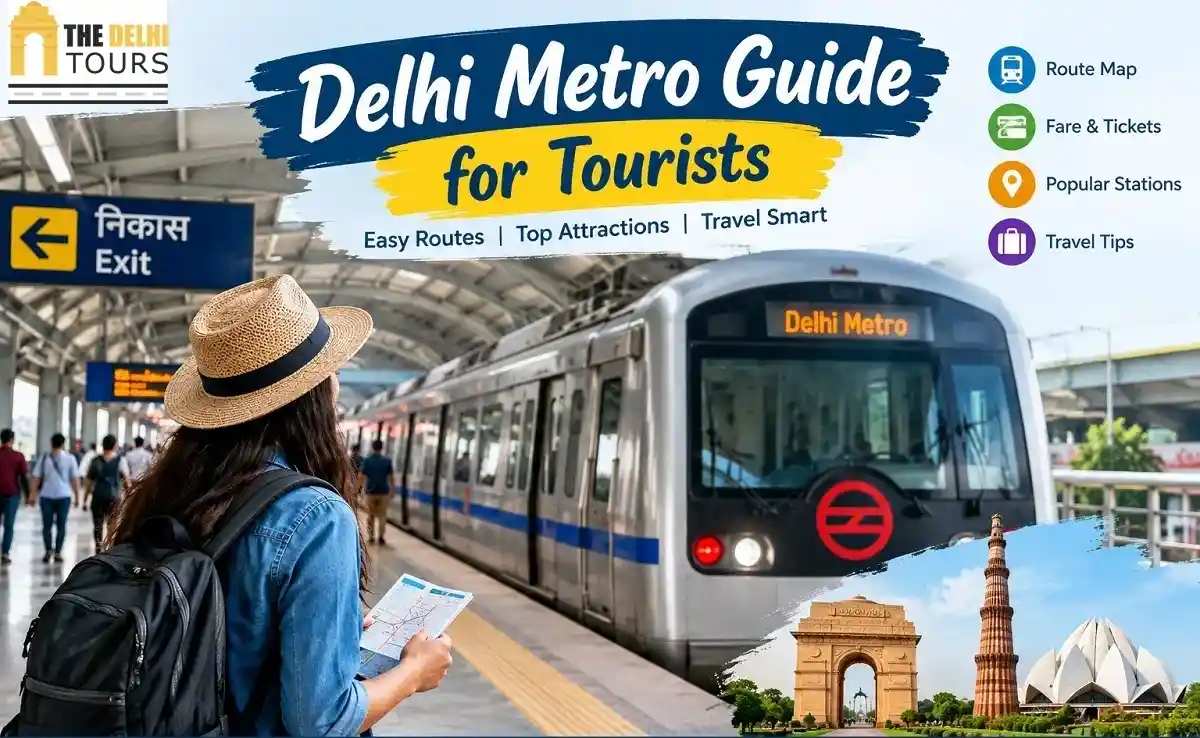
Is Delhi Metro a Good Option for Tourists?
For most sightseeing journeys, yes. The Metro connects many of Delhi’s important visitor areas, including Chandni Chowk, Red Fort, Jama Masjid, Connaught Place, Qutub Minar, Akshardham, Sarojini Nagar and Kalkaji.
Its biggest advantage is predictability: road congestion does not directly affect Metro journey time. However, the total trip still includes security screening, walking inside stations, interchange time and the distance between the exit gate and the attraction.
That distinction matters. A place described as “near a Metro station” may still require a 5–15 minute walk or a short auto/e-rickshaw ride.
Delhi Metro Lines Tourists Are Most Likely to Use
Delhi Metro has a much larger network than most tourists need for a short stay. These are the lines that commonly appear in sightseeing itineraries:
Yellow Line
Useful for New Delhi, Rajiv Chowk, Chandni Chowk, Central Secretariat, INA, Hauz Khas and Qutub Minar.
This is one of the most useful lines for first-time visitors because it connects central Delhi, Old Delhi and parts of South Delhi.
Violet Line
Useful for Lal Quila, Jama Masjid, Delhi Gate, Mandi House, Central Secretariat and Kalkaji Mandir.
For Old Delhi sightseeing, Lal Quila and Jama Masjid stations make the Violet Line particularly relevant.
Blue Line
Useful for Rajiv Chowk, Supreme Court, Akshardham and Noida.
Rajiv Chowk is an interchange between the Yellow and Blue lines.
Magenta Line
Useful for Terminal 1-IGI Airport, Hauz Khas, Kalkaji Mandir and Botanical Garden.
Pink Line
Useful for places such as Sarojini Nagar, Dilli Haat-INA and several cross-city connections.
Airport Express Line
The Airport Express serves New Delhi, Shivaji Stadium, Dhaula Kuan, Delhi Aerocity, Airport (T-3), Dwarka Sector 21 and Yashobhoomi Dwarka Sector 25.
Do not choose a route simply because it uses fewer lines. DMRC’s official journey planner lets passengers compare the shortest route, minimum-interchange route and lowest-fare route.
Delhi Metro Fare for Tourists in 2026
DMRC currently uses distance-based fares for regular journeys.
| Distance | Monday–Saturday | Sunday & National Holidays |
|---|---|---|
| 0–2 km | ₹11 | ₹11 |
| 2–5 km | ₹21 | ₹11 |
| 5–12 km | ₹32 | ₹21 |
| 12–21 km | ₹43 | ₹32 |
| 21–32 km | ₹54 | ₹43 |
| Above 32 km | ₹64 | ₹54 |
These are the current DMRC fare slabs shown on the official fare page as of October 2026. Journeys involving the Airport Express may have a different fare depending on the route and interchange, so use DMRC’s journey planner for the exact amount.
Is the Delhi Metro Tourist Card Worth Buying?
DMRC currently offers:
- One-Day Tourist Card: ₹200
- Three-Day Tourist Card: ₹500
The price includes a ₹50 refundable security deposit. DMRC states that the travel value itself is non-refundable; the security deposit can be refunded when an eligible physically intact card is surrendered.
DMRC also states that Tourist Smart Cards provide unlimited rides during their validity. Tourist Cards are available across Metro stations except the Airport Express Line.
A Tourist Card is not automatically the cheapest choice. Someone making only a few short journeys may spend less using individual fares. It becomes more convenient when the itinerary involves repeated Metro travel across the city.
Delhi Airport to the City by Metro: Check Your Terminal First
Airport transport is one area where tourists should avoid assuming that every Delhi airport terminal uses the same Metro station.
Arriving at Terminal 3
Airport (T-3) is on the Airport Express Line, which connects the airport with New Delhi and other stations including Delhi Aerocity and Shivaji Stadium.
New Delhi station is useful for travellers continuing towards areas served by the Yellow Line.
Arriving at Terminal 1
Terminal 1-IGI Airport is on the Magenta Line. DMRC’s current station information identifies T1 IGI Airport and its airport access.
Before leaving the airport, confirm the terminal printed on your flight information and then plan the Metro journey. Searching only for “Delhi Airport Metro” can lead to the wrong route.
[ADD FIRST-HAND DATA: If your travel team regularly handles Delhi airport arrivals, add the most common terminal/Metro confusion reported by actual customers.]
Best Metro Stations for Delhi Tourist Places
For sightseeing, knowing the nearest useful station is more valuable than memorising the complete network.
| Attraction/area | Useful Metro station | Line |
|---|---|---|
| Red Fort | Lal Quila | Violet |
| Jama Masjid | Jama Masjid | Violet |
| Chandni Chowk | Chandni Chowk | Yellow |
| Connaught Place | Rajiv Chowk | Yellow/Blue |
| Qutub Minar | Qutub Minar | Yellow |
| Akshardham | Akshardham | Blue |
| Lotus Temple area | Kalkaji Mandir | Violet/Magenta |
| India Gate area | Central Secretariat | Yellow/Violet |
| Sarojini Nagar Market | Sarojini Nagar | Pink |
Treat these as useful Metro access points, not a promise that every attraction is directly outside the station.
Exit gates matter too. Large stations can open onto different roads, markets or sides of a railway station. DMRC’s station pages provide gate and nearby-place information, so checking the exit before leaving the paid area can save unnecessary walking.
Suggested to Read:
- Most Popular Tourist Places to Visit in Delhi
- Popular 33 Places to Visit in Delhi with Family
- Places in Delhi That Foreign Visitors Genuinely Love
A Practical Way to Plan Delhi Sightseeing by Metro
A better sightseeing plan groups attractions geographically.
For example, Red Fort, Jama Masjid and Chandni Chowk belong in the same Old Delhi sightseeing block. Visiting one Old Delhi attraction, travelling to South Delhi, and then returning to Old Delhi later adds unnecessary transfers.
The same principle works elsewhere. If Qutub Minar and another South Delhi attraction are on your itinerary, consider covering them in the same part of the day.
This is planning logic rather than a fixed itinerary. Actual travel time depends on your starting point, interchange route, walking speed, queues and how long you spend at each attraction.
[ADD FIRST-HAND DATA: Insert one real Delhi sightseeing route used by your company/customers, with actual starting area and practical observations. Do not add estimated customer experience.]
How to Use Delhi Metro for the First Time
- Find your nearest station. Then identify the station that best serves your destination.
- Check the official journey planner. Compare route, interchange and fare.
- Buy the appropriate ticket/card. Choose a regular journey ticket or Tourist Card based on how much you plan to travel.
- Complete security screening. Allow additional time if you are carrying luggage.
- Check the direction before boarding. Platform signs normally identify the direction using the terminal station.
- Follow interchange signs carefully. At large interchange stations, changing lines can involve a noticeable walk.
- Check the correct exit gate before leaving. This is especially useful at large stations and sightseeing areas.
- Keep time for the last mile. Your attraction may require a walk, auto-rickshaw or e-rickshaw after the Metro.
For a first journey, DMRC’s official journey planner is more reliable than an old saved screenshot of the network map because the network continues to expand. Phase IV sections, including Majlis Park–Maujpur-Babarpur and Deepali Chowk–Majlis Park, entered operation in March 2026.
Delhi Metro Timings: Why You Should Check Your Exact Station
Avoid relying on a single statement such as “Delhi Metro closes at 11 PM.”
First- and last-train timings vary by station, line, direction and day. DMRC provides station-specific first/last train information and allows users to plan journeys for a selected date and departure time.
This matters most when:
- catching an early flight or train;
- returning late after sightseeing or an event;
- using the Airport Express;
- travelling on Sundays or holidays.
Check the specific journey on the day of travel rather than planning around a generic closing time.
Common Mistakes Tourists Should Avoid
Boarding in the wrong direction: Knowing the line colour is not enough. Check the terminal/direction shown on the platform.
Using the wrong airport route: Terminal 1 and Terminal 3 have different Metro connections.
Ignoring exit gates: At large stations, the wrong exit can put you on the opposite side of a busy road or farther from the attraction.
Planning too many cross-city trips: Delhi is spread out. Grouping attractions by area usually reduces unnecessary transfers.
Using an old Metro map: DMRC’s network is still expanding. Check the current interactive map before travelling.
Assuming the Tourist Card is always cheaper: Compare the card price with the number and length of journeys you actually expect to make.
Practical Tips for Foreign and Domestic Tourists
Travel lighter when possible. Bags have to pass through station security screening, and luggage also makes crowded interchanges less convenient.
Keep your phone and wallet secure in busy stations and coaches. For any security-related assistance, the CISF Metro helpline currently listed by DMRC is 155655. The DMRC passenger helpline is 155370.
Save the name of your destination station rather than relying only on the attraction name. If you need local transport after leaving the Metro, you can then explain exactly where you are starting from.
For elderly travellers or anyone with limited mobility, check station facilities before travelling. DMRC’s “Know Your Station” information includes details such as lifts/escalators and station facilities for individual stations.
[ADD FIRST-HAND DATA: Add genuine feedback from senior citizens/families who have used Delhi Metro through your business, if available.]
When Metro May Not Be the Most Convenient Choice
Metro works particularly well when both ends of the journey are reasonably close to stations. It may be less convenient when you have heavy luggage, several elderly family members, multiple small children or a destination with a long last-mile connection.
A taxi or pre-arranged vehicle can also make more sense when several people are travelling together with luggage or when door-to-door convenience matters more than cost.
There is no single “best” transport option for every Delhi itinerary. Compare total travel time, walking, luggage, group size and final destination rather than fare alone.
Key Takeaways
The Delhi Metro is practical for tourists because many major sightseeing areas are connected to the network and regular fares currently start at ₹11. A one-day Tourist Card costs ₹200 and a three-day card costs ₹500, including a ₹50 refundable security deposit.
Airport passengers should remember one distinction: Terminal 3 uses the Airport Express, while Terminal 1 is served by the Magenta Line.
For sightseeing, plan Delhi by area, check the correct station exit, and use DMRC’s current journey planner for fares, interchanges and first/last train information.
7. FAQs
1. Is Delhi Metro safe for tourists?
Delhi Metro uses security screening at stations and CISF security. Travellers should still take normal city precautions, particularly with phones, wallets and bags in crowded stations and trains. DMRC lists CISF’s Metro helpline as 155655.
2. What is the Delhi Metro fare in 2026?
As of October 2026, regular Monday-to-Saturday DMRC fare slabs range from ₹11 to ₹64, depending on distance. Sunday and national-holiday slabs range from ₹11 to ₹54. Airport Express fares should be checked separately for the specific journey.
3. How much does the Delhi Metro Tourist Card cost?
The current price is ₹200 for one day and ₹500 for three days. Both include a ₹50 refundable security deposit.
4. Does the Delhi Metro Tourist Card offer unlimited travel?
DMRC describes the Tourist Smart Card as offering unlimited Metro rides during its validity. Tourist Cards are available at Metro stations except the Airport Express Line.
5. Which Metro station is best for the Red Fort?
Lal Quila on the Violet Line is the useful Metro station for the Red Fort area.
6. Which Metro station should I use for Chandni Chowk?
Use Chandni Chowk station on the Yellow Line for the Chandni Chowk area. Old Delhi is crowded, so walking and last-mile travel time should be included in your plan.
7. Can I reach Qutub Minar by Delhi Metro?
Yes. Qutub Minar station on the Yellow Line is the usual Metro access point. Allow additional time to reach the monument after leaving the station.
8. Which Metro goes to Delhi Airport Terminal 3?
Use the Airport Express Line for Airport (T-3). It connects T3 with stations including Delhi Aerocity, Dhaula Kuan, Shivaji Stadium and New Delhi.
9. Which Metro goes to Delhi Airport Terminal 1?
Terminal 1-IGI Airport station is on the Magenta Line. Confirm your flight terminal before planning the journey.
10. What time does Delhi Metro close?
There is no single last-train time that applies to every station and direction. Check the official DMRC first/last train information for your station, route and travel date.
11. Is a Tourist Card cheaper than individual Metro tickets?
Not necessarily. A Tourist Card is useful for frequent travel, but a visitor making only a few short journeys may spend less on individual fares. Compare your planned journeys before buying.
12. Is Delhi Metro suitable for senior citizens?
It can be, particularly when the origin and destination are close to stations. Check the relevant station’s lift/escalator facilities and consider the amount of walking required at interchanges and after exiting.
Conclusion
Delhi Metro removes much of the uncertainty that road traffic can add to a sightseeing day, but a good Metro plan involves more than choosing the nearest station. Check the line direction, interchange, exit gate and last-mile distance before starting each journey.
Current regular fares range from ₹11 to ₹64 on Monday–Saturday, while Tourist Cards cost ₹200 for one day and ₹500 for three days. Airport travellers should verify their terminal first because T1 and T3 use different Metro connections.
For information that can change—particularly fares, network extensions and first/last train timings—check the official Delhi Metro Rail Corporation (DMRC) website shortly before travelling.