How to Plan Gangotri Yatra from Delhi in 2026
Planning a Gangotri Yatra from Delhi for the first time? You’re probably sitting with twenty browser tabs open and still confused about where to start. The route, the registration, the distances, the stops — it can feel overwhelming fast. But honestly, once you break it down step by step, this yatra is one of the most manageable pilgrimages in the Garhwal Himalayas.
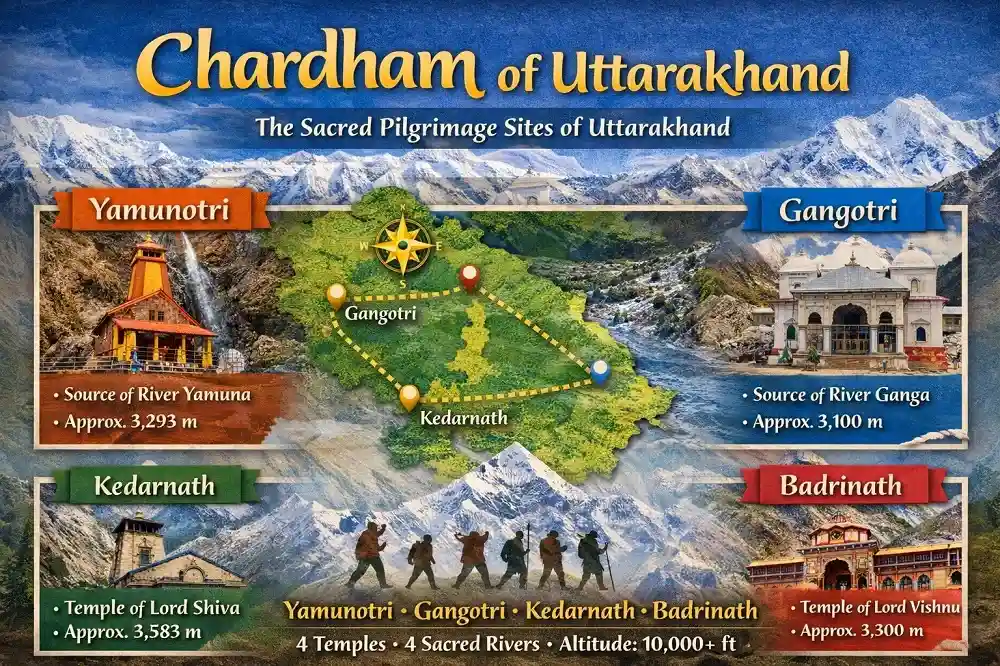
Gangotri Temple is located in the Uttarkashi district of Uttarakhand, on the banks of the Bhagirathi River in the Himalayas. It’s the second stop on the Char Dham circuit and one of the most spiritually charged places in all of India. The journey from Delhi covers roughly 490–501 km by road. It’s not a quick weekend trip — but with the right planning, it’s deeply doable.
Here’s exactly how to plan it.
Know the Basics First — Temple, Altitude, and Opening Dates
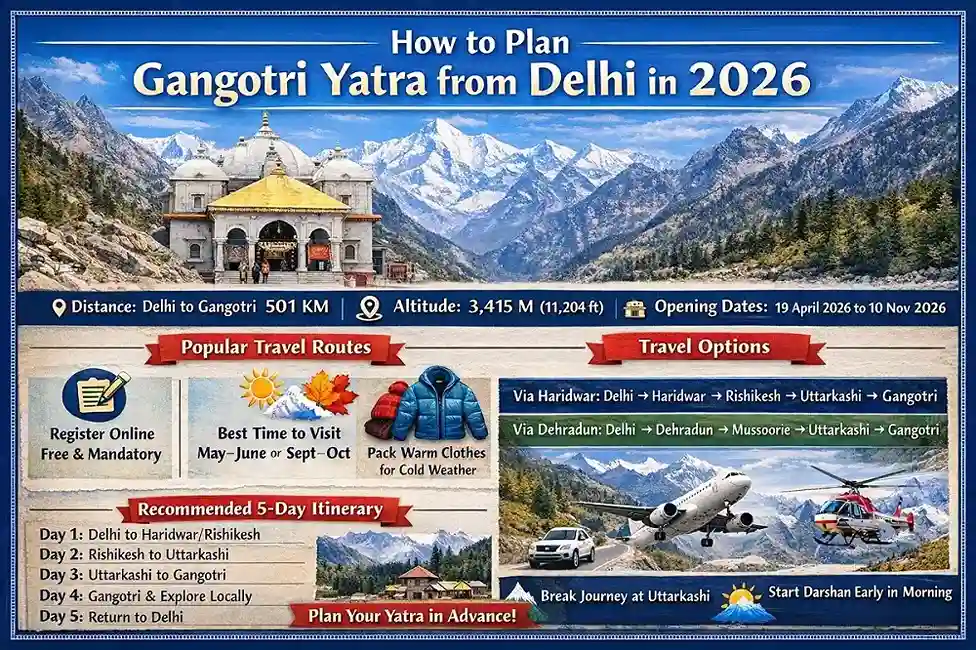
Gangotri Dham is one of the most sacred pilgrimage sites in Hinduism, located at an altitude of 3,415 metres (11,204 feet) above sea level. Situated on the banks of the holy Bhagirathi River, this divine shrine is dedicated to Goddess Ganga.
It is believed that King Bhagirath’s penance brought the celestial river Ganga to Earth at this site, which is why the river is called Bhagirathi at its source — an eternal tribute to King Bhagirath’s unwavering devotion.
The present temple structure dates back to the 18th century and reflects classic Himalayan temple architecture. Built in white stone, the shrine stands on the banks of the Bhagirathi River amid deodar forests and high mountain peaks.
For 2026 — Gangotri Temple opens on 19 April 2026, on the auspicious occasion of Akshaya Tritiya. The temple closing date for 2026 is tentatively 10 November 2026. The full pilgrimage season therefore runs approximately seven months, giving you a wide planning window.
Suggested Tour:
Best Time to Visit Gangotri from Delhi
All months in the season are not equal. Here’s the honest breakdown.
April–June is the most popular window — weather is relatively clear, roads are stable, and the temple energy after the opening ceremony is vibrant. The best time to visit Gangotri is May–June and September–October when weather conditions are stable.
July–August should be approached with real caution. Monsoon rains bring landslide risk on the mountain roads, especially between Uttarkashi and Gangotri. You can still visit, but delays of several hours are common, and some stretches become genuinely dangerous.
September–October is arguably the best time for most pilgrims. Post-monsoon skies are crystal clear, the mountains are at their most visible, and the crowds have thinned out compared to May. The cold bites harder — especially at 3,415 metres — but it’s manageable with proper clothing.
The average maximum temperature at Gangotri is about 10 to 15 degrees Celsius. Warm and woollen clothes are a necessity almost all year round. The average minimum temperature easily goes below the zero-degree mark.
Gangotri Yatra Registration — Mandatory, Free, and Easy
This is non-negotiable and many first-timers skip this step until it’s too late.
Registration is mandatory for Gangotri Dham Yatra. It can be done online through the Char Dham’s official website and is free of cost. It can also be done through the mobile application ‘Tourist Care Uttarakhand,’ available on Android and iOS. You can also register through WhatsApp by texting ‘Yatra’ on +91 8394833833.
After registering, pilgrims get a registration receipt that must be shown at the entry point of the Gangotri Temple, where it is scanned for a token mentioning the slot and timings for Ganga Temple Darshan.
Do this at least 3–4 weeks before your travel dates. Peak season slots in May fill up fast — to be present at Gangotri on 19 April, you need to register by mid-March and book accommodation early April.
How to Reach Gangotri from Delhi — All Options
Option 1 — By Road (Most Popular)
The distance between Delhi to Gangotri by road is approximately 501 km, which takes around 14 hours if you aren’t halting anywhere.
Most pilgrims break the journey into two days, which is far smarter than attempting a single non-stop drive.
The two main road routes are:
Route 1 (Via Haridwar): Delhi → Haridwar → Rishikesh → Narendranagar → Tehri → Dharasu Bend → Uttarkashi → Bhatwari → Gangnani → Harsil → Gangotri. Total distance approximately 474 km, average driving time around 11 hours.
Route 2 (Via Dehradun): Delhi → Dehradun → Mussoorie → Chamba → Tehri → Dharasu Bend → Uttarkashi → Bhatwari → Gangnani → Harsil → Gangotri.
Route 1 via Haridwar is the most commonly taken. Rishikesh is the major starting point for most pilgrims and tour operators.
You can travel by private cab (most comfortable), shared taxi, UPSRTC or Uttarakhand Roadways bus from ISBT Kashmiri Gate, or self-drive if you’re confident on mountain roads. Night driving is restricted on many hill stretches — factor this into your planning.
Option 2 — By Train Then Road
The nearest railway station to Gangotri is Rishikesh, well connected with Delhi, Haridwar, and major Indian cities. Trains such as the Mussoorie Express and Yoga Express reach Rishikesh in five to seven hours from Delhi. After arriving, travellers can take taxis or Uttarakhand Roadways buses toward Uttarkashi, which takes about 6 hours through steady hill roads.
From Uttarkashi, it’s another 100 km to Gangotri — roughly 3–4 hours.
Option 3 — By Flight Then Road
The nearest airport to Gangotri is Jolly Grant Airport in Dehradun, around 250 km from the shrine. From Delhi, travellers can take a short flight to Dehradun and continue by road for eight to nine hours via Uttarkashi and Harsil to reach Gangotri.
Flight time from Delhi to Dehradun is just 45–50 minutes. This is the fastest option to get to Uttarakhand, though the road journey onwards still takes most of a day.
Option 4 — By Helicopter
Helicopter services operate from Sahastradhara Helipad in Dehradun to Harsil during the yatra season, offering a faster way to reach the upper valley. From Harsil, Gangotri is just about a one-hour drive by road. Same-day return helicopter packages usually cost between ₹75,000 and ₹1,00,000 per person.
Gangotri Yatra helicopter booking must be made through authorised operators in advance. This service is preferred for senior citizens and time-constrained travellers.
The Recommended Day-by-Day Itinerary from Delhi
Planning a standalone Gangotri Yatra (without full Char Dham circuit)? Here’s a practical 5-day plan:
Day 1 — Delhi to Haridwar/Rishikesh
Leave Delhi early morning — by 5–6 AM if possible. The distance between Delhi and Haridwar is approximately 220 km, which can be covered in around 5–6 hours by road. Reach Haridwar by afternoon, attend the Ganga Aarti at Har Ki Pauri in the evening. Overnight at Haridwar or Rishikesh.
Day 2 — Rishikesh to Uttarkashi (approx. 170 km)
The road from Rishikesh to Uttarkashi passes through Devprayag, Srinagar (Uttarakhand), Rudraprayag, and Dharasu Bend — a scenic but slow mountain drive taking 6–7 hours. Uttarkashi is a proper town with good hotels, medical facilities, ATMs, and mobile connectivity. Spend the night here to acclimatise before the final climb.
This overnight stop is genuinely important. Senior citizens and pilgrims with heart conditions, asthma, or respiratory issues are advised to consult a doctor before planning the yatra. Spending at least one night at Uttarkashi to acclimatise before proceeding to Gangotri is highly recommended.
Day 3 — Uttarkashi to Gangotri (approx. 100 km)
The final drive after Uttarkashi involves steep mountain driving and usually takes 3–4 hours. The route passes through the gorgeous Harsil Valley, Bhatwari, Gangnani Hot Springs, and Bhaironghati before arriving at Gangotri.
Stop at Gangnani — there are natural hot water springs here where pilgrims take a dip before reaching the temple. It’s a brief stop but worth it.
Arrive at Gangotri in the afternoon and offer your prayers to Goddess Ganga. Explore the nearby Bhagirath Shila, Pandava Gufa, Bheem Gufa, Gauri Kund, and Surya Kund. Attend the 7 PM Ganga Aarti at the shore and 8 PM Sandhya Aarti in the main temple complex.
Overnight at Gangotri or Harsil.
Day 4 — Gangotri Darshan, Gaumukh Option, Begin Return
The morning aarti, known as Mangala Aarti, is held at 6:00 AM behind closed doors. The darshan timing for Gangotri Temple is 4:00 AM to 2:00 PM and 3:00 PM to 9:00 PM. The Aarti timing is 6 AM and 7:45 PM.
Reach the temple by 7–8 AM for darshan before the crowds build. For those wanting to extend the experience — the Gaumukh Tapovan Trek is a 19 km trek from Gangotri to the actual glacier source of the Ganga. This requires a separate permit and a full day. Most day visitors skip it; serious trekkers add a Day 4 just for this.
Begin return journey to Uttarkashi or Harsil in the afternoon.
Day 5 — Return to Delhi
Uttarkashi to Haridwar takes 6–7 hours. Haridwar to Delhi takes another 5–6 hours. Most pilgrims split this into an overnight at Rishikesh/Haridwar and reach Delhi the following morning.
Key Stops on the Route Worth Knowing
Devprayag — where the Alaknanda and Bhagirathi rivers meet to form the Ganga. This sacred confluence is one of the Panch Prayag and worth a brief stop for its spiritual significance.
Uttarkashi — the last major town before Gangotri. It is famous for its ancient temples and beautiful nature, about 100 km away from Gangotri. Pilgrims often choose to stay here overnight due to its good accommodation options and transportation facilities, with regular taxis and shared vehicles available to reach the temple.
Harsil — a small immaculate village on the banks of the Bhagirathi River, about 24 km from Gangotri, surrounded by imposing snow-laden mountains and dense coniferous and deodar forests. Travellers seeking better comfort often stay in Harsil. It’s a genuinely beautiful village — often described as the “Mini Switzerland of India.”
Gangnani Hot Springs — natural sulphur springs about 45 km before Gangotri, where pilgrims traditionally bathe before the final stretch.
Accommodation Along the Route
Government-run GMVN guesthouses are available at places like Barkot, Harsil, and Joshimath for prices starting from ₹1,000 a night. Dharamshalas run by religious trusts provide accommodation as low as ₹300 a night. Privately operated hotels start from ₹1,000 a night with heating facilities. Luxury options start from ₹3,000 a night.
Book accommodation well in advance — especially for May and early June. In peak season, Uttarkashi and Gangotri fill up entirely within days of the opening ceremony date becoming public.
Darshan Rules and What to Expect at the Temple
Only Hindu devotees are allowed inside the sanctum. Visitors are advised to wear modest, traditional clothing suitable for a religious setting. Footwear must be removed before entering temple areas.
Pilgrims are allowed to do darshan for 4 hours in May and June. From July to October, the temple permits darshan for only one hour at a time due to crowd management. This is why arriving early in the morning is smart — the lines are shorter and the mountain light in the early hours is genuinely magical.
The entire temple complex is simple and compact. The idol of Goddess Ganga is made of black stone. The Bhagirathi River flows right alongside — the sound of it is constant and deeply peaceful.
Practical Tips That Actually Matter
- Leave Delhi by 4–5 AM on Day 1. Mountain roads slow everything down — early starts are not optional on this route.
- Withdraw cash in Rishikesh or Uttarkashi. ATMs in hilly regions are often non-functioning. Purola, on the way to Uttarkashi, has the last reliable ATM.
- Night driving restriction. Many sections of the Uttarkashi–Gangotri road restrict vehicle movement after dark — ask your driver or hotel beforehand.
- Mobile network. Airtel’s mobile network works relatively better in this region than others, but connectivity thins out significantly after Uttarkashi. Download offline maps before you leave.
- Medical prep. Carry ORS sachets, personal medications, and a basic first aid kit. Those above 60 or with any respiratory or heart condition should get a medical check before departure.
- Carry warm clothing even in May. At 3,415 metres, the temperature drops sharply after sunset regardless of the season.
- Plastic-free zone. Gangotri falls within the Gangotri National Park zone. The road from Gangotri to Gaumukh is inside a protected area — follow environmental rules and carry no single-use plastic.
Cost of Gangotri Yatra from Delhi — Rough Estimate
Here’s a realistic per-person cost for a solo pilgrim on a budget road trip:
Delhi to Rishikesh bus/train: ₹300–₹600. Rishikesh to Uttarkashi shared taxi: ₹400–₹600. Uttarkashi to Gangotri taxi: ₹300–₹500 shared. Accommodation (3 nights on route, budget): ₹1,000–₹2,500 per night. Meals: ₹200–₹400 per day at local dhabas. Private cab option (Delhi–Gangotri–Delhi, 5 days): ₹12,000–₹20,000 depending on vehicle type.
Package tours from Delhi covering Gangotri Ek Dham typically cost ₹8,000–₹18,000 per person including transport, accommodation, and meals.
FAQs
Q1. What is the distance from Delhi to Gangotri?
The distance between Delhi to Gangotri by road is approximately 501 km, which takes around 14 hours without halts.
Q2. When does Gangotri Temple open in 2026?
Gangotri Temple opens on 19 April 2026, on the auspicious occasion of Akshaya Tritiya.
Q3. Is registration mandatory for Gangotri Yatra?
Yes, registration is mandatory. It is free of cost and can be done online through the Char Dham official website, through the ‘Tourist Care Uttarakhand’ app, or via WhatsApp by texting ‘Yatra’ on +91 8394833833.
Q4. What is the best route from Delhi to Gangotri?
The most popular route is Via Haridwar: Delhi → Haridwar → Rishikesh → Tehri → Uttarkashi → Harsil → Gangotri, covering approximately 474 km.
Q5. What is the altitude of Gangotri Temple?
Gangotri Dham is located at an altitude of 3,415 metres (11,204 feet) above sea level.
Q6. What are the darshan timings at Gangotri Temple?
The darshan timing is 4:00 AM to 2:00 PM and 3:00 PM to 9:00 PM. The Aarti timings are 6 AM (Mangala Aarti) and 7:45 PM (Sandhya Aarti).
Q7. How many days are required for Gangotri Yatra from Delhi?
A minimum of 5 days is recommended for a comfortable trip — 2 days travel each way and 1 full day at Gangotri, with overnight acclimatisation at Uttarkashi.
Q8. Where should I stay on the way to Gangotri?
GMVN guesthouses are available at Harsil for prices starting from ₹1,000 a night. Dharamshalas start from ₹300 a night. Uttarkashi has the best variety of private hotels ranging from budget to mid-range.
Q9. Can senior citizens undertake the Gangotri Yatra?
Gangotri helicopter service is preferred for senior citizens and time-constrained travellers. For those travelling by road, the journey does not require trekking — the temple is accessible entirely by motorable road — which makes it more accessible than Yamunotri or Kedarnath.
Q10. What places should I visit near Gangotri?
Nearby highlights include Bhagirath Shila, Pandava Gufa, Bheem Gufa, Gauri Kund, Surya Kund, and the Gaumukh Glacier — 18 km from the temple and the actual source of the Ganga. Harsil village and the Nelong Valley are also worth adding if you have extra days.
Quick Takeaway: Gangotri Yatra from Delhi is best planned over 5–6 days minimum. Book your registration early, break the drive at Uttarkashi, start darshan by 7 AM, and plan your visit for May or September for the best combination of weather, visibility, and manageable crowds. The journey itself — through rivers, forests, and Himalayan passes — is as much a part of the experience as the temple.