Why Delhi Is the Best Destination for Educational Tours in 2026
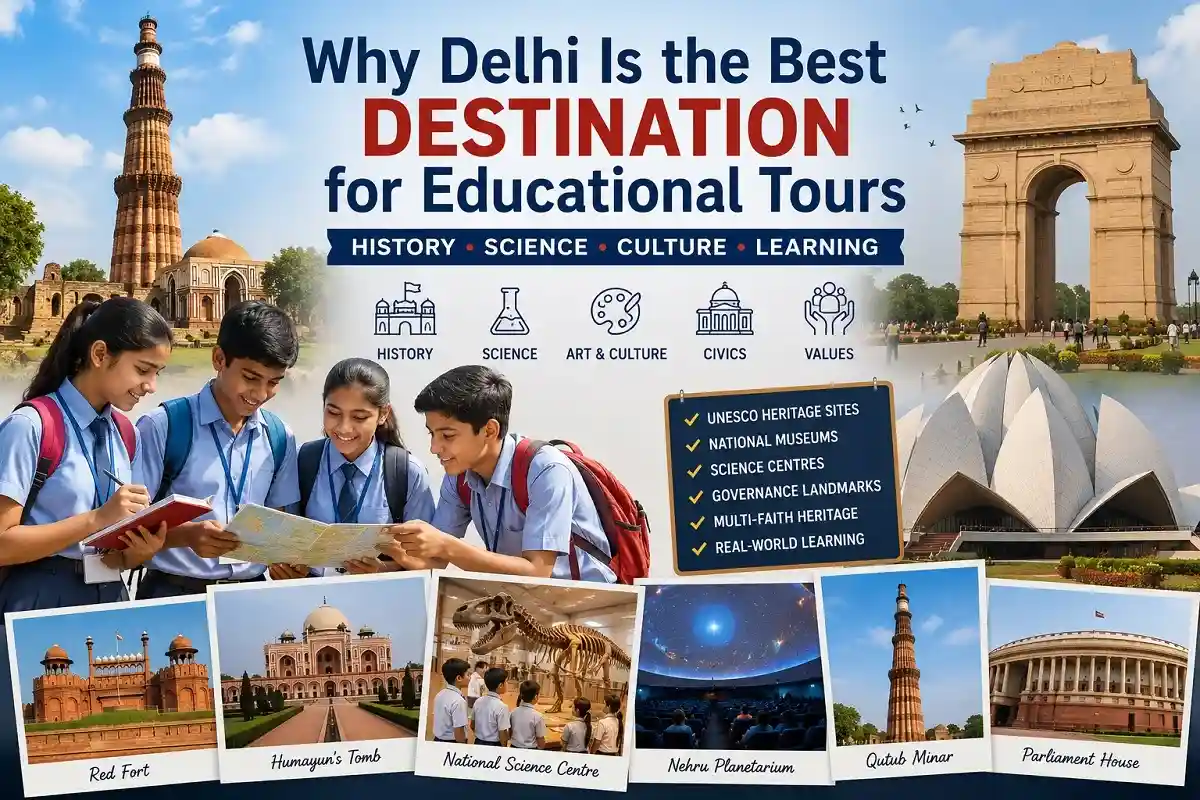
History students get three UNESCO World Heritage Sites within 20 kilometres of each other. Science students get the National Science Centre and Nehru Planetarium — both fully operational in 2026 with dedicated school group rates. Civics students get India Gate, the National War Memorial, and Kartavya Path. Art students get the National Museum, which houses over 2 lakh artefacts spanning 5,000 years, with free entry for school students up to Class 12.
No other city in India offers this range across this many subjects, in one metro-connected area. Delhi is not just a good educational tour destination. For most school subjects taught under CBSE, ICSE, and NEP 2020 curricula — it is the best one.
This guide covers exactly why, with verified 2026 facts, confirmed entry fees, school group rates, curriculum links, and practical planning tips.
Quick Overview
What Makes Delhi Unique as an Educational Destination
Most educational tour destinations are strong in one subject. Bengaluru leads for STEM. Jaipur for Rajput and Mughal architecture. Kolkata for colonial history. The Sundarbans for ecology.
Delhi is the exception. A Class 9 batch studying Mughal history and a Class 11 batch studying Indian democracy can visit adjacent sites on the same day — and both return with content mapped directly to their syllabus. That multi-subject depth is Delhi’s defining advantage.
It also aligns directly with India’s National Education Policy. NEP 2020 Section 4.6 mandates experiential learning as standard pedagogy across all school stages. The Bagless Days provision requires schools to formally schedule outdoor and field learning from Class 6 onwards. Delhi satisfies this mandate across every subject.
Three UNESCO World Heritage Sites — History Made Physical
1. Qutb Minar and Its Monuments (UNESCO 1993)
The 72.5-metre red sandstone minaret is the tallest brick minaret in the world, built in 1192 by Qutb-ud-din Aibak. The complex includes the Quwwat-ul-Islam Mosque — the oldest mosque in north India — built with materials from 20 demolished temples, a live lesson in conquest and cultural change. The Iron Pillar of Delhi, rust-free for over 1,600 years, raises metallurgy questions that connect directly to Class 8 science. Open all 7 days, 7:00 AM–5:00 PM. Entry: ₹40 Indians, ₹550 foreigners, children under 15 free.
2. Humayun’s Tomb (UNESCO 1993)
Built in 1570, this was the first garden-tomb on the Indian subcontinent and directly influenced the design of the Taj Mahal. The Charbagh garden layout, the 47-metre central dome, and the red sandstone-marble combination are architectural precedents students can observe and trace forward through history. Open all 7 days, 6:00 AM–6:00 PM. Entry: ₹35 Indians, ₹550 foreigners, children under 15 free.
3. Red Fort Complex (UNESCO 2007)
Built by Shah Jahan between 1638 and 1648, the Red Fort is where Mughal administrative power was exercised for nearly 200 years — and where India’s first Prime Minister raised the national flag on August 15, 1947. A single visit connects Mughal governance, architecture, and Indian independence. Following an ASI order dated February 13, 2026, the Red Fort is now open all 7 days from sunrise to 9:00 PM. Entry: ₹35 Indians, ₹600 walk-in or ₹550 online for foreigners.
Science Education: Two Dedicated Institutions
National Science Centre — Pragati Maidan
Established in 1992 and part of the National Council of Science Museums, the National Science Centre spans four floors with galleries for Human Biology, Prehistoric Life, Heritage, Information Technology, Fun Science, and Technology. The Dinosaur Gallery — with life-size animated models — is particularly effective with Class 5–9 students. A cyber school runs short-term courses for students and teachers.
| Detail | Information (2026) |
| Metro | Pragati Maidan (Blue Line) — 5-min walk |
| Timings | 9:30 AM – 6:00 PM (closed Holi and Diwali only) |
| Entry — General | ₹80 per person |
| Entry — School group (25+) | ₹60 per person |
| Entry — School students (organised group) | ₹30 per student |
| Entry — Govt school students | ₹10 per student |
| Full theatre school booking | ₹5,000 for up to 250 students — 9:30 AM or 10:30 AM slots |
| Contact | 011-2337-4996 | nscd.gov.in |
Nehru Planetarium — Teen Murti Bhavan
Inaugurated by Prime Minister Indira Gandhi on February 6, 1984, the Nehru Planetarium houses the Megastar Definiti optical star projector — displaying up to 2 million stars simultaneously. The Soyuz T-10 rocket that carried Rakesh Sharma, India’s first cosmonaut, to space is on display along with his mission journal and space suit. Sky shows run in Hindi and English. Timings: 11:30 AM (English), 1:30 PM (Hindi), 3:00 PM (English), 4:00 PM (Hindi). Closed Monday.
| Detail | Information (2026) |
| Metro | Udyog Bhawan or Central Secretariat (Yellow Line) |
| Timings | Open Tue–Sun | Closed Monday |
| School student entry | ₹50 per student (show ticket) |
| Adults | ₹100 (2D show) |
| Full school theatre booking | ₹5,000 for 250 seats — 9:30 AM or 10:30 AM |
| Small group concession | ₹20 per head in public shows |
| Contact | 011-2301-4504 | nehruplanetarium.org |
National Museums: Five Institutions, Every Subject Covered
⚠ Important 2026 Note: 2026 Update — National Museum: The museum at Janpath is OPEN (10 AM–6 PM, closed Monday). Entry: ₹20 for Indians, FREE for school students up to Class 12 with ID cards, ₹650 for foreigners. Three galleries (Arms & Armour, Textiles, Jewellery) are currently closed for renovation. All other galleries — Indus Valley, Buddhist Art, Mughal miniatures, manuscripts — are fully accessible. Confirm gallery status at nationalmuseumindia.gov.in before visiting.
| Museum | Subject Focus | Entry (Indians) | Timings | Closed |
| National Museum, Janpath | History, archaeology, art — 2 lakh artefacts, 5,000 years (3 galleries under renovation) | ₹20 adults | FREE for school students (Class 1–12 with ID) | 10 AM–6 PM | Monday + national holidays |
| National Science Centre, Pragati Maidan | Science — biology, tech, prehistoric life, IT | ₹30 (school group) / ₹10 (govt school) | 9:30 AM–6 PM | Holi and Diwali only |
| National Gallery of Modern Art (NGMA) | Art — post-1850 Indian and international modern art | ₹20 | 10 AM–5 PM | Monday |
| Crafts Museum, Pragati Maidan | Indian traditional crafts, textiles, tribal art | ₹30 | 9:30 AM–5 PM | Monday |
| National Museum of Natural History | Biology, ecology, natural world | Nominal fee | Varies — check before visiting | Monday |
Civics and Governance: No Other City Compares
Delhi is the seat of the Indian government. That makes it the only city where civics students can stand at the places they study — not look at photographs of them.
- India Gate + National War Memorial: India Gate honours 82,000 soldiers of World War I. The National War Memorial, opened February 2019, inscribes 25,942 names of post-independence soldiers killed in conflict. Both free, open 24 hours. Direct link to Class 8–10 history and Class 9 civics.
- Kartavya Path: The 3-km ceremonial boulevard from Rashtrapati Bhawan to India Gate — flanked by Parliament, North and South Blocks. Renamed from Rajpath in September 2022 as part of Central Vista redevelopment. A live civics lesson for Class 9–12 students studying Indian governance.
- Raj Ghat: Simple black marble memorial marking where Gandhi was cremated on January 31, 1948. Free entry. The deliberately understated design is itself a teaching moment about power and influence. Direct link to Class 10 nationalism chapter.
Religious Studies: Four Faiths, Active Sites, One City
India is the birthplace of Hinduism, Buddhism, Jainism, and Sikhism. Delhi has living places of worship and heritage from all four — plus one of India’s most important mosques and a famous Sufi dargah. For Class 9–12 religious studies students, this means encounters with living faith traditions, not museum displays.
- Jama Masjid: Built by Shah Jahan 1644–1656. India’s largest mosque — courtyard holds 25,000 people. Free entry, appropriate dress required. Open to all visitors.
- Akshardham Temple: Built in 2005 by 11,000 artisans — entirely stone-carved, no steel. Temple entry free. Exhibitions: ₹170 adults, ₹125 children, ₹100 senior citizens. Closed Monday.
- Gurudwara Bangla Sahib: Site where Guru Har Krishan Ji stayed in 1664 during a smallpox epidemic. Free entry, all days. One of the most serene spaces in central Delhi.
- Lotus Temple (Bahá’í): A UNESCO-cited lotus-shaped architectural masterpiece open to all faiths. Free entry, Tuesday–Sunday.
- Nizamuddin Dargah: Shrine of 14th-century Sufi saint Hazrat Nizamuddin Auliya — 5-minute walk from Humayun’s Tomb. Thursday evening qawwali is one of Delhi’s most authentic cultural experiences. Free entry.
Curriculum Mapping: What Students Learn at Each Site
| Class / Subject | Delhi Site | NCERT Chapter Link |
| Class 6–7 History | Qutub Minar complex | Delhi Sultanate — Ch. 3–4 |
| Class 7–8 History | Red Fort, Humayun’s Tomb, Jama Masjid | Mughal Empire — Ch. 5–9 |
| Class 8 History + Civics | Raj Ghat, National Museum | British rule, Independence — Ch. 5–7 |
| Class 9 Political Science | Kartavya Path, India Gate, Parliament area | Constitutional Design — Ch. 1–4 |
| Class 8–10 Science | National Science Centre | Biology, Tech, Prehistoric Life — Ch. 6, 7, 14 |
| Class 8–12 Physics | Nehru Planetarium | Astronomy, Light, Space units |
| Class 9–12 Art | National Museum, NGMA, Crafts Museum | Indian Art History chapters |
| Class 9–12 Religious Studies | Jama Masjid, Akshardham, Gurudwara, Lotus Temple, Nizamuddin | Major world religions — all traditions |
| Class 9–11 Geography | Okhla Bird Sanctuary, Yamuna riverfront | Biodiversity, river systems — Ch. 2, 5 |
Budget: Delhi Is the Most Affordable Major Educational Destination
| Category | Day Trip (per student) | Overnight Trip (per student) |
| Transport (bus) | ₹200–₹500 | ₹300–₹600 |
| Monument entries (3–4 sites) | ₹35–₹80 | ₹70–₹160 (2 days) |
| Science Centre / Planetarium | ₹30–₹50 | Same |
| Meals | ₹100–₹200 | ₹200–₹350 |
| Accommodation | Not required | ₹300–₹600 (institutional dormitory) |
| Total per student | ₹400–₹900 | ₹900–₹1,800 |
Budget Note: Most ASI monuments charge ₹35–₹40 per Indian student. Children under 15 enter FREE. National Museum is free for all school students up to Class 12 with ID. National Science Centre charges ₹30 for organised school groups, ₹10 for government schools. A full 2-day Delhi educational tour is possible for under ₹1,500 per student.
Practical Planning Tips for School Coordinators
Before the Trip
- Book ASI monuments online at asi.nic.in — group QR tickets skip queues entirely. Book 2–3 weeks in advance for October–March season.
- Nehru Planetarium school shows: call 011-2301-4504. The 9:30 AM and 10:30 AM full-theatre slots (₹5,000 for 250 students) must be booked in advance — they fill quickly.
- National Science Centre: contact 011-2337-4996. School group entry ₹30 per student, ₹10 for government schools.
- National Museum: Confirm gallery availability at nationalmuseumindia.gov.in before booking — Arms & Armour, Textiles, and Jewellery galleries are currently under renovation.
- Prepare a 2–3 session pre-tour classroom module before departure. Students who arrive with subject context retain significantly more from site visits.
- Create a structured observation worksheet for each site — specific questions tied to curriculum content.
On the Day
- Supervision ratio: 1 teacher per 15–20 students minimum for monument visits.
- Start early — Red Fort and Qutub Minar are least crowded between 7:00–9:00 AM. Qutub Minar opens 7:00 AM, Red Fort at sunrise.
- Delhi Metro Yellow Line connects: Chandni Chowk → New Delhi → Rajiv Chowk → Qutub Minar. Blue Line covers Akshardham and Pragati Maidan. It is the fastest, safest school group transport.
After the Trip
- Within one week: conduct a post-visit debrief or assign a structured report linking observations to textbook content. This step locks in the learning and satisfies NEP 2020 post-experience consolidation requirements.
Frequently Asked Questions
1. Why is Delhi considered the best educational tour destination in India?
Delhi has the largest concentration of curriculum-aligned educational sites in one metro-connected city: 3 UNESCO World Heritage Sites, 5+ national museums with free or low-cost student entry, a dedicated national science centre, a planetarium with school group rates, and direct NCERT chapter connections across history, science, civics, art, and religious studies. NEP 2020 Bagless Days provision makes Delhi the natural first choice for structured field learning from Class 6 onwards.
2. What are the entry fees for school students at Delhi’s major sites in 2026?
National Museum: FREE for school students up to Class 12 with ID cards. National Science Centre: ₹30 per student (organised group), ₹10 for government school students. Nehru Planetarium: ₹50 per student. Red Fort: ₹35 per Indian student (children under 15 free). Qutub Minar: ₹40 per Indian student (children under 15 free). Humayun’s Tomb: ₹35 per Indian student (children under 15 free). India Gate, Raj Ghat, Kartavya Path: free.
3. Is the National Museum Delhi open in 2026?
Yes. The National Museum on Janpath is open Tuesday to Sunday, 10:00 AM to 6:00 PM. Entry for Indians is ₹20; school students up to Class 12 enter free with ID cards. Three galleries — Arms & Armour, Textiles, and Jewellery — are closed for renovation as of 2026. The main galleries including Indus Valley, Buddhist Art, Mughal miniatures, and manuscripts are fully open. Check nationalmuseumindia.gov.in for current gallery status before planning.
4. How do I book Nehru Planetarium for a school group?
Call 011-2301-4504 to book dedicated school shows at 9:30 AM or 10:30 AM. Full theatre booking for up to 250 students costs ₹5,000 — under ₹20 per student for a dome sky show. Small school groups can also use the ₹20 per head concession in regular public shows. The planetarium is closed on Mondays. Book at least 2–3 weeks in advance during October–March school season.
5. How many UNESCO World Heritage Sites does Delhi have in 2026?
Delhi has three UNESCO World Heritage Sites: Qutb Minar and its Monuments (designated 1993), Humayun’s Tomb (1993), and the Red Fort Complex (2007). All three are within Delhi city limits, metro-accessible, open all 7 days, and directly connected to Class 6–12 NCERT history and architecture curricula.
6. What is the best time of year for a school educational tour to Delhi?
October to March is the recommended window. October–November offers clear skies and comfortable temperatures for outdoor monument visits. January–February is ideal for indoor institutions like the National Museum and National Science Centre. Avoid April–June (temperatures reach 44–47°C — outdoor monument visits are unsafe for students) and July–September (monsoon disruption).
7. Can a Delhi educational tour satisfy NEP 2020 Bagless Days requirements?
Yes — directly. NEP 2020 Section 4.6 mandates experiential learning as standard pedagogy. The Bagless Days provision requires outdoor and field learning from Class 6 onwards. A well-planned Delhi tour with pre-tour classroom preparation, structured site worksheets, and a post-tour reflection assignment satisfies NEP 2020 experiential learning goals across history, science, civics, art, and geography in a single trip.